Revolutionizing fashion with data insights, smart inventory, and personalized engagement
Enhance game strategy and player performance with AI solutions for sports
We improve teaching, reduce costs, and expand reach with AI-based platforms
Advance healthcare with AI for personalized care and efficiency
Drive campaigns, boost engagement, and optimize results with AI solutions
AI solutions for smarter real estate management and customer experience
We help retailers cut costs and boost efficiency with AI
Enhance logistics, fleet management, and delivery performance
Streamline operations, reduce costs, and improve efficiency with AI
Optimize investments, detect fraud, and strengthen decision-making
Improve risk assessment, claims processing, and client satisfaction
Automate workflows, analyze cases, and improve client services with AI
We are your strategic partners, skilled in converting your unique challenges into AI-powered strategies
Explore how our company equips businesses, enterprises, and organizations with complete end-to-end AI solutions.
Get a FREE consultation! Our AI experts are ready to help you navigate the future with innovative AI-driven solutions.
Our AI tech stack offers everything you need, from expert AI developers to full-stack expertise.
Our awards showcase our commitment to delivering innovative solutions that drive business transformation.
Find out everything from when to choose us, to the types of work we do, to how the AI development process.
Explore our collection of practical eBooks designed to help business leaders understand AI, automation, and digital transformation. Get actionable insights you can apply with confidence.
Revolutionizing fashion with data insights, smart inventory, and personalized engagement
Enhance game strategy and player performance with AI solutions for sports
We improve teaching, reduce costs, and expand reach with AI-based platforms
Advance healthcare with AI for personalized care and efficiency
Drive campaigns, boost engagement, and optimize results with AI solutions
AI solutions for smarter real estate management and customer experience
We help retailers cut costs and boost efficiency with AI
Enhance logistics, fleet management, and delivery performance
Streamline operations, reduce costs, and improve efficiency with AI
Optimize investments, detect fraud, and strengthen decision-making
Improve risk assessment, claims processing, and client satisfaction
Automate workflows, analyze cases, and improve client services with AI
We are your strategic partners, skilled in converting your unique challenges into AI-powered strategies
Explore how our company equips businesses, enterprises, and organizations with complete end-to-end AI solutions.
Get a FREE consultation! Our AI experts are ready to help you navigate the future with innovative AI-driven solutions.
Our AI tech stack offers everything you need, from expert AI developers to full-stack expertise.
Our awards showcase our commitment to delivering innovative solutions that drive business transformation.
Find out everything from when to choose us, to the types of work we do, to how the AI development process.
Explore our collection of practical eBooks designed to help business leaders understand AI, automation, and digital transformation. Get actionable insights you can apply with confidence.

Revolutionizing fashion with data insights, smart inventory, and personalized engagement
Enhance game strategy and player performance with AI solutions for sports
We improve teaching, reduce costs, and expand reach with AI-based platforms
Advance healthcare with AI for personalized care and efficiency
Drive campaigns, boost engagement, and optimize results with AI solutions
AI solutions for smarter real estate management and customer experience
We help retailers cut costs and boost efficiency with AI
Enhance logistics, fleet management, and delivery performance
Streamline operations, reduce costs, and improve efficiency with AI
Optimize investments, detect fraud, and strengthen decision-making
Improve risk assessment, claims processing, and client satisfaction
Automate workflows, analyze cases, and improve client services with AI
We are your strategic partners, skilled in converting your unique challenges into AI-powered strategies
Explore how our company equips businesses, enterprises, and organizations with complete end-to-end AI solutions.
Get a FREE consultation! Our AI experts are ready to help you navigate the future with innovative AI-driven solutions.
Our AI tech stack offers everything you need, from expert AI developers to full-stack expertise.
Our awards showcase our commitment to delivering innovative solutions that drive business transformation.
Find out everything from when to choose us, to the types of work we do, to how the AI development process.
Explore our collection of practical eBooks designed to help business leaders understand AI, automation, and digital transformation. Get actionable insights you can apply with confidence.

Revolutionizing fashion with data insights, smart inventory, and personalized engagement
Enhance game strategy and player performance with AI solutions for sports
We improve teaching, reduce costs, and expand reach with AI-based platforms
Advance healthcare with AI for personalized care and efficiency
Drive campaigns, boost engagement, and optimize results with AI solutions
AI solutions for smarter real estate management and customer experience
We help retailers cut costs and boost efficiency with AI
Enhance logistics, fleet management, and delivery performance
Streamline operations, reduce costs, and improve efficiency with AI
Optimize investments, detect fraud, and strengthen decision-making
Improve risk assessment, claims processing, and client satisfaction
Automate workflows, analyze cases, and improve client services with AI
We are your strategic partners, skilled in converting your unique challenges into AI-powered strategies
Explore how our company equips businesses, enterprises, and organizations with complete end-to-end AI solutions.
Get a FREE consultation! Our AI experts are ready to help you navigate the future with innovative AI-driven solutions.
Our AI tech stack offers everything you need, from expert AI developers to full-stack expertise.
Our awards showcase our commitment to delivering innovative solutions that drive business transformation.
Find out everything from when to choose us, to the types of work we do, to how the AI development process.
Explore our collection of practical eBooks designed to help business leaders understand AI, automation, and digital transformation. Get actionable insights you can apply with confidence.
Manual tagging effort eliminated
Faster content categorization for large batches
Equivalent effort saved from the tagging team
Bestprover is a marketing platform in Canada that operates a large, growing directory of business pages. Every listing needs an industry label and a subcategory tag so users can find the right businesses quickly. Before AutotagAI, two people did this work by hand, reading each page, deciding on a category, and entering it manually. As new listings arrived daily from Google, Yelp, Trustpilot, and brand websites, the backlog grew faster than the team could clear it.
Andreas Remy, CEO and Founder of Bestprover, came to Tezeract with a clear brief: build a custom AI content tagging system that fits Bestprover’s taxonomy, processes millions of records accurately, and removes the dependency on manual review for standard categorization.
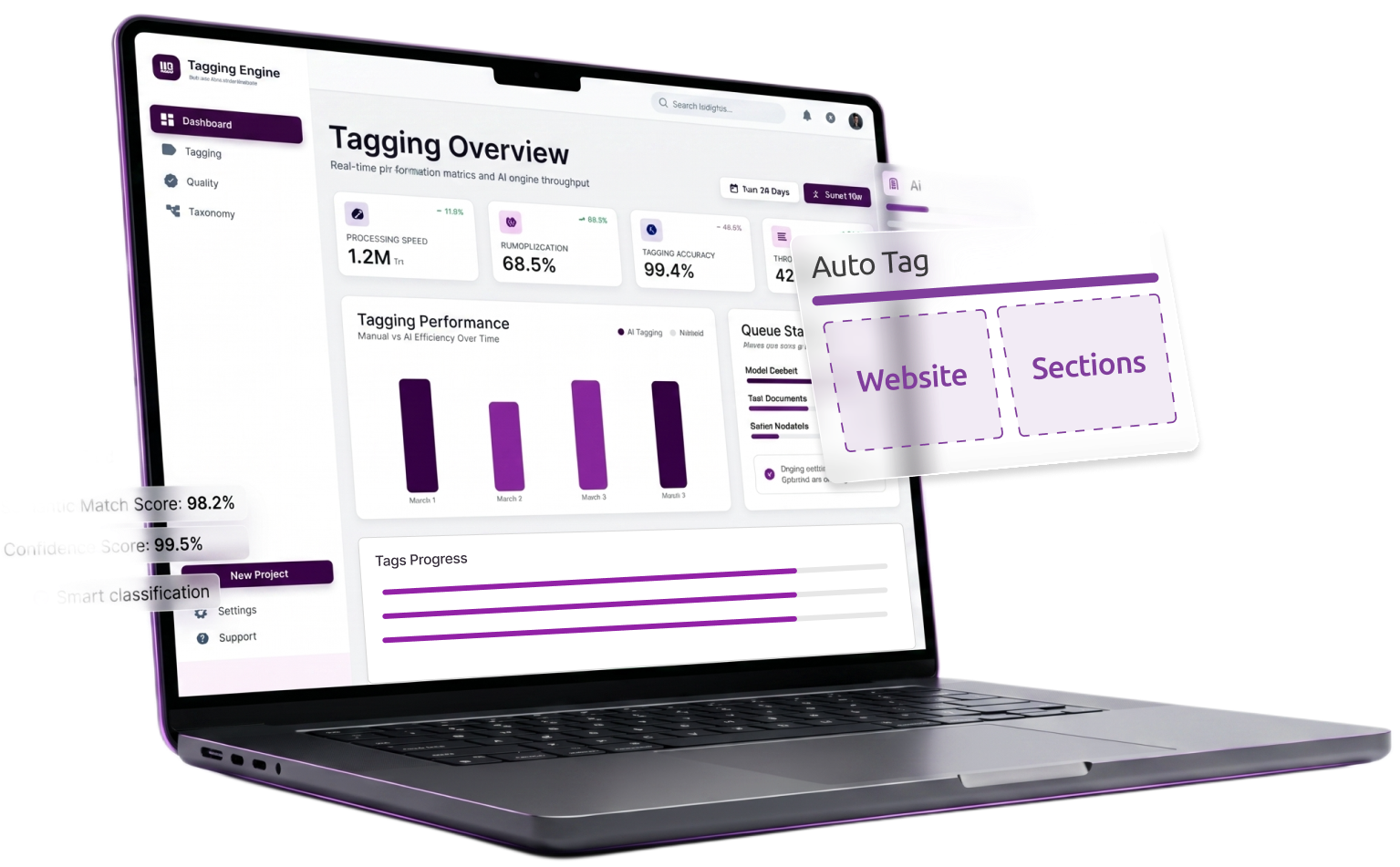
Tezeract built AutotagAI, a Python-based automated content-tagging engine using sentence transformers, semantic similarity, and a custom category-mapping algorithm, that now tags every new listing automatically, logs confidence scores for auditing, and exports clean, structured results to Excel for the business team.
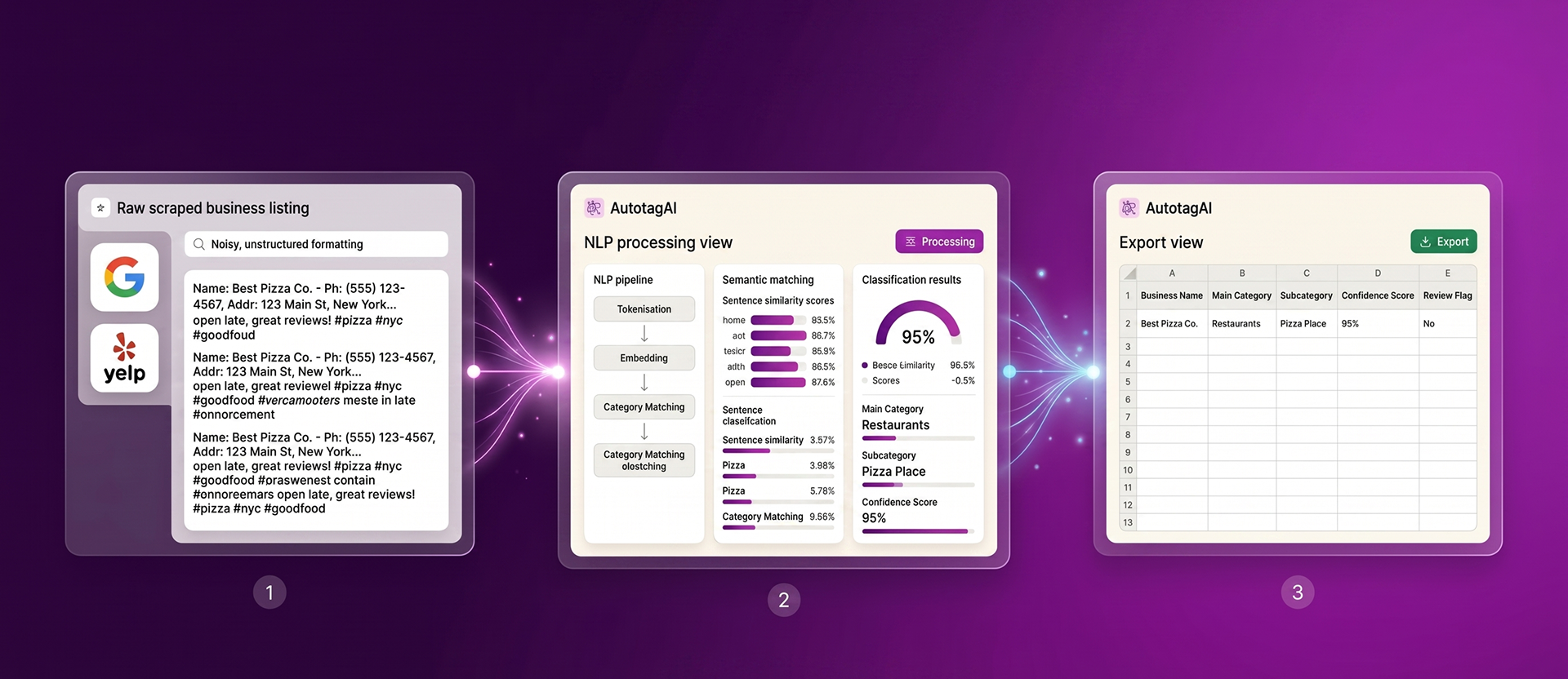
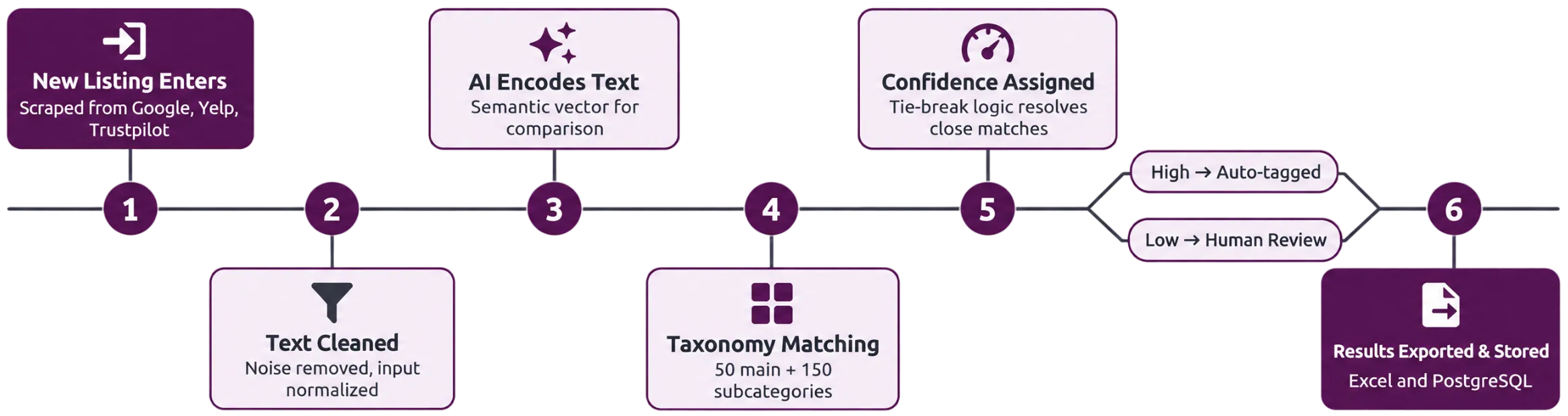
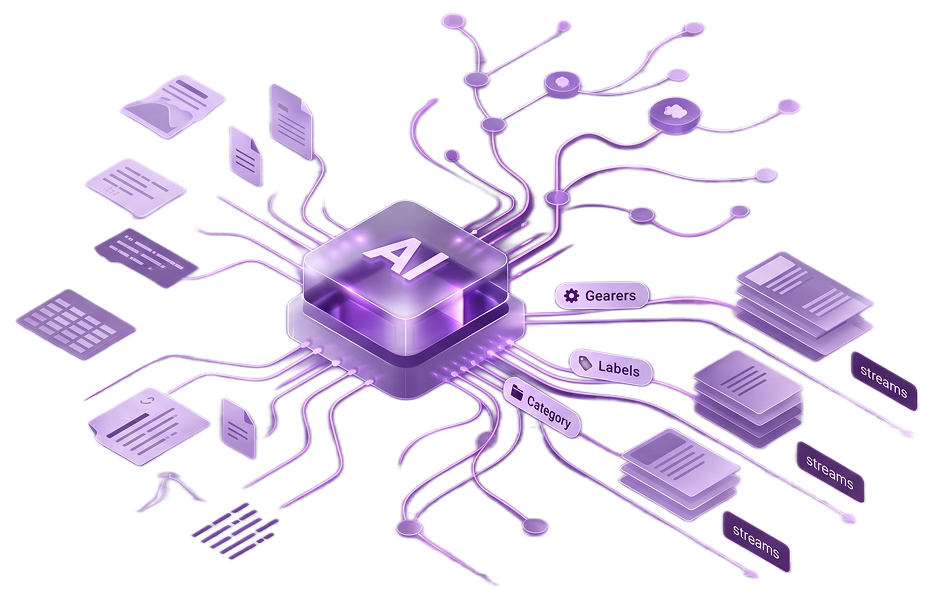
New listings arrive. AutotagAI extracts the business description, scores it against ~50 main categories and ~150 subcategories, applies the best-fit tag with a confidence score, and logs the result.
The team reviews only low-confidence edge cases. Everything else is done.
Client Name
Andreas Remy
Industry
Marketing
Business Model
Business directory and review aggregation platform
Location
Canada
Target Audience
Consumers searching for businesses by industry and category
Decision Maker
CEO & Founder
Company
Bestprover / NEONMONKI
Pain Point
Two people tagging thousands of business listings by hand, inconsistent metadata, growing backlogs, degraded search quality
If you manage a large content library or product catalog where consistent labeling is critical for search, filtering, or downstream automation, Bestprover’s situation before this build will look familiar. The bottleneck is the lack of a system that can reliably read, understand, and categorize it at scale.
The automated content tagging engine Tezeract, built for Bestprover, is designed to remove that bottleneck entirely, and its architecture scales to new categories, new data sources, and new volumes without rebuilding from scratch.
“I am extremely impressed with the AI and automation expertise demonstrated by Tezeract in automating our tagging system. Their solution efficiently matched new data with our existing dataset, significantly streamlining our workflow. Their efficient communication and collaboration made the experience exceptional. Highly recommend Tezeract for business process automation.”
Andreas Remy, CEO & Founder
NEONMONKI
The Challenge
01
Bestprover’s tagging process lacked infrastructure. Two team members read each business listing and manually assigned industry and subcategory labels. As the directory grew, pulling listings from Google, Yelp, Trustpilot, and brand websites, the volume of incoming data outpaced the team’s capacity to tag it. Backlogs grew. Tags drifted. The same type of business received different labels depending on who reviewed it and when.
The deeper issue was compounding degradation. Inconsistent metadata doesn’t just slow down the team; it actively damages the product. Search results become unreliable. Filters surface the wrong businesses. Users lose trust in the directory. And every new listing added to the system without a consistent tag makes the problem harder to fix retroactively.
All categorization was done by human judgment, with no system to enforce consistency across reviewers or over time
02
Without calibrated rules, some listings received too many tags and others too few, both of which hurt search quality and filter accuracy
03
Tag rules changed over time and were hard to keep synchronized across tools and team members, raising maintenance overhead with every update
04
Business descriptions scraped from multiple sources contained duplicates, inconsistent formatting, and unclear labels that slowed manual review
05
Listings, tags, and review notes were spread across spreadsheets and internal tools with no unified system for QA or sharing
06
More listings meant more people, with no route to efficiency; the team was at capacity before the growth plan had even started
07
If your team is stuck sorting and labeling data manually, it slows everything down. AutotagAI shows how automation can fix that.
Andreas and his team had tried the obvious alternatives before committing to a custom build. Some felt like a black box, no visibility into why a tag was chosen, which made trust and audit impossible. Rule-based scripts in spreadsheets helped at the margins but couldn’t handle the semantic complexity of real business descriptions.
Off-the-shelf tagging tools
Didn’t fit Bestprover’s industry and subcategory taxonomy; limited transparency into tagging logic; not designed for directory-scale volumes
Rule-based keyword scripts
Fast to set up but brittle, couldn’t handle semantic variation, noisy text, or evolving categories without constant manual maintenance
Outsourced manual taggingOff-the-shelf tagging tools
Addressed volume but introduced new consistency problems; cost-prohibitive at scale and still required internal QA overhead
Tezeract proposed a custom AI data tagging platform built on sentence transformers and semantic similarity, tuned specifically to Bestprover’s taxonomy and data sources. The plan was backend-only, so the team could plug it into their existing tools without a new interface.
The phased delivery approach gave Andreas confidence that the system would work on real data before the full investment was committed.
The Solution
Tezeract built AutotagAI as a Python-based AI data tagging platform that processes business listings end-to-end, from raw scraped text to clean, structured, export-ready tags, without manual intervention for standard categorization.
The system uses sentence transformers for semantic similarity, NLTK for text cleaning and summarization, and Scikit-learn for vectorization and threshold calibration. Every tag decision is logged with a confidence score. Low-confidence items are flagged for human review. Everything else is done automatically.
The architecture is built around Bestprover’s specific taxonomy, comprising approximately 50 main categories and 150 subcategories, with a custom category-mapping algorithm that integrates taxonomy mapping with similarity scores and rule-based checks for over-tagging and under-tagging.
The result is a system that tags consistently, explains its decisions, and scales to millions of records without adding headcount.
01
02
03
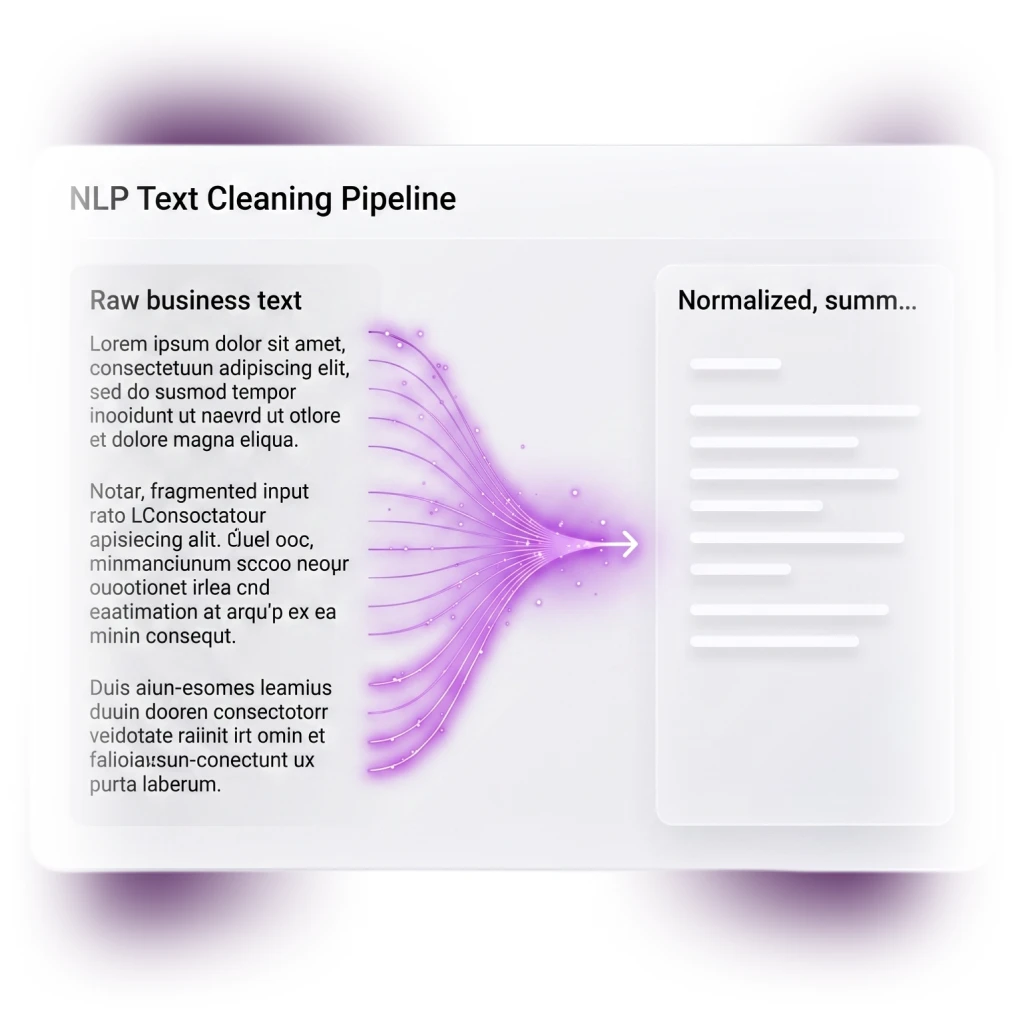
NLTK-powered text preprocessing and summarization layer that normalizes noisy, inconsistent input from Google, Yelp, Trustpilot, and brand websites before it reaches the classification model
04
Weak signal extraction from public sources, Google, Yelp, Trustpilot, used to build and improve training sets, reduce bias, and raise precision across underrepresented categories
05
Every tag decision is logged with a confidence score; items below the calibrated threshold are automatically flagged for human review, keeping the team focused on edge cases rather than routine categorization
06
FastAPI-powered batch processing that handles millions of records efficiently, with clean Excel exports via OpenPyXL and PostgreSQL writes for downstream integration, no new UI required, no workflow disruption
With the right tagging system, your raw data becomes clean, searchable, and ready for growth.
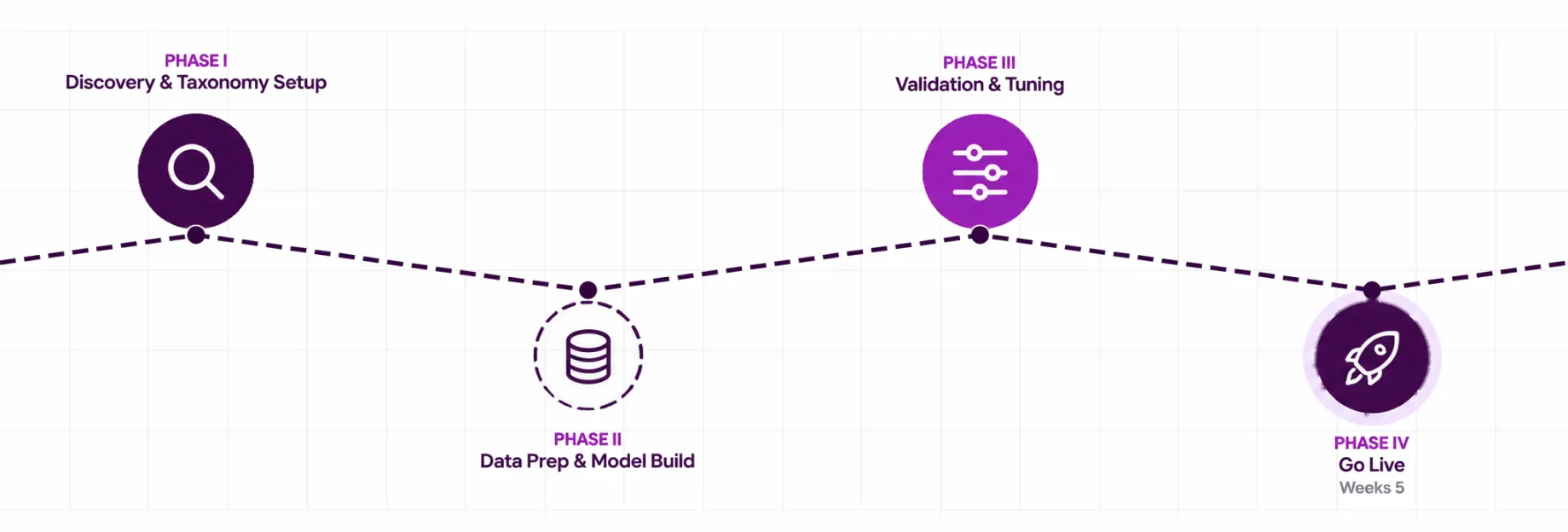
Tezeract delivered AutotagAI in four focused phases over five weeks, with a pilot on real Bestprover data before the full build was committed.
01
Before anything was built, the team worked through what the tagging system actually needed to know, settling on around 50 main categories and 150 subcategories, along with the rules governing tag assignment. Review goals and success metrics were locked in at the same time, so there was a clear bar to hit.
Key Milestone: Taxonomy structure and tagging rules signed off.
02
Public signals were pulled from Google, Yelp, Trustpilot, and brand sites to build out the annotation sets the model would learn from. Sentence transformers were trained using Scikit-learn, and a FastAPI layer was stood up to handle batch processing at scale.
Key Milestone: First model passed accuracy validation on the pilot dataset.
03
The model was put through its paces on real Bestprover data, with confidence thresholds carefully calibrated to avoid both over-tagging and under-tagging. Tie-break rules were finalized and the system was signed off once every KPI had been met.
Key Milestone: All KPIs met on the validation set; system approved for full deployment.
04
Millions of records were tagged in a single scaled run, with human reviewers stepping in to handle anything the model flagged as low-confidence. The final dataset was exported to Excel and handed over, clean and ready for business use.
Key Milestone: Full dataset tagged, reviewed, and delivered.
Noisy, inconsistent input data from multiple scraped sources
Inconsistent metadata from subjective manual tagging in the existing dataset
Over-tagging and under-tagging in edge cases
Built an NLTK-powered text cleaning and summarization layer that normalizes inputs before they reach the classification model; added pattern-based deduplication to handle near-duplicate listings
Used semantic tagging NLP with a fixed taxonomy and confidence thresholds to normalize historical tags; flagged high-divergence records for human review and correction
Built category versioning and retrain hooks into the architecture so new categories can be added and the model updated without rebuilding the full pipeline
Calibrated confidence thresholds and tie-break logic during the validation phase using real Bestprover data; added category versioning to handle taxonomy updates without retraining from scratch
AutotagAI moved Bestprover’s content categorization from a manual, person-dependent process to a structured, AI-driven engine. New listings are tagged automatically. Confidence scores are logged. Edge cases are flagged.
The team reviews what matters and ignores what doesn’t.
Faster content categorization for large batches
Manual tagging effort eliminated
Equivalent effort saved from the tagging team
Before AutotagAI, tagging thousands of business listings with accurate industry and sub-industry labels was a manual, inconsistent, and expensive process. Metadata quality varied by who did the work and how much time they had.
That inconsistency is gone.
1
Millions of records tagged accurately without manual review at every step
2
Consistent metadata quality across every batch, regardless of volume
3
Taxonomy updates applied automatically as categories grow or shift
4
Fewer errors to fix downstream, which means fewer delays in data-dependent workflows
1
A tagging pipeline that integrates directly into existing data infrastructure
2
Scalable architecture that handles growing datasets
3
Configurable category mapping that adapts to domain-specific taxonomies
4
Reduced dependency on manual annotation teams for ongoing data maintenance
1
Cleaner, more reliable data to power search, recommendations, and reporting
2
Faster time-to-insight because the data arrives already structured and labeled
3
A system that improves over time as more data flows through it
4
Lower cost per tagged record compared to manual or outsourced annotation
We design AI systems that tag, score, and organize your data automatically based on your own taxonomy.
What technologies power our AI-based content and data tagging system?
What potential use cases AI‑based tagging have?
The AI system processes millions of entries in a fraction of the time it took manually, reducing tagging time from weeks to hours.
01
No need for human input in the tagging process. The AI autonomously handles classification from start to finish, eliminating repetitive manual work.
02
By using NLP and semantic similarity models, the system ensures consistent tagging logic and accurate categorization even across messy or multilingual datasets.
03
The client scaled their data operations effortlessly without expanding the team, avoiding recruitment, training, and ongoing management costs.
04
With structured tags like A, A1, A2, the system brought clarity to previously unorganized data, making it easier to analyze, search, and manage.
05
The initial AI-based tagging solution laid the groundwork for future enhancements, such as placing real brand profiles into categories using contextual scraping and classification.
06
The content and data tagging problem is one of the most common bottlenecks in data-driven businesses, and one of the most underestimated. It looks like a staffing problem. It feels like a quality problem. But it’s fundamentally an architecture problem. When you build the right AI data tagging infrastructure, the staffing and quality problems resolve themselves.
AutotagAI is proof that content categorization using NLP doesn’t require a massive model or a complex deployment. It requires a clear taxonomy. The result is a system that scales to millions of records, maintains consistency across every tag, and improves over time as the taxonomy evolves and the training data grows.
Your questions answered here
An AI tagging system is a smart solution that uses artificial intelligence to automatically categorize, label, or tag content or data. It leverages natural language processing (NLP), machine learning, and transformer-based classification models to analyze unstructured data and assign it to relevant categories or tags. This approach enables AI-based automated content categorization that eliminates the need for manual labeling and ensures speed and accuracy at scale.
Automated content tagging streamlines the classification of large datasets, ensuring consistency, faster turnaround, and reduced human effort. With AI-powered business classification, businesses can scale without hiring large tagging teams. It improves data organization, enables better search/filter functionality, and is ideal for handling messy or multilingual data using AI-enabled multilingual data categorization models.
Yes. AI systems are designed to perform auto-tagging for unstructured business data, even if the data is inconsistent or poorly formatted. Techniques such as semantic classification, sentence transformers, and smart matching algorithms allow the AI to understand content in context, match patterns, and make accurate tagging decisions—even in large, messy datasets.
Unlike rule-based systems, which rely on predefined keyword logic, AI uses context-aware auto-tagging systems driven by transformer-based tagging pipelines. These models understand sentence structure, context, and meaning using sentence similarity models and semantic similarity tagging. The result is more accurate, scalable, and adaptive classification that improves over time.
Absolutely. One of the key strengths of an AI-based auto-tagging of content solution is scalability. It functions as a scalable AI tagging platform, capable of processing millions of records with minimal resource input. This makes it ideal for enterprises needing automated tagging for large datasets that update or grow regularly.
The tagging system leverages a combination of transformers NLP, sentence transformers in NLP, NLP pipelines for classification, and machine learning for content tagging. These technologies work together to create a highly intelligent AI-based automated tagging engine that adapts to different languages, industries, and content formats.
Yes, the system supports AI-powered category mapping and can be trained or fine-tuned for domain-specific taxonomies. Whether you’re in eCommerce, healthcare, real estate, or SaaS, the automated business tagging system can be configured to your main and subcategory structures using a flexible category mapping algorithm.
Yes. This technology has broad applicability. Whether you’re working on AI case studies for data labeling, AI scraping for classification, or LLM-based tagging workflows, the underlying models and techniques—like semantic similarity tagging, website content analysis with NLP, and smart data tagging solutions—are highly reusable and customizable.
We help businesses by automating their processes and developing customized end-to-end AI solutions that deliver proven ROI.