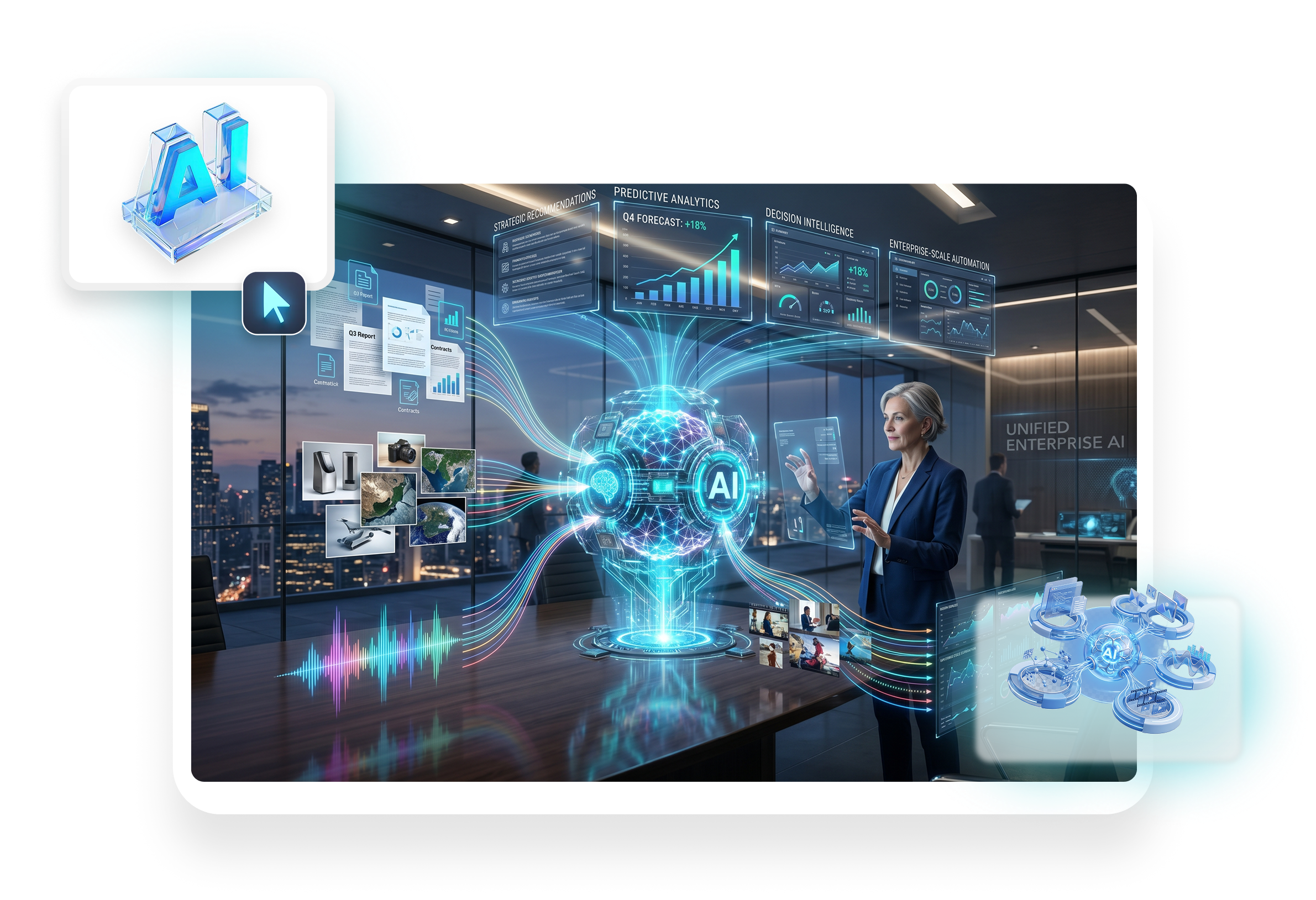
Multimodal AI Development Services for Enterprises
The Problem With Single-Modal AI at Enterprise Scale
Your Data Does Not Come in One Format. So Why Does Your AI Only Read One?
Enterprise operations are complex. A customer complaint comes in as a voice call, a support ticket, and a product image all at once. A quality control flag on the factory floor involves a sensor reading, a camera feed, and a maintenance log. A legal review pulls from scanned contracts, recorded depositions, and structured case data.
When your AI can only process one data type, your teams fill the gap manually. They copy outputs from one tool into another. They summarize what the AI missed. They make judgment calls the AI should have made.
That is not an AI problem. That is an architecture problem.
The four gaps we see most often in enterprise AI setups:
- Gap 1 – Siloed models: One model for text, another for images, another for audio. No shared context between them.
- Gap 2 – Manual handoffs: Teams manually combine AI outputs because no single system can reason across data types.
- Gap 3 – Lost signal: Critical information sitting in video recordings, audio files, or scanned documents never reaches the decision layer.
- Gap 4 – Integration debt: Point solutions that cannot talk to each other create more technical debt than they solve.
These gaps do not stay small. As your data volume grows, the cost of single-modal AI compounds.
Our Multimodal AI Services
What We Build for Enterprise Teams
Multimodal AI Consulting and Strategy
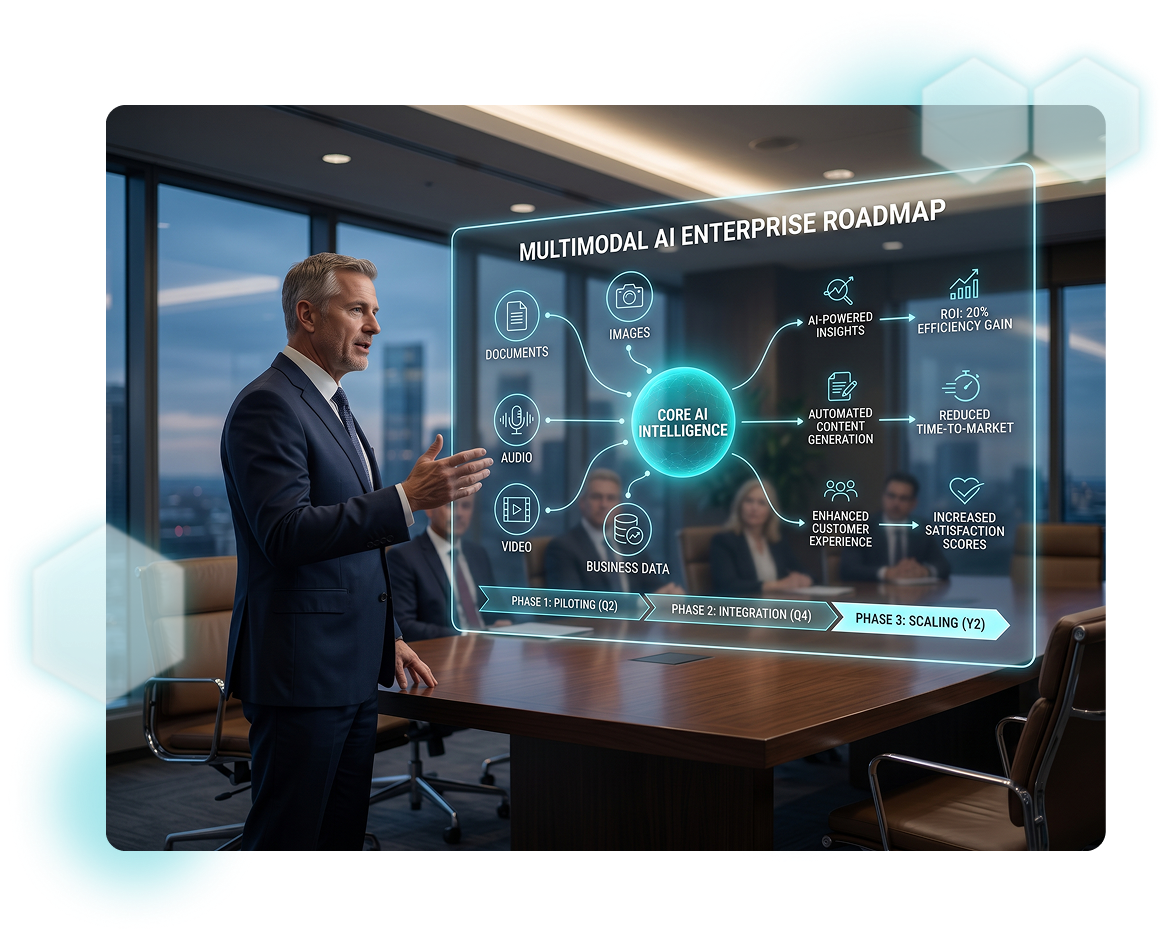
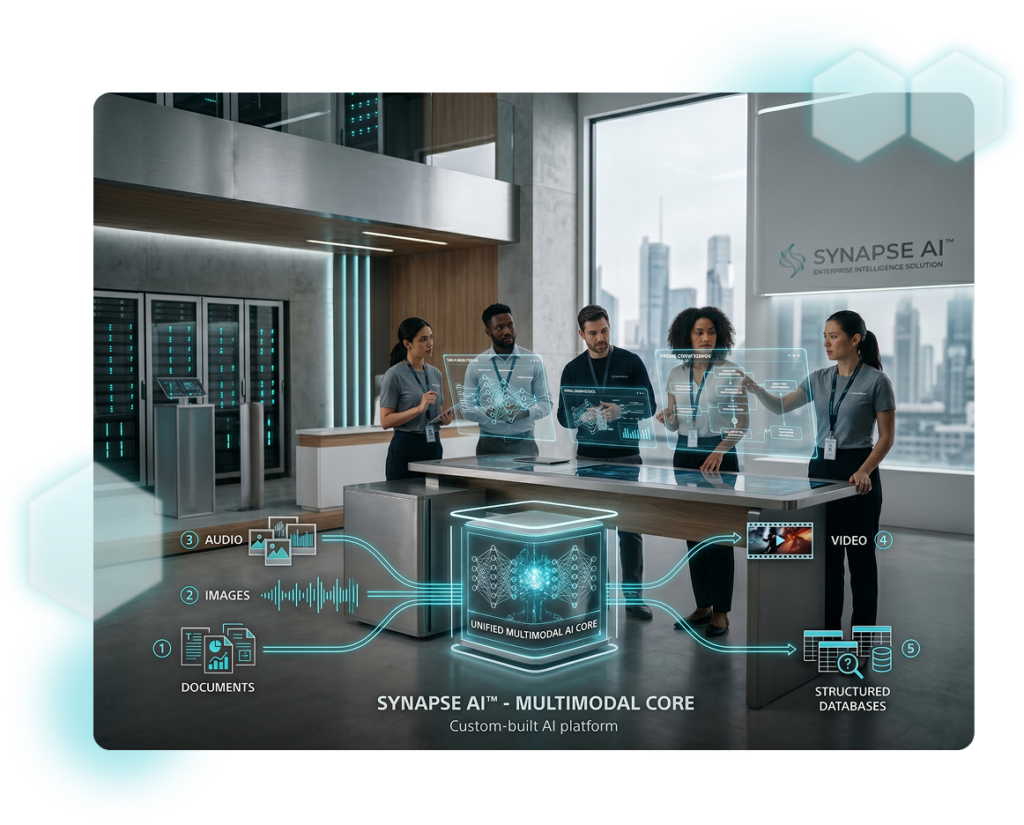
Custom Multimodal AI Development
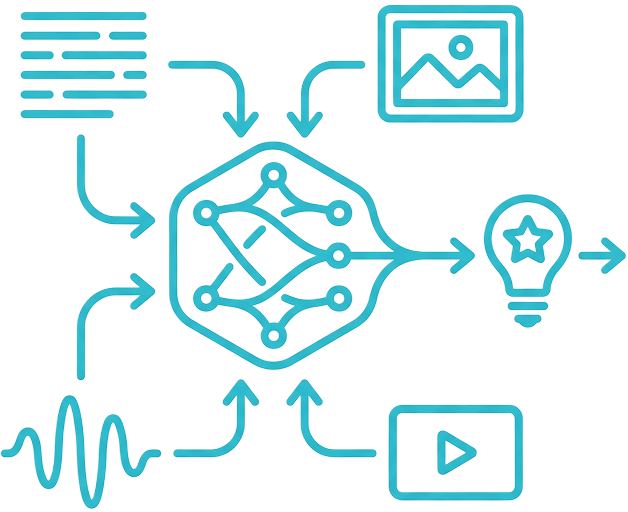
We design and build AI systems tailored to your specific data mix. Whether your inputs are documents, images, audio recordings, video feeds, or structured data, we build one system that reads and reasons across all of them. No off-the-shelf templates. No forced fit.
Best for: Enterprises with unique data environments that standard AI tools cannot handle.
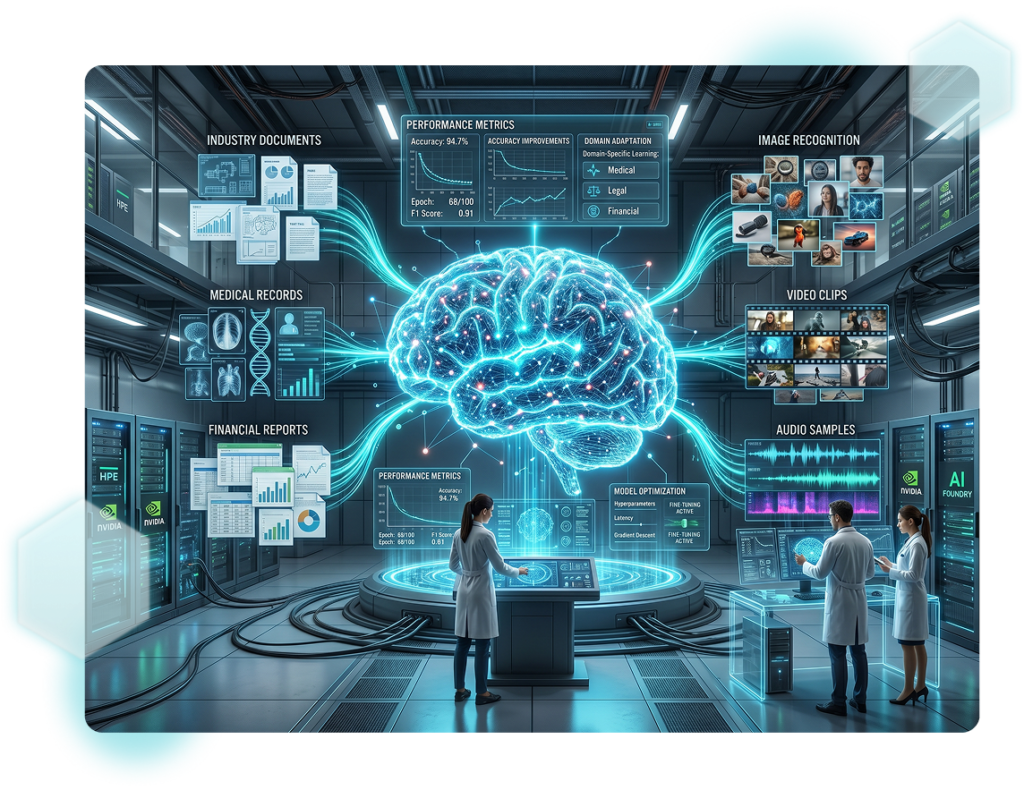
Multimodal Model Development and Fine-Tuning
We work with leading foundation models including GPT-4o, Gemini, Claude, LLaVA, Whisper, and CLIP. We fine-tune and adapt these multimodal AI models to your domain, your terminology, and your accuracy requirements. You get a model that performs on your data, not just on benchmarks.
Best for: Teams that need domain-specific accuracy across text, image, and audio inputs.
Multimodal AI Application Development
We build production-ready applications powered by multimodal AI. These include internal tools, customer-facing products, and back-office automation systems that process multiple data types within a single interface. From scoping to deployment, we own the full build.
Best for: Enterprises ready to move from pilot to a working product.
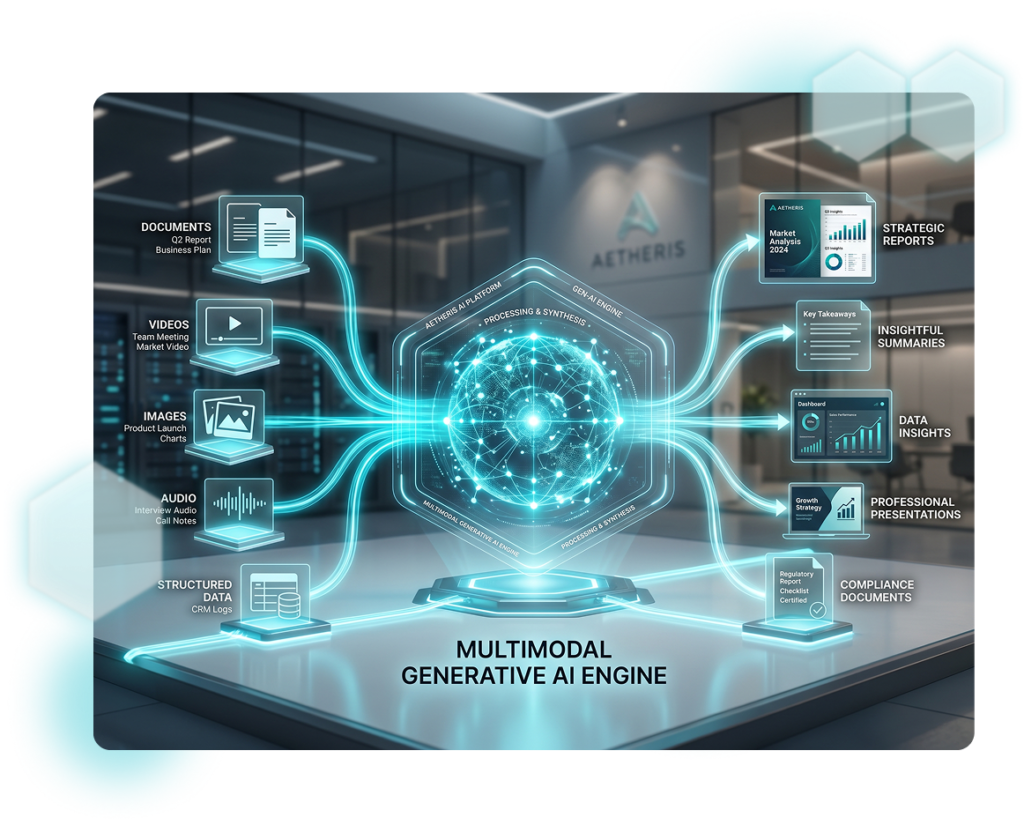
Multimodal Generative AI Services
We build generative AI systems that produce outputs across multiple formats, including text summaries from video content, image reports from structured data, and audio transcripts mapped to document records. These systems do not just retrieve information. They generate analysis, drafts, and structured outputs your teams can act on immediately.
Best for: Operations, legal, marketing, and compliance teams with high document and media volume.
AI Vision and Language Solutions
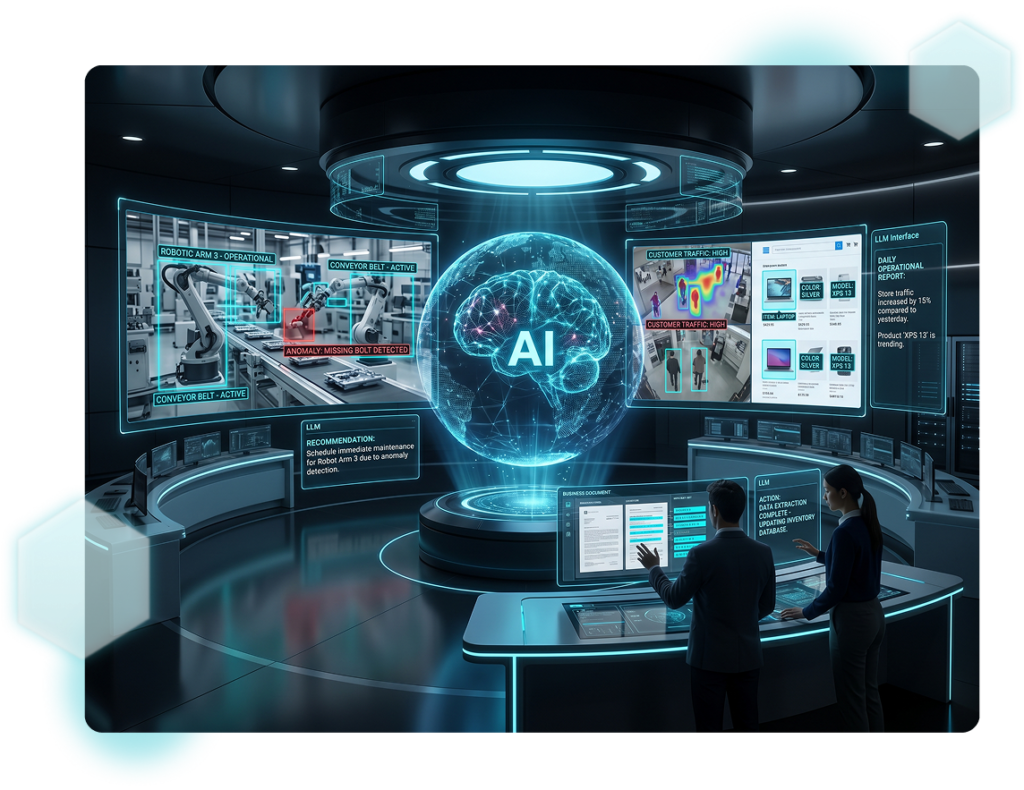
We combine computer vision and large language models into systems that can read a scene, describe what they see, extract meaning, and trigger downstream actions. Use cases include visual quality inspection with automated reporting, document understanding with image extraction, and video monitoring with natural language alerts.
Best for: Manufacturing, healthcare, retail, and security teams that rely on visual data.
Multimodal AI Integration Services
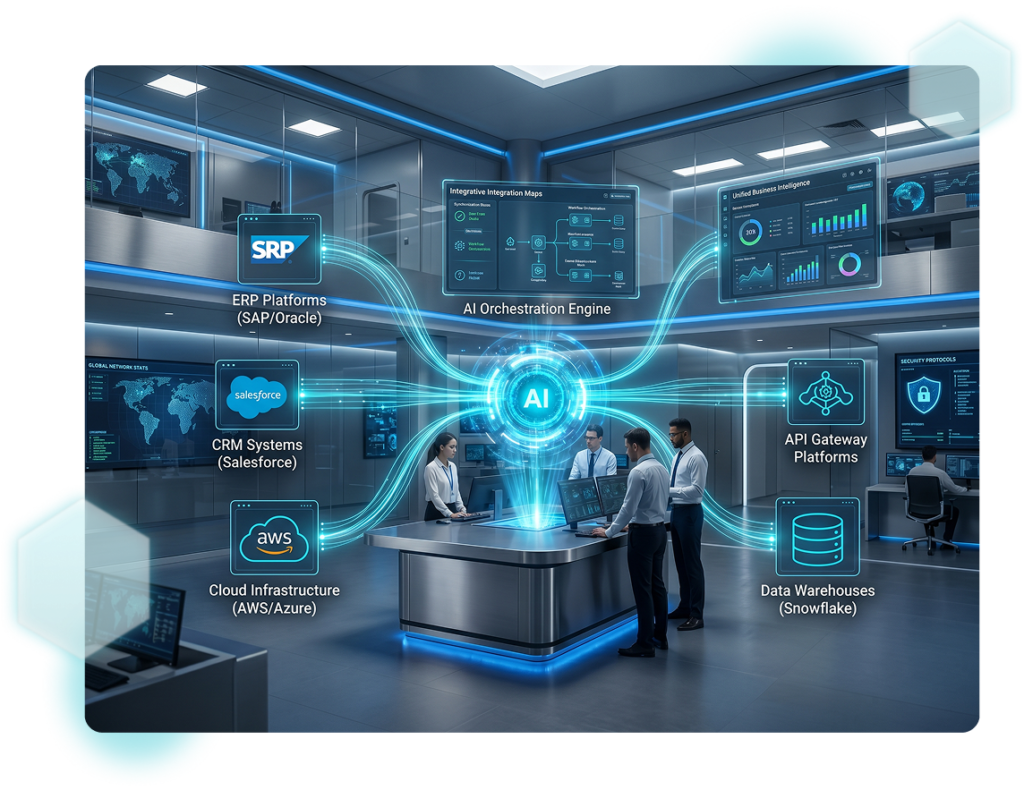
Already have AI tools in place? We integrate multimodal intelligence into your existing tech stack, connecting your models to your ERP, CRM, data warehouse, or internal platforms. We handle the API layer, the data pipeline, and the orchestration so your teams do not have to.
Best for: Enterprises adding multimodal capability to an existing AI or data infrastructure.
Not Sure Which Solution Fits Your Needs?
Most enterprises need more than one of these working together. Our team will map your current operations, identify where AI will deliver the fastest return, and recommend the right combination for your environment.
Book an Enterprise AI Assessment and our team will map the right services to your specific goals.
When we say we deliver ROI, we mean it

See what leaders with 10+ years of experience have to say about our AI solutions
These aren’t just testimonials; they are real-world results from global companies that discovered why Tezeract ranks among the top AI development companies for production-grade automation.
4.8/5 from 300+ companies
Industries We Serve
Enterprise AI Solutions Built for Your Industry
Every industry has its own data environment, compliance requirements, and operational challenges. We build enterprise AI systems that are designed around the specific realities of your sector, not generic templates adapted to fit.
Enterprise AI for Healthcare
Use AI to improve patient outcomes, reduce operational costs, and support clinical teams with faster, more accurate data analysis.
Build solutions for:
- Patient readmission prediction and early warning systems
- Medical image analysis and diagnostic support
- Personalized treatment recommendation systems
- Chronic disease progression prediction
- Electronic health record (EHR) data processing
- Remote patient monitoring and alert systems
- Medical billing fraud detection
- Patient risk stratification models
- Hospital resource and bed management forecasting
- Drug discovery and clinical trial optimization
Enterprise AI for Education
Use AI to improve learning outcomes, reduce administrative workload, and give your institution the operational visibility it needs to grow.
Build solutions for:
- Personalized learning path generation based on student performance data
- Early identification of students at risk of disengagement or failure
- Automated grading and feedback for structured assessments
- Learning management system (LMS) data analysis and reporting
- Plagiarism and academic integrity detection
- Faculty workload optimization and resource planning
- AI-assisted curriculum development and content recommendations
- Student support chatbots for admissions, scheduling, and FAQs
- Enrollment forecasting and student demand modeling
- Intelligent tutoring systems for self-paced learning
Enterprise AI for Fashion
Use AI to reduce overstock, respond faster to trends, and deliver the personalized shopping experiences that drive repeat purchases and brand loyalty.
Build solutions for:
- Trend forecasting using social, search, and sales data
- Demand planning and production volume optimization
- Visual similarity search and style recommendation engines
- Retail footfall analysis and store layout optimization
- Fabric and material defect detection using computer vision
- Influencer and campaign performance analysis
- Supply chain sustainability monitoring and reporting
- Customer style profiling and personalization at scale
- Markdown and pricing optimization for seasonal inventory
- Size and fit recommendation to reduce return rates
Enterprise AI for Sports Organizations
Use AI to improve athlete performance, reduce injury risk, and give your coaching and management teams the data advantage they need to compete.
Build solutions for:
- Player performance analysis and injury risk prediction
- Opponent scouting and game strategy modeling
- Fan engagement personalization across digital channels
- Stadium operations and crowd management optimization
- Merchandise demand forecasting and inventory planning
- Social media monitoring and brand sentiment analysis
- Athlete workload management and recovery optimization
- Sports video analysis and highlight generation
- Sponsorship value measurement and ROI modeling
- Ticket demand forecasting and dynamic pricing
Enterprise AI for Retail and E-Commerce
Use AI to increase revenue, reduce operational overhead, and deliver the personalized experiences that keep customers coming back.
Build solutions for:
- Product recommendation engines based on behavior and purchase history
- Dynamic pricing based on demand, competition, and inventory levels
- Demand forecasting and inventory replenishment automation
- Customer segmentation and lifetime value modeling
- Cart abandonment prediction and recovery automation
- Review analysis and sentiment monitoring at scale
- Store layout and AI-powered search and catalog merchandisingoptimization
- Warehouse picking and fulfillment optimization
Enterprise AI for Real Estate
Use AI to improve property valuations, identify high-value opportunities faster, and automate the operational processes that slow down your teams.
Build solutions for:
- Automated property valuation models (AVM)
- Investment opportunity scoring based on market and property data
- Lease and contract extraction and review automation
- Tenant churn prediction for commercial and residential portfolios
- AI-powered property search and recommendation engines
- Market trend forecasting for pricing and demand
- Construction project risk and cost prediction
- Document classification and due diligence automation
- Lead qualification and follow-up automation for agents
- Predictive maintenance for property portfolios
Enterprise AI for Transportation and Logistics
Use AI to cut fuel costs, reduce downtime, and improve delivery performance across your fleet and logistics operations.
Build solutions for:
- Fleet route optimization and real-time rerouting
- Predictive maintenance for vehicles and transportation assets
- Driver behavior monitoring and safety scoring
- Freight load optimization and capacity planning
- Delivery time prediction and SLA performance monitoring
- Fuel consumption analysis and reduction modeling
- Autonomous inspection using computer vision
- Logistics network design and optimization modeling
- Customer delivery experience tracking and feedback analysis
- Multi-modal transport coordination and planning
Enterprise AI for Insurance
Use AI to speed up claims processing, improve underwriting accuracy, and reduce fraud exposure across your entire book of business.
Build solutions for:
- Automated claims processing and damage assessment
- Underwriting risk scoring using structured and unstructured data
- Fraud detection across claims and policy applications
- Customer churn prediction and renewal propensity modeling
- Policy document extraction and classification
- AI-assisted pricing and actuarial modeling
- First notice of loss (FNOL) automation
- Regulatory Customer service automation for policy inquiries and renewals monitoring and audit trail automation
- Subrogation opportunity identification
Enterprise AI for Banking and Finance
Use AI to strengthen risk management, detect fraud faster, and give your finance teams the data intelligence they need to make better decisions at speed.
Build solutions for:
- Real-time transaction fraud detection and prevention
- Anti-money laundering (AML) pattern detection
- Credit risk scoring and loan decision automation
- Automated regulatory reporting and compliance monitoring
- Customer churn prediction and retention modeling
- AI-powered financial advisory and wealth management tools
- Document processing for KYC and onboarding
- Trading signal analysis and portfolio risk modeling
- Intelligent dispute resolution and case routing
- Customer lifetime value prediction
Enterprise AI for Sales and Marketing
Use AI to generate better leads, improve conversion rates, and build marketing programs that are driven by data rather than assumptions.
Build solutions for:
- Lead scoring and sales pipeline prioritization
- Customer segmentation and behavioral targeting
- AI-generated content and campaign personalization
- Churn prediction and proactive retention workflows
- Customer segmentation and lookalike audience modeling
- Competitive intelligence monitoring and analysis
- Sales forecasting and quota planning models
- Sentiment analysis across customer feedback channels
- Marketing attribution modeling and spend optimization
- Account-based marketing (ABM) targeting and scoring
- Conversational AI for sales outreach and qualification
Enterprise AI for Legal and Law Groups
Use AI to reduce the time your legal teams spend on manual document work and give them faster access to the insights that matter in every case.
Build solutions for:
- Contract review, clause extraction, and risk flagging
- Legal document drafting using approved templates and AI
- Litigation outcome prediction and case strategy support
- Regulatory change monitoring across jurisdictions
- eDiscovery automation for large document volumes
- Billing and time-entry analysis and anomaly detection
- Matter management and deadline tracking automation
- Compliance risk scoring across business units
- Legal research summarization and precedent identification
- Client intake and matter classification
Enterprise AI for Supply Chain Management
Build solutions for:
- End-to-end supply chain visibility and risk monitoring
- Supplier performance scoring and risk classification
- Inventory optimization across multiple warehouses and regions
- Predictive maintenance for warehouse and logistics equipment
- Route optimization and last-mile delivery planning
- Procurement spend analysis and cost reduction modeling
- Demand-supply matching and replenishment automation
- Carbon footprint tracking and sustainability reporting
- Import and export compliance documentation processing
- Real-time shipment tracking and delay prediction
Do not see your industry listed?
The highest-impact starting point is different for every organization. Our team will review your current operations across departments and identify where AI will deliver the clearest and fastest return for your business.
Our Process
How We Take You From First Call to Full Deployment
Enterprise AI projects fail most often not because of bad technology, but because of poor scoping, unclear ownership, and handoffs that nobody planned for. Our delivery process is built to eliminate those failure points at every stage. Here is exactly how we work.
We start with your business, not with the technology. We hold structured working sessions with your key stakeholders to map your data environment, understand your current workflows, and identify the specific outcomes you need the AI system to deliver. At the end of this phase, you receive a Scope Document that covers your data types and their current state, defined inputs and outputs, integration points with your existing systems, data quality gaps flagged upfront, and a clear statement of what the system will and will not do. No ambiguity. No assumptions carried forward.
Our engineering and AI teams design the full system architecture before a single line of code is written. This covers model selection, pipeline design, modality handling, and integration planning. We present the architecture to your technical team for review and sign-off, giving you full visibility into which foundation models will be used and why, how each data modality will be processed and connected, where fine-tuning is needed versus where off-the-shelf models are sufficient, and what the infrastructure and deployment environment will look like.
This is where development happens. Our team builds the multimodal AI pipeline, fine-tunes models on your domain data, and connects the system to your existing infrastructure. We run two-week sprint cycles with demos at the end of each sprint so your team can review progress and give feedback in real time. By the end of this phase, you have a working system tested against your real data, model performance benchmarks against your defined accuracy targets, full integration with your ERP, CRM, or data systems, and complete documentation of the build for your internal teams.
Before anything goes live, we run structured testing across all modalities, edge cases, and integration points. This includes accuracy testing, load testing, failure mode analysis, and a business validation review where your team confirms the system behaves exactly as agreed in the scope document. We do not move to deployment until your team signs off.
We deploy to your environment, whether that is AWS, Azure, Google Cloud, or an on-premise setup, and handle the full deployment pipeline, monitoring setup, and alerting configuration. Your team receives a handover package that includes system architecture documentation, model cards for every fine-tuned model deployed, runbooks for your internal engineering team, and escalation protocols with SLA definitions. We also provide a recorded walkthrough and a 30-day post-launch support window so your team is never left without a next step.
AI systems need maintenance as your data changes and your business grows. We offer retainer-based support that covers model monitoring, retraining triggers, performance reporting, and feature additions. You stay current without rebuilding from scratch every time your needs evolve.
Our Technology Stack
The Technology Behind Every Enterprise AI System We Build
We select and combine tools based on your use case, your data environment, and your infrastructure. Here is the full stack we work across.
GPT
Claude
GPT-3
Phi-3
Groq
DALL-E
PALM
GPT-4o
Gemini
Whisper
Llama3
Mid journey
MistralAI
Stable Diffusion
OpenAI embedding model
TensorFlow
PyTorch
Scikit-learn
Keras
Hugging Face Transformers
LangChain
LlamaIndex
EC2
GCP
cloud
AWS
Azure
Docker
digital ocean
Redis
Flask
Sqllite
FastAPI
Nest js
NodeJS
express js
Rabbit MQ
Celery
django
MongoDB
PostgreSQL
ChromaDB
VectorDB
GeoPy
Bokeh
Plotly
Scrapy
Seaborn
Selenium
Playwright
Metplotlib
Geopandas
Requests
Beautifulsoup
TF-IDF
EasyOCR
Chunking
Tokenization
Machine Translation
Keyword Extraction
Word Embeddings
Sentiment Analysis
Topic Modeling
Speech Recognition
Text Summarization
Semantic Caching
Face-recognition
Stop Words Removal
Named Entity Recognition
Stemming and Lemmatization
Pillow
OpenCV
VGG-16
Yolo
Librosa
Audio Flux
EfficientNet
Inceptionv3
ResNet50
Face-recognition
The Right Tools. The Right Team. Built for Your Stack.
We work with the most advanced AI frameworks, LLMs, and MLOps tools available. More importantly, we know how to combine them into systems that work in production. Tell us what you want to build and we will map out the right architecture.
Why is it worth working with us?
Our clients' success is our greatest achievement
Faisal
CEO of FormOle
Alan
Chairman & CEO of Peersuma
Pablo Sanchez
CEO of Notebook
Abdullah
CEO of Navex
Charles Glah
Owner of FrontOffice
Jawad Bhati
CEO of AI-powered Project Management Tool
Adam Smith
CEO of Upstar
Shefket Robellie
CEO of Voltox
Ollie
Project Coordinator
Susana Raj
Owner of Minmini
Randel
Chariman of Doozoo
Suleman Niazi
Founder of Konnect
Jan Brabres
Chairman of FN-AD
David Milward
Chairman of Metadataworks
Sudeep Kulkarni
CEO & Founder, WeCode
Marcus Nguyen
CEO & Founder, AI Makeup app
Andreas Remy
CEO & Founder, Neonmonki
David
CEO of Alisia
James
CEO & Founder, FluenttalkAI
What you can optimize with Conversational AI?
Stay Ahead of the Competition with Our Cutting-Edge Conversational AI Development Services & solutions
Cross-Modal Reasoning Architecture
Most systems run parallel inference. A text model reads the document. A vision model reads the image. The results are concatenated and passed to an output layer. These systems break whenever the meaning lives at the intersection of two data types, not inside either one.
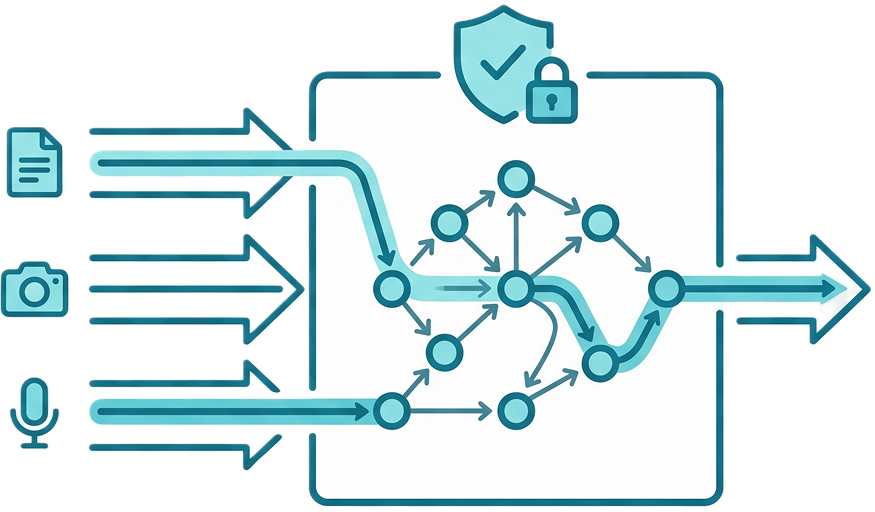
We build architectures where signal is fused across modalities before reasoning happens. The system learns that a contradiction between a physician’s written note and an imaging result is clinically significant. It learns that a tone in a call recording changes the interpretation of the written transcript. That kind of reasoning requires purpose-built fusion architecture, not parallel pipelines glued together.
Data Governance for Multimodal Pipelines
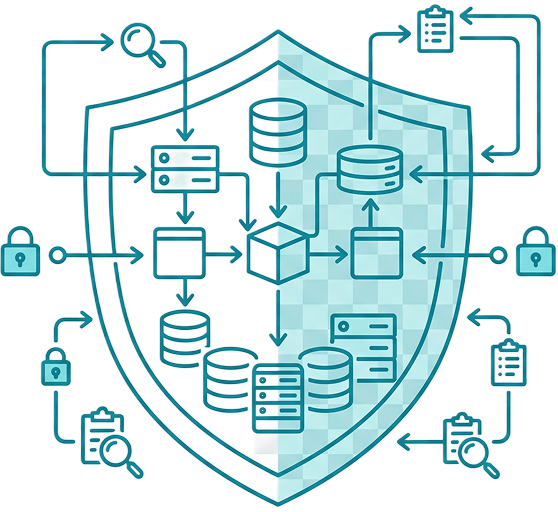
Enterprise data does not arrive clean or unified. Your images have different provenance than your text records. Your audio files sit in different storage systems than your documents. Treating them as one undifferentiated data lake creates lineage problems you will not discover until a compliance audit.
We build separate ingestion and processing pipelines for each modality, with a unified lineage layer on top. Every piece of data has a traceable origin, a documented transformation history, and a clear record of which model version processed it and when. This is the infrastructure your legal and compliance teams will ask for before any enterprise system goes to production.
Compliance-Ready Deployment From Day One
Compliance is not a layer you add after the system is built. When it is retrofitted, it breaks things. We design HIPAA, SOC2, and GDPR requirements into the system architecture at the start, not the end.
This includes data residency controls so your data does not leave a defined geographic boundary, private VPC and on-premise deployment options for regulated environments, role-based access controls applied at the data and model level, and audit logging across every inference event. Regulated industry clients do not need to ask for these. They are already there.
Evaluation and Safety Infrastructure
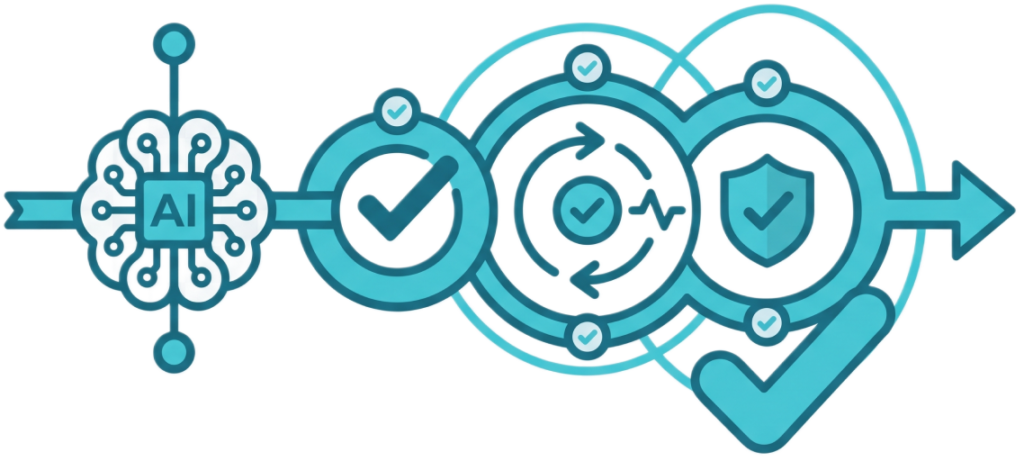
A multimodal AI system that performs well in a demo and fails in production is not a production system. It is a prototype. The gap between the two is almost always an evaluation problem, not a model problem.
We build evaluation infrastructure alongside every system we deliver. This includes hallucination detection pipelines tuned to your domain, red-team testing loops that systematically probe failure modes before go-live, and golden evaluation sets built from your actual data that reflect the edge cases your business actually encounters. Every model update goes through the same evaluation gate before it reaches production.
Why Tezeract
What You Are Actually Getting When You Work With Us
A lot of AI development companies will take your project. Fewer have built multimodal systems that operate in regulated, high-stakes production environments. Here is what separates how we work.
We Build for Production, Not Demos
A working demo is not a production system. We have seen too many enterprise AI projects stall between proof of concept and live deployment because the team that built the demo was not equipped to handle the production requirements. Every engagement we take on is scoped and built with production in mind from the first call. That means evaluation infrastructure, monitoring, rollback capability, and documented handoff, not just a model that works in a notebook.
We Work Across the Full Stack
Most AI vendors specialize in one layer. Model fine-tuning. Or deployment. Or data pipelines. We cover the full stack from data architecture and model selection through to deployment, monitoring, and ongoing iteration. You do not need to coordinate between three vendors to get one system into production.
We Stay Engaged After Go-Live
AI systems drift. Data distributions shift. Models that performed well at launch degrade over time without ongoing evaluation and maintenance. We offer structured post-deployment support that includes monitoring, re-evaluation against your golden sets, and proactive recommendations when performance signals change. You do not have to chase us down six months after launch.
300+ AI Projects Delivered.
Yours Could Be Next.
We offer a free $1,000 AI strategy session to every new client. No commitment. No generic pitch. Just a clear plan for what AI can do for your business, built by engineers who have done it across 20+ countries.
Why is it worth working with us?
Our Blogs
We’re passionate about sharing our knowledge with others and providing valuable resources that can make a real difference. Whether you’re a business owner, entrepreneur, or industry professional, we’re confident that you’ll find Tezeract articles informative, engaging, and relevant.
Frequently Asked Questions
What exactly are multimodal AI development services and how are they different from standard AI development?
Standard AI development typically works with one data type at a time. A text model. A vision model. An audio model. Multimodal AI development services build systems that process two or more data types together and reason across them simultaneously. The difference is not cosmetic. When meaning lives at the intersection of a document and an image, or a call recording and a transaction record, a single-modal system cannot find it. A multimodal AI system can. For enterprises dealing with real-world data that arrives in multiple formats at once, this is the architectural distinction that determines whether a system is actually useful in production.
What does a multimodal AI development company actually deliver? Is this a model, a product, or a service?
It depends on what your business needs. A multimodal AI development company like Tezeract delivers purpose-built systems scoped to a specific business problem. That could be a standalone multimodal AI application, a set of APIs integrated into your existing infrastructure, or a full multimodal AI pipeline from data ingestion through to output delivery. You do not receive a generic product. You receive a system designed around your data, your workflows, and your production environment.
How is custom multimodal AI development priced?
Custom multimodal AI development is scoped and priced based on three factors: the complexity of the data types involved, the production infrastructure requirements, and the level of evaluation and compliance work needed. We do not publish fixed pricing because no two enterprise systems have the same requirements. What we do offer is a structured scoping call where we assess your use case and give you a clear effort and cost estimate before any commitment is made.
What modalities do your multimodal AI models support?
Our multimodal AI models are built to work across text, images, audio, video, structured data, and documents. The specific combination depends on what your data environment looks like and what the system needs to reason about. Most enterprise deployments involve two or three modalities. Some involve all of them. We scope the architecture based on what the problem actually requires, not what is technically possible in isolation.
Can you integrate multimodal AI into our existing systems rather than building something new?
What is the difference between multimodal AI application development and multimodal AI software development?
In practice the terms overlap, but the distinction is in scope. Multimodal AI application development typically refers to a user-facing system, something your team or your customers interact with directly. Multimodal AI software development refers to the underlying infrastructure: the pipelines, APIs, data processing layers, and model serving components that power a system. Most of our enterprise engagements involve both. We build the software layer and the application layer together so neither is limited by the other.
Do you offer multimodal generative AI services or is your focus limited to classification and extraction tasks?
Both. Our multimodal generative AI services cover use cases where the system needs to produce output, structured reports, clinical summaries, product descriptions, risk briefs, and similar generation tasks. We also build classification, extraction, retrieval, and detection systems. The right architecture depends on what the output needs to look like and how it gets used downstream. We scope both in the same discovery process.
What does enterprise multimodal AI solutions delivery look like for regulated industries?
Enterprise multimodal AI solutions for regulated industries are designed with compliance requirements built in from the start, not added at the end. This means HIPAA, SOC2, and GDPR controls are part of the architecture, not a retrofit. Data residency requirements are addressed during infrastructure scoping. Audit logging is included in the base system. And explainability requirements are factored into model selection and evaluation design. Regulated industry clients do not need to ask for a compliance review at the end of a project. It is part of how the project is built.
How long does a typical multimodal AI development project take?
Most enterprise multimodal AI development engagements run between 10 and 20 weeks from kickoff to production deployment. The range depends on the number of modalities involved, the complexity of the data environment, and the compliance requirements. We share a detailed timeline after the discovery and scoping phase. We do not give estimates before we understand what we are actually building.
What AI vision and language solutions does Tezeract specialize in?
Our AI vision and language solutions cover document understanding, visual question answering, image-text retrieval, scene and object reasoning, and cross-modal search. These are the building blocks for enterprise applications in healthcare, legal, financial services, retail, and manufacturing where visual and textual data need to be understood together. We combine foundation models with domain-specific fine-tuning to build systems that perform on your data, not just on benchmark datasets.
What happens after the system goes live?
We offer structured post-deployment support that includes performance monitoring, evaluation against your golden test sets, model retraining as your data distribution shifts, and proactive recommendations when system behavior changes. AI systems are not static. The support structure we put in place reflects that. The terms are agreed during scoping and included in the engagement contract.
How do we get started?
Book a scoping call. We will assess your use case, your data environment, and your production requirements in one structured session. If there is a fit, we will outline an engagement approach and a cost estimate. If multimodal AI is not the right tool for your problem, we will tell you that too.
Talk to Us About Your Use Case
If your business runs on more than one data type and your current AI setup treats them separately, there is a gap worth closing. We will tell you in one call whether multimodal AI is the right fit and what building it would actually involve.
No pitch. No commitment. Just a direct conversation with the team that would do the work.