Custom AI Model Fine-Tuning Services
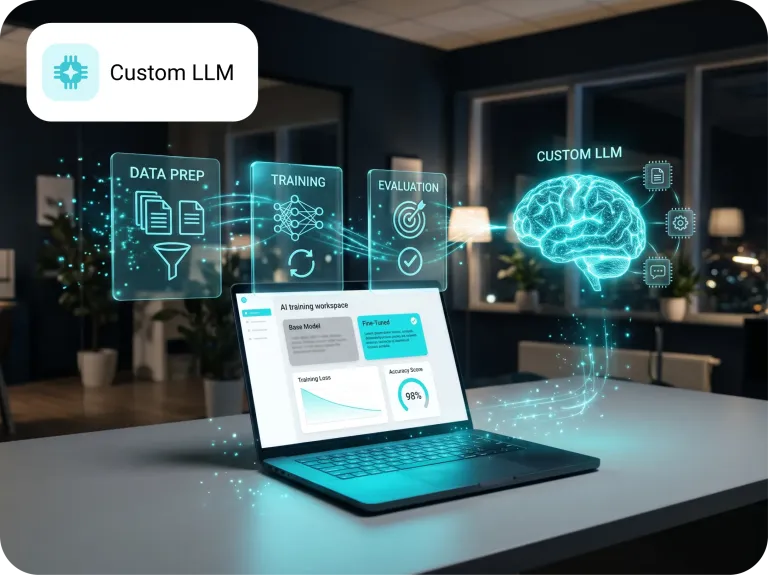
Custom AI model fine-tuning for outputs that fit your business
Generic models are built for everyone. They don’t know your data, your terminology, or how your business operates. Our custom LLM fine-tuning services adapt pretrained and open-source models to your workflows, so you get accurate, consistent outputs without rebuilding your AI stack or managing endless prompts. We handle the data preparation, training, and evaluation needed to turn a generic model into one built for your use case.
- Compliance-ready from day one
- No lock-in contracts
- Full source code ownership
- No data shared externally
Building production AI since 2021, before ChatGPT
100+
Products live
25+
Engineers on staff
4.9/5
From 200+ founders
Trusted & recognised
Since 2021
Before ChatGPT
Live in 6 Weeks
Fixed scope
100% In-House
No outsourcing
Global Clients
15+ countries
Production-Grade
Not prototypes
Why Generic AI Models Fall Short
Generic AI models create more work, not less
Off-the-shelf models sound confident even when they’re wrong, leaving your team to catch the mistakes instead of saving time.
No Business Context
Generic models don't know your product names, internal policies, or how your team talks to customers, so they guess instead of answering correctly.
Confident, Not Accurate
Outputs sound polished even when they're wrong, which makes errors harder to catch before they reach a customer or a report.
Endless Prompt Patching
Teams try to fix gaps with longer, more detailed prompts. It works briefly, then becomes inconsistent and hard to maintain across the team.
Unpredictable in Production
A model that looks capable in a demo often behaves inconsistently once it's handling real, repeated business tasks.
More Manual Review, Not Less
Someone has to check and correct AI output regularly, which adds work instead of removing it.
Inconsistent Customer and Team Experience
Responses vary by user, prompt, and situation, making it difficult to trust the model for repeatable processes.
The Solution
Custom AI Fine-Tuning For Accurate, Business-Ready Outputs
Generic AI models struggle with rigid responses, missing context, and inconsistent answers. Custom AI fine-tuning services adapt a pretrained model to your data, terminology, and workflows, so it performs reliably on your real use cases.
Fine-tune pretrained models to understand your data, workflows, and goals
Partner with a custom AI fine-tuning company to build business-ready AI
Train models on your business data for accurate, relevant outputs
Adapt AI models to your terminology, tone, and industry language
Evaluate model performance against your real use cases before deployment
Deploy fine-tuned models into your existing tools without replacing your stack
Choosing the Right Approach
When to Use Prompting, RAG, or Fine-Tuning
Get a clear answer on which approach fits your use case, without paying for the wrong one.
Use Prompting
When rules are simple and risk is low
Best when:
- Simple classification
- Low stakes
- Fast iteration needed
- No training data
Use RAG
When answers depend on changing knowledg
Best when:
- Dynamic knowledge base
- Need citations
- Frequent content updates
- Multiple sources
Use Fine-Tuning
When you need consistent formats, high precision, and domain behavior
Best when:
- Consistent output format
- Domain-specific language
- High precision required
- Cost optimization at scale
What We Fine-Tune and How
Custom AI fine-tuning services covering every stage of model customization
Get the exact fine-tuning capability your use case needs, without piecing together multiple vendors.
Large Language Model (LLM) Fine-Tuning
Adapt large language models to your business data, terminology, and tasks for more accurate, consistent outputs. Instead of relying on a general-purpose model to guess at context, you get a model that already understands how your business communicates. This reduces errors and the need for constant correction once the model is in production.
Domain-Specific AI Model Customization
Customize models around your industry's language, rules, and context so outputs reflect how your business actually operates. Whether your field has specific compliance language, technical terminology, or internal processes, the model learns to work within those boundaries. The result is output your team can trust without rewriting or re-checking it every time.
Instruction Tuning
Train models to follow your specific instructions and formats reliably, reducing the need for repeated correction. Instead of writing longer and longer prompts to get the format or tone you want, the model learns your expectations directly during training. That means more predictable behavior across different users and use cases, without manual prompt management.
Prompt Optimization
Refine and structure prompts to get more consistent, predictable results from your fine-tuned or existing models. This involves testing and adjusting prompt structure, instructions, and examples so the model performs reliably across different inputs. It's often paired with fine-tuning to get the most consistent results out of a deployed model.
Custom Dataset Preparation
Clean, structure, and prepare your business data into training-ready datasets built for your fine-tuning goals. This includes organizing raw data, removing inconsistencies, and formatting it in a way the model can learn from effectively. Good data preparation is often the difference between a fine-tuned model that performs well and one that doesn't.
Model Evaluation and Performance Testing
Test fine-tuned models against your real use cases, not just general benchmarks, before anything reaches production. We assess accuracy, consistency, and behavior across the specific scenarios your business will actually encounter. This ensures the model is validated against your standards, not generic industry metrics, before you rely on it.
Continuous Model Optimization
Monitor and refine model performance over time as your data, use cases, and requirements evolve. Business needs change, and a model that performs well today may need adjustment as your data or processes shift. Ongoing optimization keeps the model aligned with your current operations instead of becoming outdated.
AI Model Deployment and Integration
Deploy your fine-tuned model into your existing tools and workflows without disrupting what already works. We handle the technical steps needed to get the trained model running in your environment, whether that's an internal tool, customer-facing product, or backend system. The goal is a smooth transition from trained model to working part of your operations.
Supervised Fine-Tuning
Train models on labeled, task-specific examples to improve accuracy on the exact outputs your business needs. This approach is especially effective when you have clear examples of correct outputs and want the model to replicate that standard consistently. It's one of the most direct ways to shape model behavior around a specific task.
Not sure which service fits?
Already have a validated idea and need a working prototype fast? See MVP Development. Need one specific AI capability added into existing software? See Custom AI Development. This service is for building a complete AI product from strategy through launch.
Where Fine-Tuning Delivers Value
Fine-tuning AI models for businesses across real, repeatable tasks
Fine-tuning works best on tasks your business performs repeatedly, where consistency and accuracy matter more than general knowledge. These are a few of the areas where it delivers the clearest value.
Customer Support Assistants
Train a model on your product details, policies, and tone so it handles common questions accurately and consistently, instead of giving generic or inconsistent answers that need correction.
Internal Knowledge Tools
Build assistants that understand your internal documentation, processes, and terminology, helping employees find accurate answers without digging through multiple systems or asking colleagues directly.
Industry-Specific Language Models
Adapt a model to understand and generate language specific to your industry, whether that's regulatory terminology, technical vocabulary, or internal shorthand your team uses daily.
Content and Communication Consistency
Train a model to generate responses, summaries, or drafts that consistently match your brand voice, tone, and formatting standards, without needing manual rewriting each time.
Workflow-Specific Decision Support
Fine-tune a model to assist with repeatable decisions based on your business rules and historical patterns, reducing reliance on long reference documents or manual lookups.
What have we built for businesses?
AI Development Projects That Delivered Measurable Results
We have designed, built, and deployed production-ready AI products across industries. Every project below started with a real business problem. Every solution was built, tested, integrated, and handed over as a fully working AI product.
FluentTalk AI AI Language Tutor
Problem
Learners had no speaking partner, received slow and generic feedback, and lost motivation over time. Manual tutoring could not scale across 21+ languages.
Solution
We delivered a custom AI language tutor built on Google Speech-to-Text, OpenAI GPT-4o, and adaptive roleplay scenarios. The product was deployed on AWS with real-time pronunciation analysis and full multilingual support. The client needed no in-house AI team to run it.
Results
87%
Manual learning processes automated
80%
Time saved per learner
21+
Languages supported
FormOle AI Virtual Sports Coaching App
Problem
Soccer athletes had no access to personal coaches. Manual video review was slow, feedback was inconsistent, and progress could not be tracked at scale.
Solution
We built an AI sports coaching product using YOLO for player detection, MediaPipe Pose for angle analysis, and a Python/Flask AI server deployed on GCP with React Native mobile apps. The client received a fully working AI product with no internal AI team needed to operate it.
Results
50%
Reduction in manual coaching time
60%
Improvement in coaching accessibility for remote athletes
100%
Soccer video analysis automated end to end
Pitchmark AI Marketing Pitch Automation
Problem
Marketing agencies spent hours on manual research across SEO tools and spreadsheets to produce one pitch per day. LLM accuracy sat at 50% before refinements.
Solution
We built an AI pitch generation product using GPT-4, Selenium, Google Keywords API, and MongoDB. It pulls live SEO and competitor data and generates client-ready pitch documents automatically, with no manual research required from the client’s team.
Results
10-15
Pitch drafts produced daily instead of 1
10X
Increase in monthly report generation
70%
Fewer review edits due to better accuracy
FN-AD AI-Based Fashion Brand and Wholesaler Matching
Problem
FN-AD ran its entire brand-wholesaler matching workflow in Excel. Manual profiling slowed outreach, caused category mismatches, and missed leads at scale.
Solution
We built a custom AI matching engine using LLaVA, NLP, Apollo Scraper, and an AI-powered CRM. The product automates brand profiling, scores leads, and routes matches by category and region, replacing a fully manual process with an always-on AI product.
Results
87%
Manual learning processes automated
47%
Increase in productivity
50%
Lift in lead conversion rate
5.0
Quality rating and willingness-to-refer
Want Results Like These for Your Business?
300+ AI products delivered. 25+ countries served. 5+ years of building AI products that work in the real world. Let us do the same for you.
Why It's Worth Doing
Enterprise LLM fine-tuning services that translate into real business outcomes
01
Higher Accuracy on Your Specific Tasks
A model trained on your data performs better on your actual use cases than a generic model ever will, because it’s learned from examples that reflect your real scenarios.
02
More Consistent Output
Responses stay consistent across users, sessions, and time, instead of varying based on how a prompt happened to be written that day.
03
Less Manual Review
Fewer outputs need to be checked and corrected before they’re usable, freeing your team to focus on work other than babysitting AI responses.
04
Reduced Prompt Dependency
Behavior is built into the model through training rather than maintained through long, fragile prompts that break when someone edits them.
05
Better Alignment With Your Brand and Policies
Outputs reflect your terminology, tone, and internal standards by default, rather than needing constant correction to match how your business communicates.
06
A Foundation That Improves Over Time
As your data and use cases evolve, the model can be refined further, rather than starting over with a new generic model each time requirements change.
How We Work
Custom LLM development and fine-tuning in four clear steps
Fine-tuning doesn’t need to feel like a black box. Our process is built around four straightforward stages, each with a clear purpose and output.
01
Define the Use Case
We start by understanding the specific task, behavior, or output you need the model to handle, and confirm whether fine-tuning is actually the right approach before anything else moves forward.
02
Prepare the Data
Your business data is cleaned, structured, and organized into a training-ready dataset, since the quality of this step directly determines how well the fine-tuned model performs.
03
Fine-Tune and Evaluate
The model is trained on your prepared data, then tested against your real use cases and scenarios, not just general benchmarks, before it’s considered ready.
04
Deploy and Support
Once validated, the model is deployed into your existing tools and workflows, with ongoing monitoring available to refine performance as your data and needs evolve.
Which latest technologies do we use?
Leveraging Your Business with Our Cutting-Edge Artificial Intelligence Tech Stack
GPT
Claude
GPT-3
Phi-2
Groq
CTRL
PALM
GPT-4o
Pix2Pix
Gemini
Mediapipe
Guardrails
VertexAI
Whisper
StyleGAN
Llama3
DeepDream
Mid journey
MistralAI
Stable Diffusion
OpenAI embedding model
Redis
Flask
Sqllite
FastAPI
Nest js
NodeJS
express js
Rabbit MQ
Celery
django
MongoDB
PostgreSQL
ChromaDB
VectorDB
CSS
HTML
React
vue js
Next js
React js
React Native
typescript js
EC2
GCP
cloud
AWS
Azure
Docker
digital ocean
GCP
SSL
Ngnix
Gitlab
cloud
Github
Docker
Amazon
CICD
Gunicorn
digital ocean
Cypress
clickup
Burpsuite
Postman
selenium
Playwright
Jemeter
Figma
Canva
photoshop
aftereffects
adobe illustrator
What our clients say about tezeract

Our client's success is our greatest achievement
Faisal Haq
CEO of FormOle
Alan
Chairman & CEO of Peersuma
Pablo Sanchez
CEO of Notebook
Abdullah
CEO of Navex
Charles Glah
Owner of FrontOffice
Jawad Bhati
CEO of AI-powered Project Management Tool
Adam Smith
CEO of Upstar
Shefket Robellie
CEO of Voltox
Ollie
Project Coordinator
Susana Raj
Owner of Minmini
Randel
Chariman of Doozoo
Suleman Niazi
Founder of Konnect
Jan Brabres
Chairman of FN-AD
David Milward
Chairman of Metadataworks
Sudeep Kulkarni
CEO & Founder, WeCode
Marcus Nguyen
CEO & Founder, AI Makeup app
Andreas Remy
CEO & Founder, Neonmonki
David
CEO of Alisia
James
CEO & Founder, FluenttalkAI
Why Why Work With Tezeract
AI fine-tuning services built around production outcomes, not demos
Tezeract isn’t a tool vendor or a single-service shop. Fine-tuning is one part of a broader AI development and automation practice, which means the work is approached with full production use in mind from the start, not just model accuracy in isolation.
200+
Business Apps Developed
20+
Countries Served
7+
Business Partnerships
25+
Team of experts
Reasons to choose us
Business-First Approach
We start with the business problem, not the technology. Fine-tuning is recommended only when it's genuinely the right fit for your use case, not the default answer to every AI need.
Production-Ready Focus
Models are evaluated against your real scenarios and deployed into your actual workflows, rather than handed over as a standalone file that still needs significant work to become usable.
End-to-End Capability
Beyond fine-tuning, Tezeract builds custom AI solutions, automation, and integrations, which means the fine-tuned model can connect into a larger system when your needs go beyond a single model.
Breadth Across AI and Automation
Our team works across machine learning, data science, and workflow automation, bringing a wider perspective to how a fine-tuned model should behave within your broader operations.
Why is it worth working with us?
Our Blogs
We’re passionate about sharing our knowledge with others and providing valuable resources that can make a real difference. Whether you’re a business owner, entrepreneur, or industry professional, we’re confident that you’ll find Tezeract articles informative, engaging, and relevant.
Frequently Asked Questions
What is the difference between fine-tuning and prompt engineering?
Prompt engineering adjusts the instructions given to a model at the time of use, while fine-tuning trains the model itself on your data so the desired behavior is built in. Fine-tuning reduces reliance on long, carefully maintained prompts because the model has already learned the expected response pattern.
Do I need a large amount of data to fine-tune a model?
The amount of data needed depends on the task and the fine-tuning method used. Some approaches work with a smaller, well-structured dataset, while others benefit from more volume. This is one of the first things we assess on the initial call before recommending an approach.
Can you fine-tune open-source models as well as commercial ones?
Yes. Our custom AI fine-tuning services support both open-source models and commercial foundation models, depending on what fits your use case, budget, and deployment requirements.
Will fine-tuning work with the AI model we're already using?
In most cases, yes. We evaluate your current model and use case first to confirm whether fine-tuning is the right fit, or whether a different approach would serve you better.
How long does a typical fine-tuning project take?
Timelines vary based on data readiness, model complexity, and the scope of the use case.
Will the fine-tuned model be deployed into our existing systems?
Yes. Once a model is trained and evaluated, it’s deployed into your existing tools and workflows. For deeper integration needs beyond deployment, this can be paired with Tezeract’s AI integration services.
Can a fine-tuned model be updated later as our data changes?
Yes. Models can be refined over time as your data, processes, or requirements evolve, rather than needing to start over with a new model.
How is fine-tuning different from building a custom AI model from scratch?
Fine-tuning adapts an existing pretrained model to your business, which is typically faster and more cost-effective than building a new model from the ground up. If your use case requires a fully custom AI product or platform, that falls under Tezeract’s custom AI development services.
Ready to Get Started
Custom AI fine-tuning services, starting with a no-pressure call
Before any development starts, we have a short call to understand your use case and confirm fine-tuning is the right fit. Here’s what that conversation covers.
What Happens in 30 Minutes?
We Understand Your Use Case
We ask about the task, workflow, or problem you need the model to handle, and the outputs you're currently getting that aren't working.
We Identify the Right Approach
Based on your use case, we confirm whether fine-tuning, RAG, prompting, or a combination is the right fit, and explain why.
We Define Next Steps
If fine-tuning is the right approach, we outline what data, timeline, and process would look like for your specific use case, with no obligation to proceed.
- You Only Pay When We Deliver
- Fixed Price, Locked Before We Start
- You Own 100% of the Code
- NDA Signed First