Introduction
Are you tired of watching your banking systems struggle under the weight of decades-old technology? You’re not alone. Most financial institutions are wrestling with legacy systems that were built for a different era one where digital transformation in banking wasn’t even on the radar. These outdated core banking systems are now holding back innovation, increasing cybersecurity risks, and making simple updates feel like major surgery. But here’s the thing: modernization doesn’t have to be a nightmare.
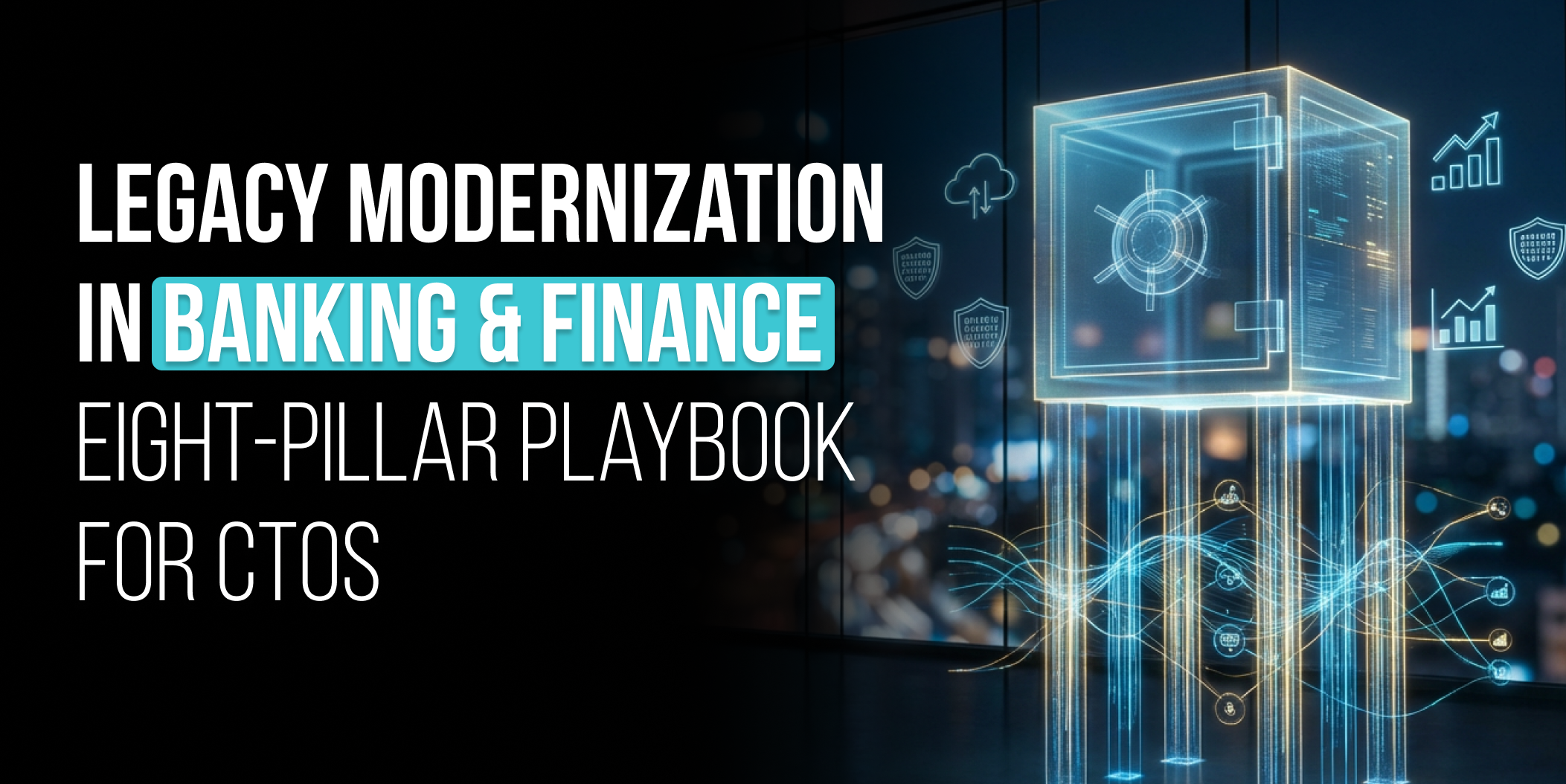
At Tezeract, we’ve developed a comprehensive banking legacy modernization playbook that transforms this complex challenge into a manageable, strategic process. Our eight pillar modernization framework provides CTOs with a clear roadmap for banking system transformation, turning what seems impossible into achievable milestones. Ready to discover how leading financial institutions are successfully navigating their modernization journey?
Eight-Pillar Playbook For Legacy Modernization In Banking
Think of your banking data as a goldmine sitting in a vault valuable but inaccessible. The first pillar of our banking legacy modernization playbook focuses on liberating this data and activating it where decisions happen. Edge computing transforms how financial institutions process information by bringing computational power closer to data sources. Instead of sending every transaction to centralized servers, smart edge nodes handle real-time fraud detection, customer authentication, and risk assessment instantly. This approach reduces latency from seconds to milliseconds, crucial for high-frequency trading and instant payment processing. Core banking systems benefit enormously from edge activation, enabling branches to operate independently even during network disruptions while maintaining seamless customer experiences.
Pillar 1: Data Activated At The Edge
Legacy monolithic systems are like massive cruise ships impressive but impossible to turn quickly. Microservices in banking represent the shift to agile speedboats, each handling specific functions independently. This pillar breaks down complex banking operations into discrete, manageable services: payment processing, account management, loan origination, and compliance monitoring. Each microservice operates independently, communicates through APIs, and can be updated without affecting the entire system. When a bank needs to integrate a new payment method or update fraud detection algorithms, they modify only the relevant microservice. This modular approach accelerates digital transformation in banking by enabling rapid feature deployment, easier maintenance, and improved system resilience. Financial institutions can now respond to market changes in weeks rather than months.
Pillar 2: Modular Microservices Ecosystem
Cloud adoption in banking isn’t just about cost savings it’s about transforming your entire business model. This pillar positions cloud native banking as the foundation for scalability, innovation, and competitive advantage. Traditional on-premises infrastructure requires massive upfront investments and lengthy procurement cycles. Cloud platforms eliminate these barriers, allowing banks to scale resources dynamically based on demand. During peak transaction periods like Black Friday, cloud infrastructure automatically provisions additional capacity, then scales down during quiet periods. Cloud native platforms also enable rapid experimentation with new financial products and services. Banks can launch pilot programs, test market response, and iterate quickly without significant infrastructure investments. The cloud becomes a business accelerator, enabling financial institutions to move from reactive to proactive market positioning while reducing operational overhead and improving disaster recovery capabilities.
Pillar 3: Cloud As Business Accelerator
You can’t improve what you can’t measure, and in banking, measurement means comprehensive observability. This pillar establishes monitoring, logging, and tracing as fundamental design principles rather than afterthoughts. Observability-first engineering provides real-time visibility into system performance, user behavior, and business metrics across your entire technology stack. Modern banking systems generate millions of events daily transactions, API calls, user interactions, and system alerts. Without proper observability, identifying performance bottlenecks or security threats becomes like finding a needle in a haystack. Comprehensive monitoring enables proactive issue resolution, reducing system downtime and improving customer satisfaction. Banks implementing observability-first approaches report 60% faster incident resolution and significantly improved regulatory compliance through automated audit trails and real-time compliance monitoring.
Pillar 4: Observability-First Engineering
Traditional banking security operated on the castle-and-moat principle strong perimeter defenses protecting trusted internal networks. Today’s distributed banking environment requires a fundamentally different approach: zero trust architecture. This pillar assumes no user, device, or network component is inherently trustworthy, requiring continuous verification for every access request. Cybersecurity in financial institutions becomes proactive rather than reactive, with every transaction, API call, and data access authenticated and authorized in real-time. Zero trust implementation includes multi-factor authentication, encrypted communications, micro-segmentation, and continuous behavioral analysis. When an employee accesses customer data, the system verifies their identity, checks their authorization level, monitors their behavior patterns, and logs every action. This approach significantly reduces the risk of both external attacks and internal threats while maintaining compliance with stringent financial regulations.
Pillar 5: Security Reimagined With Zero Trust
Artificial intelligence transforms banking from a reactive service industry to a proactive financial partner. This pillar integrates AI capabilities throughout your modernized infrastructure, automating routine tasks while optimizing complex decision-making processes. AI-driven automation handles everything from customer service chatbots to sophisticated fraud detection algorithms that analyze transaction patterns in real-time. Machine learning models continuously improve by learning from new data, becoming more accurate at predicting customer needs, assessing credit risks, and identifying suspicious activities. Financial technology innovation accelerates when AI handles routine compliance checks, regulatory reporting, and risk assessments automatically. Banks implementing comprehensive AI strategies report 40% reduction in operational costs and 25% improvement in customer satisfaction scores. The key is building AI capabilities into your modernized architecture from the ground up, ensuring seamless integration with microservices, cloud infrastructure, and data systems rather than bolting AI onto existing legacy platforms.
Pillar 6: AI-Driven Automation And Optimization
Technology transformation without people transformation is like buying a Ferrari and hiring a horse-and-buggy driver. This pillar focuses on evolving your workforce capabilities to match your modernized technology stack. Legacy system upgrade projects often fail because organizations underestimate the human element of change management. Successful workforce transformation includes comprehensive training programs, clear career progression paths, and cultural shifts toward continuous learning and innovation. Technical teams need skills in cloud technologies, microservices architecture, and modern development practices. Business teams require understanding of digital customer journeys, data-driven decision making, and agile methodologies. Leadership must embrace new management approaches that support rapid iteration and calculated risk-taking. We’ve found that banks investing equally in technology and people transformation achieve 3x better outcomes than those focusing solely on technical upgrades.
Pillar 7: Workforce Transformation
The final pillar ensures your modernization efforts create momentum for ongoing innovation rather than a one-time upgrade. This eight pillar modernization framework establishes processes, metrics, and cultural practices that sustain long-term competitive advantage. Continuous innovation requires systematic approaches to experimentation, rapid prototyping, and iterative improvement. Banks create innovation labs, establish partnerships with fintech companies, and implement feedback loops that capture customer insights and market trends. Technical debt reduction becomes an ongoing priority rather than a periodic crisis response. The innovation flywheel connects customer feedback to product development, market insights to strategic planning, and operational metrics to continuous improvement initiatives. Organizations implementing this pillar report sustained growth rates 2x higher than competitors, with improved employee engagement and customer loyalty. The banking system transformation becomes self-reinforcing, with each successful innovation building capabilities and confidence for the next breakthrough.
Pillar 8: Continuous Innovation Flywheel
Benefits Of Legacy Modernization In Banking
The benefits of legacy modernization in banking extend far beyond simple technology upgrades they represent a fundamental transformation that positions financial institutions for sustained competitive advantage. When we examine successful banking modernization initiatives, three critical advantages emerge that directly impact both operational efficiency and customer satisfaction.
First, modernized legacy systems banking infrastructure dramatically reduces operational costs while improving system reliability. Traditional core banking systems often require extensive manual maintenance, consume significant resources, and create bottlenecks that slow down critical business processes. Through strategic banking modernization, institutions typically see 30-40% reduction in infrastructure costs within the first two years, alongside improved system uptime and faster transaction processing.
Second, enhanced digital transformation in banking capabilities enable institutions to respond rapidly to market demands and regulatory changes. Modern systems built with microservices in banking architecture allow for independent component updates, reducing the risk of system-wide failures and enabling faster feature deployment. This agility proves crucial when adapting to evolving customer expectations and compliance requirements.
Third, improved cybersecurity in financial institutions becomes achievable through modern security frameworks that replace outdated, vulnerable legacy architectures. Contemporary banking systems incorporate advanced threat detection, real-time monitoring, and zero-trust security models that significantly strengthen an institution’s defense posture against increasingly sophisticated cyber threats targeting the financial sector.
How To Modernize Legacy Systems In Finance: Key Steps For CTOs
Transforming outdated financial infrastructure isn’t just about technology it’s about orchestrating a strategic evolution that positions your institution for sustained growth. As a CTO, you’re tasked with navigating this complex journey while maintaining operational stability and regulatory compliance.
The first critical step in any banking modernization initiative is conducting a comprehensive system audit. This involves mapping your current technology landscape, identifying technical debt hotspots, and quantifying the business impact of legacy constraints. We recommend starting with a detailed assessment of your core banking systems, evaluating their integration capabilities, security vulnerabilities, and scalability limitations. This foundational analysis becomes your roadmap for prioritizing modernization efforts.
Next, establish a phased transformation strategy that minimizes operational disruption. Rather than attempting a complete overhaul, successful CTOs implement incremental changes through strategic data migration strategies. Begin by identifying low-risk, high-impact components that can be modernized first typically customer-facing applications or reporting systems. This approach allows your team to build confidence and expertise while delivering immediate value to stakeholders.
Cloud native platforms represent the backbone of modern financial infrastructure. Transitioning to cloud-native architectures enables dynamic scaling, reduces infrastructure overhead, and provides the foundation for advanced analytics and AI capabilities. However, this transition requires careful planning around data sovereignty, regulatory compliance, and security protocols specific to financial institutions.
Implementing microservices in banking architecture is another crucial step that enables greater agility and resilience. By decomposing monolithic systems into smaller, independent services, you create opportunities for faster development cycles, easier maintenance, and improved fault isolation. This architectural shift supports the API-first banking approach that modern financial institutions require for seamless integration with fintech partners and third-party services.
Cybersecurity in financial institutions must be embedded throughout the modernization process, not treated as an afterthought. Adopt a zero-trust security model that assumes no implicit trust and continuously validates every transaction and user interaction. This approach becomes increasingly important as you expand your digital footprint and integrate with external systems.
Financial technology innovation accelerates when you establish proper governance frameworks for your modernization efforts. Create cross-functional teams that include business stakeholders, compliance officers, and technical experts. This collaborative approach ensures that your legacy system upgrade initiatives align with business objectives while meeting regulatory requirements.
Technical debt reduction should be viewed as an ongoing investment, not a one-time project. Establish metrics to measure code quality, system performance, and maintenance overhead. Regular technical debt assessments help you make informed decisions about when to refactor existing systems versus building new solutions.
Finally, invest in change management and workforce development. Your modernization success depends heavily on your team’s ability to adapt to new technologies and processes. Provide comprehensive training on cloud-native development, modern security practices, and agile methodologies. Consider partnering with experienced modernization specialists who can accelerate your transformation timeline while transferring knowledge to your internal teams.
Remember, successful banking system transformation isn’t measured solely by technical metrics it’s about creating a foundation that enables innovation, improves customer experiences, and positions your institution for future growth in an increasingly digital financial landscape.
Also read: How Agentic AI in Banking Is Transforming ROI Through AI Automation
Conclusion
Legacy modernization in banking isn’t just about upgrading technology itâs about transforming your entire organization for the digital future. The banking legacy modernization playbook we’ve outlined provides a structured approach to navigate this complex journey successfully.
By following our eight-pillar framework, you’re not just implementing new systems; you’re building the foundation for sustained innovation and competitive advantage. The benefits of legacy modernization in banking extend far beyond operational efficiency they unlock new revenue streams, enhance customer experiences, and position your institution as a leader in digital banking evolution.
Remember, successful legacy modernization requires strategic planning, phased execution, and strong leadership commitment. If you’re curious about how AI can enhance your modernization journey, you might find it helpful to schedule a 30-minute strategy session.