AI Summary
Generative AI app development is transforming how businesses create content, automate workflows, and deliver personalized experiences, but unpredictable costs and technical complexity often hold companies back.
Decision-makers should care because understanding generative AI app cost structures, development processes, and ROI metrics means avoiding budget overruns while capturing competitive advantages worth millions.
This guide breaks down how to build generative AI app solutions with predictable pricing ($50K-$500K+ depending on complexity), proven development frameworks, and ethical AI practices that protect your reputation.
Smart businesses focus on modular architecture, data privacy by design, and measurable performance metrics when evaluating generative AI solutions to ensure long-term value.
Future-ready companies are leveraging generative AI tools development with continuous learning capabilities, seamless system integration, and bias mitigation strategies to stay ahead of rapid technological change.
I remember sitting in a conference room last March, watching our CFO’s face turn three shades of red as our initial $80,000 generative AI project estimate ballooned to $240,000. The technical team kept discovering “essential” features we hadn’t budgeted for, and honestly, none of us really understood what we were paying for.
That painful experience taught me something crucial: generative AI app development doesn’t have to be a financial black hole if you know what you’re actually building and why. The problem is, most businesses jump into AI development with excitement but zero roadmap, and that’s where things get expensive fast.
What I’ve learned since then (through plenty of trial and error) is that successful generative AI application development follows a pretty clear pattern. You need to understand the real costs upfront, know which features actually move the needle for your business, and build with future adaptability in mind. Otherwise, you’re basically throwing money at a moving target.
This guide walks you through everything I wish someone had explained to me before we started: the actual cost breakdowns, the development process that prevents scope creep, and the benefits that justify the investment. No fluff, no overly technical jargon, just the practical stuff that helps you make smart decisions about generative AI solutions for your business.
Understanding Generative AI Applications and Their Business Impact
So what exactly are we talking about when we say generative AI apps? Well, these are applications that create new content, whether that’s text, images, code, music, or even video, based on patterns they’ve learned from existing data.
What Are Generative AI Apps Used For?
The practical applications are pretty wild when you see them in action. I’ve watched companies use generative AI business applications to automate customer service responses that actually sound human, generate product descriptions for thousands of SKUs in minutes, and create personalized marketing content at scale.
One retail client I worked with last year used a custom generative AI app to create unique product photography variations. Instead of expensive photoshoots for every seasonal campaign, their system generated hundreds of on-brand images in different settings and styles. They cut their content production costs by 67% while actually increasing output.
The Real Business Value Beyond the Hype
Now, I’ll be honest, there’s a ton of noise around AI right now. Every vendor claims their solution will revolutionize your business. But the companies actually seeing results are those focusing on specific, measurable problems.
The generative AI benefits that matter most come down to three things: speed, scale, and personalization. You can produce content or solutions faster than humanly possible, scale that production without proportionally scaling your team, and customize outputs for individual users or scenarios.
A financial services company I consulted for built a generative AI app that creates personalized investment summaries for their clients. What used to take analysts 45 minutes per client now takes 3 minutes, and the quality is actually more consistent. That’s 15x faster, which means their team can serve way more clients or focus on higher-value advisory work.
But here’s what nobody tells you: these benefits only materialize if you build the right application for the right problem. I’ve seen companies spend six figures on generative AI apps that solve problems they didn’t actually have, or worse, create new problems around data quality and user trust.
Breaking Down Generative AI App Development Costs
Alright, let’s talk money. This is where most conversations get uncomfortable because the answer to “how much does it cost to develop a generative AI app?” is genuinely “it depends.” But I can give you actual ranges and explain what drives those costs up or down.
The Real Cost Ranges You Should Expect
Based on dozens of projects I’ve been involved with, here’s what you’re actually looking at for generative AI app cost:
Simple generative AI applications (basic chatbots, simple content generators) typically run $50,000 to $100,000. These use existing models like GPT-4 or Claude with custom prompts and basic integration into your systems.
Mid-complexity applications (custom-trained models, multi-feature apps, moderate integrations) usually cost $100,000 to $300,000. This is where most businesses land when they want something tailored to their specific needs and data.
Enterprise-grade solutions (fully custom models, complex integrations, advanced security, scalability features) can run $300,000 to $500,000+. These are the sophisticated systems that become core to your business operations.
I worked with a healthcare company last fall that initially wanted a “simple” patient communication app. Once we mapped out HIPAA compliance requirements, integration with their existing EHR system, and the custom training needed for medical terminology, the realistic budget landed at $280,000. They weren’t happy, but at least there were no surprises later.
Hidden Costs That Catch Everyone Off Guard
The sticker price is just the beginning. The generative AI software cost includes ongoing expenses that can actually exceed your initial development budget over time.
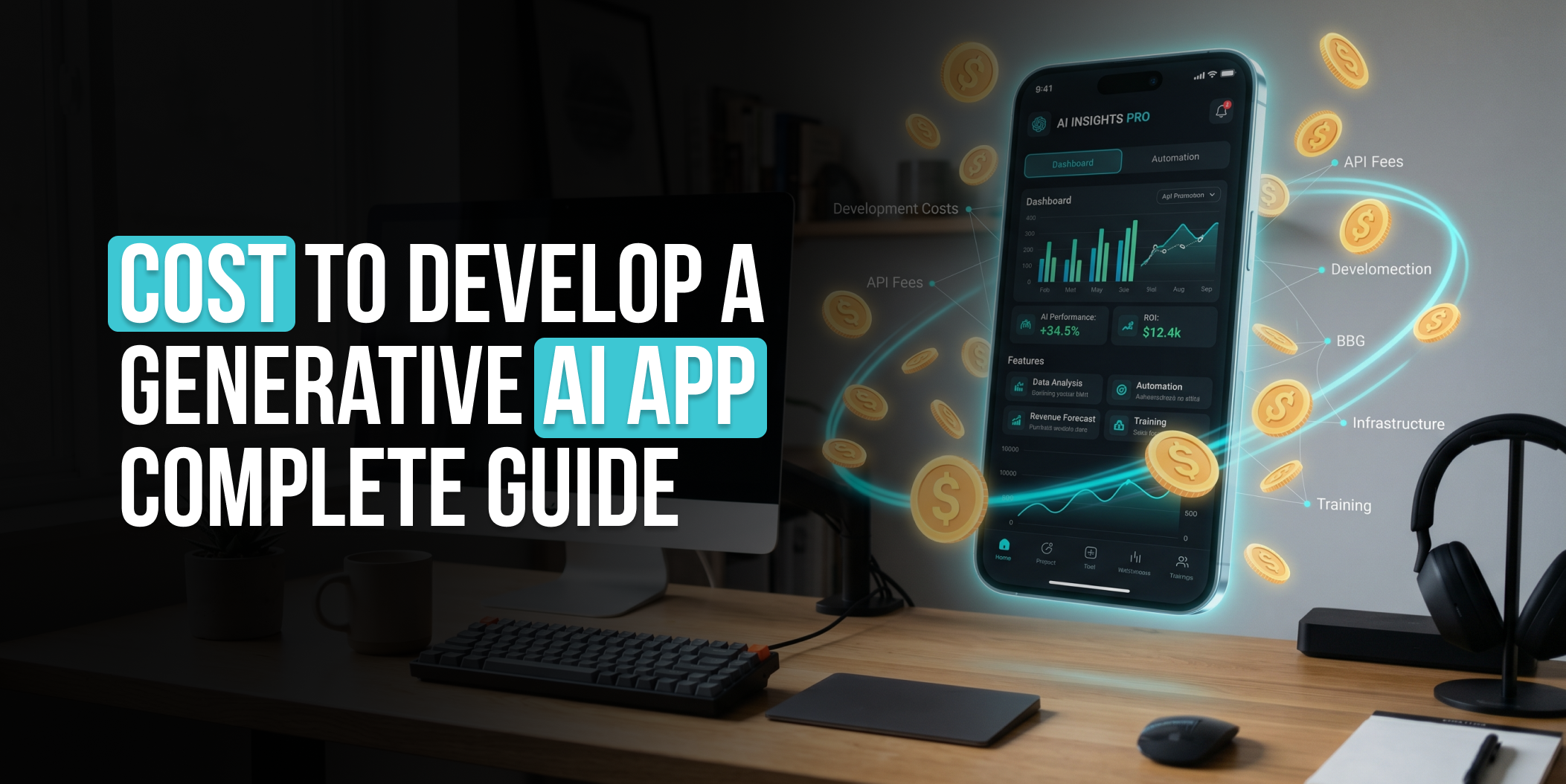
API costs for using foundation models like GPT-4 can run $500 to $5,000+ monthly depending on usage volume. One e-commerce client saw their API bills jump from $800 to $4,200 per month once they launched because user adoption exceeded projections. Good problem to have, but still a budget shock.
Infrastructure and hosting for AI applications costs more than traditional apps because of computational requirements. Expect $1,000 to $10,000+ monthly depending on scale and whether you’re using cloud services or dedicated infrastructure.
Ongoing model training and updates are essential to keep your app relevant and accurate. Budget 15-25% of your initial development cost annually for maintenance, updates, and improvements.
What Actually Drives Your Development Budget
Understanding generative AI app pricing means knowing which factors push costs up. The biggest cost drivers are customization level, data requirements, integration complexity, and security needs.
If you’re fine-tuning a model on your proprietary data, that’s significantly more expensive than using a pre-trained model with custom prompts. Data preparation alone can consume 30-40% of your development budget because AI models are incredibly picky about data quality and format.
Integration with existing systems is where budgets often explode. Connecting your new generative AI app to legacy databases, CRM systems, or other enterprise software requires custom API development and extensive testing. I’ve seen integration work take longer than building the actual AI functionality.
Security and compliance requirements multiply costs fast. If you’re handling sensitive data (financial, healthcare, personal information), expect to add 25-50% to your base development cost for proper security architecture, compliance audits, and ongoing monitoring.
The Complete Generative AI Development Process
Building a generative AI app isn’t like traditional software development. The process has some unique quirks that trip up teams who treat it like a standard web app project.
Phase 1: Discovery and Strategic Planning
The generative AI development process starts with figuring out what problem you’re actually solving. Sounds obvious, but I’ve watched companies skip this step and build technically impressive apps that nobody uses.
You need to identify specific use cases with measurable success criteria. Not “improve customer service” but “reduce average response time from 4 hours to 15 minutes while maintaining 85%+ satisfaction scores.” That specificity guides every decision that follows.
Data assessment happens early because your available data determines what’s actually possible. You need to inventory what data you have, what quality it’s in, and what gaps exist. A manufacturing client discovered they had 10 years of maintenance logs but in 47 different formats across various systems. That discovery changed their entire project scope and timeline.
Technology stack selection matters more than you’d think. Choosing between building on OpenAI’s API, using open-source models like Llama, or developing custom models from scratch has massive implications for cost, flexibility, and long-term maintenance. This is where working with experienced AI consulting services can help you navigate these critical early decisions and avoid costly mistakes down the road.
Phase 2: Design and Architecture
This is where you map out how everything will actually work. The architecture phase for generative AI tools development includes designing the user experience, planning data flows, and establishing security protocols.
User experience design for AI apps is different because you’re designing for probabilistic outputs, not deterministic ones. Your app might generate different responses to the same input, so you need to design for variability, include confidence scores, and give users control over outputs.
System architecture needs to account for scalability from day one. I learned this the hard way when a client’s app went viral internally and crashed because we’d designed for 50 concurrent users, not 500. Rebuilding for scale cost an extra $45,000 and three weeks of downtime.
Security architecture must be baked in, not bolted on. This includes data encryption, access controls, audit logging, and compliance frameworks. For generative AI data privacy, you need to decide early whether data stays on-premise, uses private cloud instances, or leverages public APIs with proper data handling agreements.
Phase 3: Development and Model Training
Now we actually build generative AI app functionality. This phase involves setting up infrastructure, developing the application logic, training or fine-tuning models, and creating integrations.
Model selection and training is where the AI magic happens. You’re either using pre-trained models with custom prompts (faster, cheaper), fine-tuning existing models on your data (moderate cost and time), or training custom models from scratch (expensive and time-intensive).
Most businesses should start with pre-trained models and custom prompting. A legal tech company I worked with got 80% of their desired functionality using GPT-4 with carefully crafted prompts and retrieval-augmented generation (RAG) to pull in their case law database. Total development time: 8 weeks instead of 6 months.
Application development wraps the AI model in user-friendly interfaces and business logic. This includes building the front-end interface, developing APIs, creating admin dashboards, and implementing monitoring systems to track performance and costs. Organizations looking for comprehensive support throughout this phase often benefit from partnering with specialists who offer end-to-end generative AI development services that handle everything from model selection to deployment.
Phase 4: Testing, Validation, and Deployment
Testing generative AI applications is more complex than traditional software because you’re testing for quality, accuracy, bias, and edge cases where the model might produce inappropriate or incorrect outputs.
Quality assurance includes functional testing (does it work?), performance testing (is it fast enough?), and output quality testing (are the results good?). You need human reviewers evaluating AI outputs against quality criteria, which is time-consuming but essential.
Bias testing and generative AI ethical considerations require checking outputs across different demographic groups, use cases, and input variations. One financial services app we tested showed subtle bias in loan recommendation language depending on applicant names, which we caught and fixed before launch.
Deployment strategy should be phased, not all-at-once. Start with a limited beta group, monitor closely, gather feedback, and iterate before full rollout. This approach has saved multiple projects from embarrassing public failures.
Essential Features for Successful Generative AI Apps
Not all features are created equal. Some generative AI app features are must-haves, while others are nice-to-haves that can wait for version 2.0.
Core Functionality That Drives Value
The foundation of any generative AI app includes the generation engine itself (the AI model producing outputs), input processing (handling and validating user inputs), and output formatting (presenting results in useful formats).
Context management is crucial for applications that need to maintain conversation history or understand user intent across multiple interactions. A customer service chatbot that forgets what you said two messages ago is basically useless.
Feedback mechanisms let users rate outputs, report issues, or request regeneration. This feedback becomes training data for improving your model over time. One content generation app I worked on improved output quality by 34% over six months purely from user feedback integration.
Advanced Features Worth the Investment
Multi-modal capabilities (handling text, images, audio, or video) expand what your app can do but add significant complexity and cost. Only invest here if your use case genuinely requires it.
Personalization engines that adapt outputs based on user preferences, history, or context create stickier applications with higher engagement. An e-learning platform using personalized content generation saw completion rates jump from 42% to 71%.
Analytics and insights dashboards help you understand how your app is being used, where it’s succeeding, and where it’s failing. This data is gold for justifying continued investment and guiding improvements.
Integration capabilities with existing tools (CRM, marketing automation, project management) make your generative AI app part of existing workflows rather than another separate tool. Seamless integration is often the difference between adoption and abandonment. If you’re looking to connect AI capabilities with your current technology stack, specialized AI integration services can ensure your new generative AI solution works harmoniously with legacy systems and modern platforms alike.
Security and Compliance Features
Data encryption (in transit and at rest) is non-negotiable for any application handling sensitive information. This includes encrypting user inputs, AI outputs, and any stored conversation history.
Access controls and authentication ensure only authorized users can access your app and its data. Role-based permissions let you control who can do what within the application.
Audit logging tracks every interaction, input, output, and system event for compliance and troubleshooting. Financial services and healthcare applications especially need comprehensive audit trails.
Compliance frameworks for GDPR, HIPAA, SOC 2, or industry-specific regulations must be built into the architecture. Retrofitting compliance is exponentially more expensive than building it in from the start.
Overcoming Common Implementation Challenges
Every generative AI project hits roadblocks. Knowing the common generative AI implementation challenges ahead of time helps you avoid or minimize them.
Tackling the Technical Complexity and Skill Gap
The biggest challenge most companies face is simply not having the right expertise in-house. Generative AI requires knowledge of machine learning, natural language processing, cloud infrastructure, and software engineering, which is a rare combination.
Your options are building an internal team (expensive and slow), hiring consultants (faster but costly), or partnering with a development firm specializing in custom generative AI solutions (balanced approach for most businesses).
Low-code and no-code platforms are emerging that let less technical teams build basic generative AI applications. Tools like Bubble with AI plugins or specialized platforms like Voiceflow can get you to a working prototype without a full engineering team.
What worked for a mid-size insurance company I advised: they hired one senior AI engineer to lead strategy and architecture, then used a development partner for implementation, and trained their existing developers on maintenance. This hybrid approach cost 40% less than building a full internal team. Companies exploring this path often find that engaging with experienced AI experts who understand both the technical and business dimensions can bridge the knowledge gap effectively.
Ensuring Data Privacy and Security
Data privacy concerns are legitimate and serious. When you send data to AI models, especially third-party APIs, you need to know exactly what happens to that data.
For generative AI data privacy, implement data anonymization before sending information to AI models. Strip personally identifiable information, use tokenization, or employ differential privacy techniques to protect sensitive data.
Private deployment options like Azure OpenAI Service or AWS Bedrock keep your data within your cloud environment and don’t use it for model training. This costs more than public APIs but provides necessary privacy guarantees for regulated industries.
Data retention policies should specify how long you keep user inputs, AI outputs, and conversation histories. Many companies default to keeping everything forever, which creates unnecessary privacy risk and storage costs.
Addressing Ethical Concerns and Bias
Bias in AI outputs is real and can cause serious problems. Models trained on internet data inherit societal biases present in that data, which can manifest in your application’s outputs.
Bias detection requires systematic testing across different demographic groups, use cases, and edge cases. You need diverse testing teams who can spot subtle biases that might not be obvious to homogeneous groups.
Mitigation strategies include using diverse training data, implementing bias detection algorithms, adding human review for sensitive outputs, and providing clear disclaimers about AI-generated content.
One hiring platform we worked with discovered their job description generator used subtly gendered language that could discourage certain applicants. We implemented a bias detection layer that flags potentially problematic language before outputs reach users.
Achieving Seamless System Integration
Getting your new generative AI app to play nicely with existing systems is often harder than building the AI functionality itself. Legacy systems weren’t designed with AI integration in mind.
API-first architecture makes integration easier by exposing your AI functionality through well-documented APIs that other systems can call. This approach lets you integrate with CRM, ERP, marketing automation, or custom internal tools.
Middleware solutions can bridge gaps between your AI app and legacy systems that don’t have modern APIs. Tools like MuleSoft or custom integration layers handle data transformation and routing.
Phased integration approach works better than trying to connect everything at once. Start with one critical integration, get it working smoothly, then add others. A logistics company integrated their generative AI routing optimizer with their dispatch system first, then added warehouse management, then customer notifications over three months. For organizations looking to streamline operations while implementing AI, combining generative AI with broader business process automation services can create compound efficiency gains across multiple departments.
Measuring and Maximizing Your Generative AI ROI
The question “is generative AI worth the investment?” can only be answered with data. You need clear metrics and measurement frameworks from day one.
Defining Success Metrics That Matter
Quantifiable generative AI ROI comes from measuring specific business outcomes, not just technical metrics. Focus on metrics that tie directly to revenue, cost savings, or strategic goals.
Efficiency metrics track time saved, volume increases, or resource optimization. A content marketing team using generative AI for first drafts measured a 60% reduction in time-to-publish and a 3x increase in content output with the same team size.
Quality metrics assess output accuracy, user satisfaction, and error rates. These are harder to measure but equally important. One legal research app tracked how often lawyers accepted AI-generated summaries without edits (started at 45%, reached 78% after six months of improvements).
Business impact metrics connect AI performance to actual business results: revenue generated, costs reduced, customers acquired, or churn prevented. These are the numbers that justify continued investment.
Calculating Total Cost of Ownership
True ROI calculation requires understanding total cost of ownership, not just initial development costs. Include development costs, ongoing API and infrastructure expenses, maintenance and updates, team training, and opportunity costs.
A realistic TCO calculation for a mid-complexity generative AI app over three years might look like: $200K initial development + $60K annual infrastructure and APIs + $40K annual maintenance = $500K total. If that app saves $250K annually in labor costs, you break even in year two and generate $250K net value in year three.
Strategies for Maximizing Value
Start with high-impact, low-complexity use cases to generate quick wins and build organizational confidence. Success breeds support for more ambitious projects.
Continuous improvement based on user feedback and performance data compounds value over time. The difference between a static AI app and one that improves monthly is dramatic. One customer service app reduced average handling time by 12% in year one, then another 18% in year two through continuous optimization.
Expand use cases once you have a working platform. The infrastructure and expertise you build for one application can often support multiple use cases with incremental investment. A content generation platform built for marketing expanded to sales enablement, then HR communications, multiplying value without proportional cost increases. To see how other organizations have achieved measurable results, exploring detailed AI case studies can provide valuable insights into realistic timelines, challenges overcome, and ROI achieved across different industries.
Best Practices for Generative AI Development Success
After watching dozens of projects succeed and fail, certain patterns emerge. These best practices for generative AI development separate successful implementations from expensive failures.
Start with Clear Business Objectives
Every successful project I’ve seen started with crystal-clear business objectives and success criteria. Not “explore AI” but “reduce customer support costs by 30% while maintaining satisfaction above 4.2/5.”
Document your objectives, get stakeholder alignment, and revisit them regularly throughout development. Scope creep happens when objectives are fuzzy or forgotten.
Prioritize Data Quality Over Quantity
More data isn’t always better. Clean, relevant, well-structured data beats massive volumes of messy data every time. One client spent $80K cleaning and structuring their data before development started, which seemed expensive until we saw how much faster and better the resulting app performed.
Invest in data preparation, validation, and ongoing quality monitoring. Your AI app is only as good as the data it learns from and operates on.
Build for Iteration and Improvement
Your first version won’t be perfect, and that’s fine. Build with modularity and flexibility so you can improve components without rebuilding everything.
Implement feedback loops, A/B testing capabilities, and performance monitoring from day one. These enable continuous improvement that compounds value over time.
Focus on User Experience
The most technically impressive AI is worthless if users don’t adopt it. Design for your actual users, not for AI engineers. Make interfaces intuitive, provide clear guidance, and set appropriate expectations about what the AI can and cannot do.
User testing throughout development catches usability issues early when they’re cheap to fix. One app we built tested beautifully with the development team but confused actual users because we used technical terminology they didn’t understand. Two days of user testing saved us from a failed launch.
Plan for Governance and Oversight
Establish clear governance around who can access the AI app, how outputs are reviewed, and what happens when things go wrong. This includes incident response plans for when the AI generates problematic outputs.
Human oversight for high-stakes decisions is essential. AI should augment human judgment, not replace it entirely, especially for decisions with significant consequences.
Future-Proofing Your Generative AI Investment
The AI landscape changes fast. What’s cutting-edge today might be obsolete in 18 months. Building with adaptability in mind protects your investment.
Modular Architecture for Easy Updates
Design your application with modular components that can be swapped or upgraded independently. This lets you adopt new models or capabilities without rebuilding everything.
A modular approach means you can switch from GPT-4 to GPT-5 (or whatever comes next) by updating one component, not rewriting your entire application. This flexibility is worth the extra planning time upfront.
Vendor Independence Where Possible
Avoid deep dependencies on single vendors or platforms when you can. Use abstraction layers that let you switch underlying AI models or infrastructure providers without major rewrites.
One company built their entire app around a specific AI vendor’s API, then that vendor changed pricing and terms dramatically. Migrating to an alternative cost them $120K and three months. A vendor-agnostic architecture would have made that switch trivial.
Continuous Learning Capabilities
Build systems that can learn and improve from usage data. This might mean fine-tuning models on new data, updating prompt strategies based on performance, or adjusting business logic based on user behavior.
Continuous learning keeps your app relevant as your business evolves, user needs change, and new capabilities emerge.
Staying Current with AI Advancements
Dedicate resources to monitoring AI developments and evaluating new capabilities. This doesn’t mean chasing every shiny new model, but staying informed about advancements that could significantly improve your application.
Quarterly technology reviews work well for most organizations. Assess new models, tools, or techniques that have emerged, evaluate their potential impact on your application, and decide whether to incorporate them.
Choosing the Right Development Partner
Unless you have extensive in-house AI expertise, you’ll likely need external help. Choosing the right partner for generative AI application development dramatically impacts your success.
What to Look for in a Development Partner
Proven experience with generative AI projects (not just general software development) is essential. Ask for case studies, references, and examples of similar projects they’ve completed.
Technical expertise across the full stack matters: AI/ML engineering, software development, cloud infrastructure, security, and your specific industry domain. A partner who understands both the technology and your business context delivers better results.
Transparent communication and pricing prevent the budget surprises that plague AI projects. Good partners provide detailed estimates, explain cost drivers clearly, and flag potential issues early. Organizations like Tezeract specialize in helping businesses navigate the complexities of AI adoption with comprehensive AI development services that cover everything from strategy to deployment, ensuring you have expert guidance throughout your generative AI journey.
Questions to Ask Potential Partners
What generative AI projects have you completed in our industry? How do you handle data privacy and security? What’s your approach to bias detection and mitigation? How do you structure pricing and handle scope changes? What does your post-launch support look like?
Their answers reveal whether they understand the unique challenges of generative AI development and have processes to address them.
Red Flags to Avoid
Overpromising on timelines or capabilities is a huge red flag. Generative AI development has inherent uncertainties, and partners who guarantee specific outcomes or unrealistic timelines are either inexperienced or dishonest.
Lack of security or compliance expertise is dangerous if you’re handling sensitive data. Don’t trust partners who treat security as an afterthought.
Unwillingness to provide references or case studies suggests they don’t have relevant experience or their previous clients weren’t satisfied.
What to Do Next: Your Generative AI Development Roadmap
You’ve got the knowledge, now here’s how to actually move forward with your generative AI adoption strategy.
What to Do Next:
Define your specific use case and success metrics. Don’t start with “we need AI.” Start with “we need to reduce customer support response time by 40% while maintaining quality.” Specific problems lead to specific solutions with measurable results.
Assess your data readiness and quality. Inventory what data you have, what condition it’s in, and what gaps exist. This assessment often reveals whether your project is feasible and what preparation work is needed before development starts.
Develop a realistic budget including ongoing costs. Use the cost ranges in this guide as starting points, then refine based on your specific requirements. Include development, infrastructure, maintenance, and a 20% contingency buffer for unexpected needs.
Evaluate build vs. buy vs. partner options. Consider whether existing solutions meet your needs, whether you have internal capability to build, or whether partnering with specialists makes sense. Most mid-size businesses find partnering delivers the best balance of cost, speed, and quality. For organizations still exploring their options, reviewing frequently asked questions about AI implementation can clarify common concerns and help you make more informed decisions about your approach.
Start with a proof of concept before full development. A 4-8 week POC validates your approach, tests feasibility, and provides concrete data for decision-making. This small investment prevents large mistakes and builds organizational confidence.
The companies winning with generative AI aren’t necessarily the ones with the biggest budgets or most technical expertise. They’re the ones who start with clear objectives, build systematically, measure rigorously, and improve continuously. That approach works whether you’re spending $50K or $500K.
Generative AI app development isn’t magic, and it’s not a silver bullet. But when you match the right technology to the right problem with realistic expectations and solid execution, the results can genuinely transform how your business operates. Just make sure you understand what you’re building and why before you write the first check.
Conclusion
Generative AI app development offers strong benefits, from improving user experience to automating content, support, and internal workflows. The cost depends on your app’s features, data needs, and level of customization, but with the right plan, it can deliver long-term value and efficiency.
If you are planning to build a generative AI app and want a clear view of costs, timelines, and expected outcomes, expert guidance can make the process smoother.
Book a call with our team to discuss your idea and get a tailored plan for your generative AI app development.