TL;DR
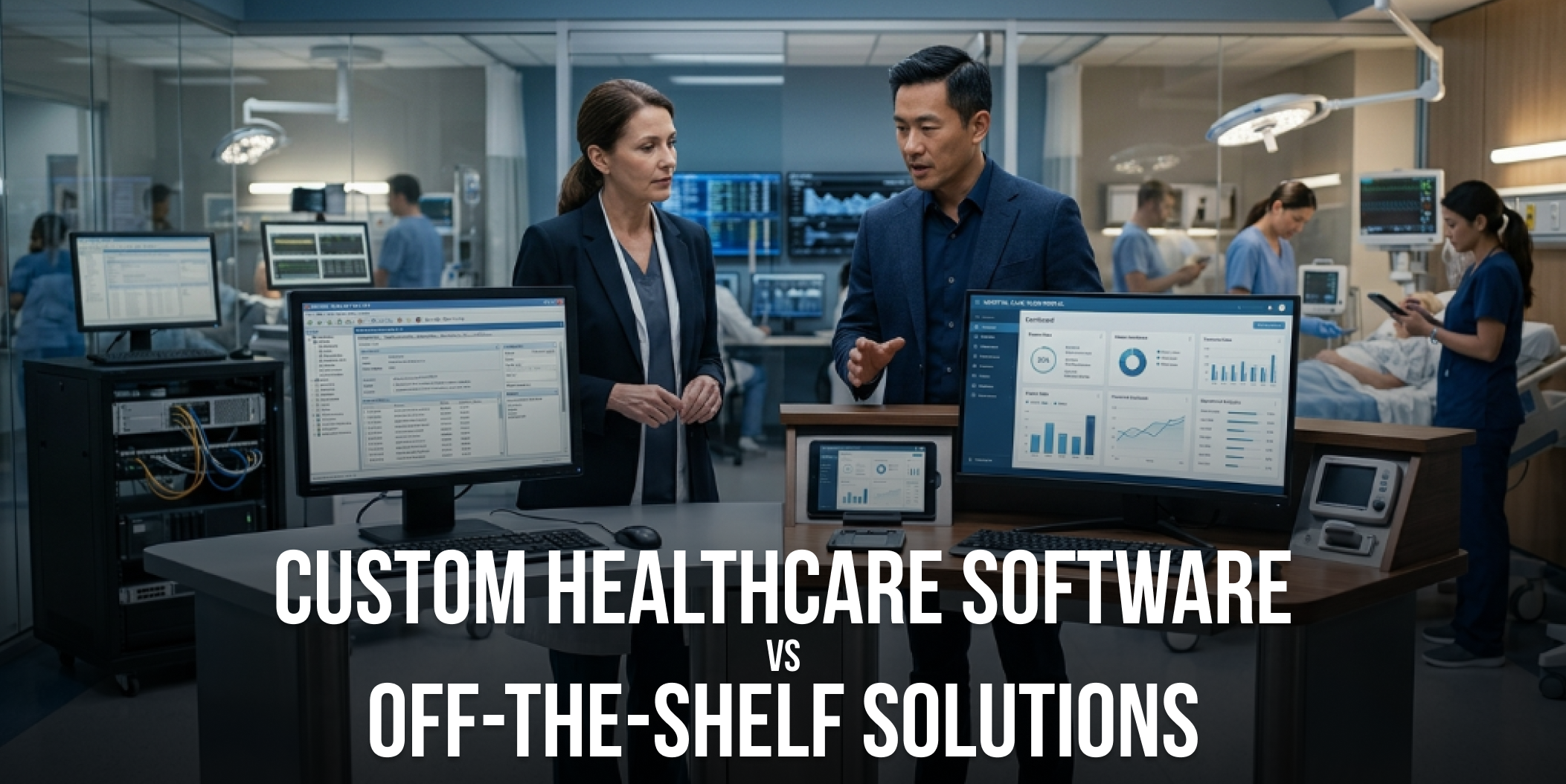
Custom healthcare AI software vs off-the-shelf solutions isn’t just a tech decision, it’s a strategic choice that impacts patient care, operational efficiency, and your bottom line.
Healthcare leaders should care because custom AI delivers seamless EHR integration, HIPAA-compliant security, and workflows tailored to your exact processes, eliminating the costly workarounds and data silos that plague generic solutions.
Our analysis reveals that while off-the-shelf software seems cheaper upfront, custom healthcare software delivers lower total cost of ownership, better user adoption, and competitive differentiation you can’t get from widely available tools.
Making the right choice means evaluating integration capabilities, scalability, compliance requirements, and long-term ROI, not just sticker price.
Forward-thinking organizations are choosing bespoke healthcare software to future-proof operations, leverage proprietary data, and deliver personalized medicine that sets them apart in an increasingly competitive market.
The Real Cost of “Good Enough” Healthcare Software
I was talking to a hospital CIO last month who looked absolutely exhausted. She’d just spent six months trying to make an off-the-shelf AI solution work with their existing systems. “We thought we were saving money,” she told me. “Turns out we just bought ourselves a very expensive headache.”
Sound familiar? You’re not alone. The custom vs off-the-shelf healthcare software debate keeps healthcare leaders up at night, and honestly, it should. This decision affects everything from patient outcomes to your organization’s ability to compete five years from now.
Here’s what most people get wrong about this choice. They look at the upfront price tag and think off-the-shelf wins. But that’s like buying a suit off the rack for your wedding because it’s cheaper than tailored, sure, you’ll have something to wear, but you’ll spend the whole day tugging at the collar and wishing it fit right.
Why This Decision Matters More Than Ever
The healthcare landscape is changing faster than ever. Personalized medicine AI software isn’t science fiction anymore, it’s what patients expect. Data privacy regulations are getting stricter. Your competitors are finding ways to do more with less. And your staff? They’re drowning in systems that don’t talk to each other.
The thing is, choosing between custom healthcare software and off-the-shelf solutions isn’t really about software at all. It’s about whether you’re willing to bend your entire operation to fit someone else’s idea of how healthcare should work, or if you’re ready to build something that actually serves your patients and staff the way they need.
The Hidden Traps of Off-the-Shelf Healthcare Solutions
Let me tell you about the stuff nobody mentions in those glossy vendor presentations. The problems that show up three months after implementation, when it’s too late to back out.
When Your Workflows Don’t Fit the Box
Off-the-shelf healthcare software comes with built-in assumptions about how you work. The problem? Your cardiology department doesn’t operate like every other cardiology department. Your patient intake process has quirks that make sense for your community. Your specialists have workflows they’ve refined over years.
But generic solutions don’t care about that. They force you into their mold. I’ve watched nurses develop elaborate workarounds, printing data from one system, manually entering it into another, keeping shadow spreadsheets to track what the official system misses. It’s maddening, and it’s dangerous.
One clinic I worked with was using an off-the-shelf solution that required 47 clicks to complete a routine patient check-in. Forty-seven. Their custom replacement? Twelve clicks. That’s not just convenience, that’s hours of staff time returned every single day.
The Integration Nightmare Nobody Warns You About
Here’s where things get really messy. You’ve got your EHR system, your billing platform, your lab systems, your imaging software. Now you want to add AI capabilities. The off-the-shelf vendor promises “seamless integration.”
Spoiler alert: It’s never seamless.
Integrating AI with existing EMR systems using generic solutions typically requires middleware, custom APIs, and ongoing maintenance that wasn’t in the original quote. You end up with data living in multiple places, none of them talking to each other properly. Your doctors can’t see the complete patient picture because information is scattered across systems that barely communicate.
The Scalability Problem That Sneaks Up on You
Right now, your off-the-shelf solution might be working okay. But what happens when you open that new wing? When you acquire another practice? When regulations change and you need new capabilities?
Generic healthcare software solutions aren’t built to grow with you. They’re built to serve the average customer, and you’re not average. You’re unique, with specific growth plans and challenges.
I’ve seen organizations hit a wall where their off-the-shelf system simply couldn’t scale. They faced a choice: limit their growth or rip everything out and start over. Both options are terrible. Both are expensive. Both could have been avoided with scalable AI solutions for hospitals designed from the start to evolve.
Why Custom Healthcare AI Software Changes Everything
Now let’s talk about what happens when you build something specifically for your organization. This is where things get exciting.
Workflows That Actually Make Sense
Custom software for healthcare starts with your reality, not someone else’s template. Your developers sit with your staff, watch how they actually work, identify the pain points, and build solutions that fit like a glove.
That cardiology department with the unique workflow? Custom software adapts to them. The intake process that serves your specific patient population? Built right in. The reporting your administrators actually need? Not buried under features you’ll never use.
One hospital I know built a custom AI system that reduced their diagnostic imaging review time by 60%. Not because the AI was magic, but because it was designed specifically for their radiologists’ workflow, their equipment, and their patient mix. An off-the-shelf solution would have given them generic capabilities that sort of worked for everyone and perfectly worked for no one.
Integration That Actually Works
Here’s the beautiful thing about bespoke healthcare software, it’s built from day one to work with your existing systems. Not through clunky middleware or fragile APIs, but through proper integration designed specifically for your tech stack.
Your custom solution knows your EHR system intimately. It speaks the same language as your billing platform. It pulls data from your labs without the manual intervention that makes your IT team want to quit.
The result? A single source of truth. Complete patient records. Clinicians who can actually see everything they need without clicking through five different systems. Data privacy in custom healthcare AI that’s built into the architecture, not bolted on as an afterthought.
Built to Grow With You
Custom healthcare software solutions are designed with your future in mind. New location? The system scales. New service line? Add the capabilities you need. Regulations change? Update the specific modules affected without touching everything else.
This isn’t theoretical. I watched a regional health system grow from three locations to twelve over five years using custom AI. Their off-the-shelf competitors? They had to replace their systems twice in that same period. The custom solution just kept evolving, adding features, scaling capacity, adapting to new requirements.
The efficiency gains from custom healthcare AI compound over time. Every optimization, every workflow improvement, every integration builds on what came before. You’re not starting over every few years, you’re continuously improving.
Start Your Healthcare AI Development Journey
Explore how custom AI can improve healthcare operations, reduce manual work, and support better decisions. Get expert guidance on your next AI project.
✅ HIPAA compliant. NDA ready.
✅ 100% confidential.
✅ 30 minutes. No obligation
The Security and Compliance Advantage You Can’t Ignore
Let’s talk about something that should terrify every healthcare leader: data breaches and compliance failures.
HIPAA Compliance That’s Actually Built In
Off-the-shelf solutions claim HIPAA compliance, and technically they might be. But “technically compliant” and “designed for your specific compliance needs” are very different things.
Custom solutions let you build data privacy in custom healthcare AI from the ground up. You decide exactly how data flows, who can access what, how long information is retained, and how it’s protected. You’re not hoping the vendor’s generic security measures cover your specific use cases, you know they do because you built them that way.
Regional and Specialty-Specific Requirements
If you operate in multiple states, you know that compliance isn’t one-size-fits-all. California has different requirements than Texas. European patients require GDPR compliance on top of HIPAA. Behavioral health has additional privacy layers.
Generic solutions try to be everything to everyone, which often means they’re not quite right for anyone. Custom software lets you build exactly the compliance framework you need for your specific situation. No paying for features you don’t need, no gaps in coverage for requirements that matter to you.
The User Experience Factor That Makes or Breaks Adoption
You know what kills healthcare technology faster than anything else? When the people who have to use it every day hate it.
Interfaces Designed for Your Actual Users
Nurses don’t work like doctors. Administrators don’t work like clinicians. Front desk staff don’t work like billing specialists. But off-the-shelf solutions give everyone basically the same interface with minor variations.
Custom healthcare software lets you design role-specific experiences. Your ER docs get the fast, streamlined interface they need for quick decisions. Your researchers get the deep data access and analysis tools they require. Your billing team gets workflows optimized for their specific processes.
I’ve seen user adoption rates jump from 60% to 95% when organizations switched from generic to custom solutions. That’s the difference between technology that fights you and technology that helps you.
Training That Actually Sticks
Here’s something nobody talks about: training costs for off-the-shelf solutions are brutal. You’re teaching people to work around the software’s limitations, to remember which workarounds apply to which situations, to navigate interfaces that don’t match their mental models.
Custom solutions that match your workflows? Training is intuitive because the software works the way your staff already thinks. New employees get up to speed faster. Mistakes decrease. Satisfaction increases.
One clinic reduced their training time from two weeks to three days by switching to custom software. That’s not just cost savings, that’s new staff becoming productive almost immediately instead of struggling for weeks.
The Real Economics: Total Cost of Ownership
Okay, let’s talk money. Because I know what you’re thinking: “Custom sounds great, but it must cost a fortune.”
The Hidden Costs of “Cheap” Solutions
That off-the-shelf solution with the attractive monthly fee? Let’s add up what you’re really paying:
- Licensing fees that increase every year
- Per-user costs that explode as you grow
- Integration expenses for every system it needs to talk to
- Customization fees for basic features you need
- Training costs that never end because the interface is confusing
- IT overhead maintaining workarounds and manual processes
- Lost productivity from inefficient workflows
- Opportunity costs from features you can’t implement
The ROI of Building It Right
Custom healthcare AI software requires upfront investment, no question. But you’re building an asset that appreciates, not renting a tool that depreciates.
You own the code. You control the roadmap. You capture the efficiency gains. You don’t pay for features you’ll never use. You don’t wait for the vendor to maybe add the capability you desperately need.
Plus, the benefits of custom AI in healthcare compound. Every workflow optimization saves time. Every integration eliminates manual work. Every user experience improvement increases adoption. These gains build on each other year after year.
Competitive Advantage You Can’t Buy Off the Shelf
Here’s something that keeps me up at night on behalf of healthcare organizations using generic solutions: If your competitors can buy the same software you’re using, where’s your competitive edge?
Differentiation Through Technology
Custom healthcare software solutions let you build capabilities that are uniquely yours. That specialized diagnostic tool that leverages your specific patient data? Competitive advantage. That patient engagement platform designed for your community’s demographics? Differentiation. That operational efficiency system optimized for your exact processes? Market leadership.
I know a specialty clinic that built custom AI for a specific rare disease. Their diagnostic accuracy and treatment planning capabilities became so advanced that they started attracting patients from across the country. Their competitors using off-the-shelf solutions? Still offering the same generic care as everyone else.
Innovation at Your Pace
With off-the-shelf software, you innovate when the vendor decides to innovate. With custom solutions, you innovate when you’re ready, in the directions that matter to your strategy.
Want to experiment with a new approach to personalized medicine AI software? Build it. See an opportunity in a specific patient population? Create tools for it. Identify a workflow bottleneck? Fix it immediately instead of submitting a feature request that might get addressed in two years.
This agility is the competitive advantage with custom healthcare AI that off-the-shelf solutions simply cannot provide. You’re not waiting for permission or hoping your needs align with the vendor’s roadmap. You’re in control.
Making the Decision: Custom vs Off-the-Shelf Healthcare Software
So how do you actually decide? Here’s the framework I use when advising healthcare organizations.
When Off-the-Shelf Might Work
Look, I’m not saying off-the-shelf is always wrong. For very small practices with standard workflows, limited budgets, and no plans for significant growth, a generic solution might be adequate. If you’re doing exactly what everyone else does and that’s your strategy, off-the-shelf could work.
But be honest about the limitations you’re accepting. You’re trading long-term flexibility for short-term convenience. You’re betting that your needs won’t evolve significantly. You’re accepting that you’ll never have a technology advantage over competitors.
For a deeper dive into this decision-making process, you might find it helpful to explore how custom AI services compare to off-the-shelf solutions across different business contexts.
When Custom Is the Clear Choice
Custom healthcare software makes sense when:
- You have unique workflows that drive your competitive advantage
- Integration with existing systems is critical
- You’re planning significant growth or expansion
- Compliance requirements are complex or specialized
- User adoption of current systems is poor
- You need capabilities that don’t exist in off-the-shelf solutions
- Long-term cost control matters more than upfront savings
- You want technology as a strategic differentiator
Basically, if you’re serious about using technology to improve patient outcomes, operational efficiency, and competitive position, custom is the way to go.[IMAGE REQUIRED: Decision tree flowchart helping healthcare leaders choose between custom and off-the-shelf solutions based on key criteria] [IMAGE ALT TAG: custom-vs-off-the-shelf-healthcare-software-decision-guide]
What to Look for in a Custom Development Partner
Choosing to go custom is step one. Choosing the right partner is step two, and it’s just as important.
You want a team that:
- Understands healthcare operations, not just technology
- Has proven experience with healthcare compliance and security
- Starts with your problems, not their preferred tech stack
- Provides transparent pricing and realistic timelines
- Shows you working solutions, not just prototypes
- Offers ongoing support and evolution, not just initial development
- Acts as a strategic partner, not just a vendor
When evaluating potential partners, look for organizations that specialize in healthcare software development and have a proven track record of delivering production-ready solutions that actually work in complex healthcare environments.
Looking for Custom Healthcare AI Software?
Build AI software around your workflows, data, and patient care needs. Our team helps healthcare providers create secure and scalable custom solutions.
✅ HIPAA compliant. NDA ready.
✅ 100% confidential.
✅ 30 minutes. No obligation
How Tezeract Builds Custom AI-Powered Healthcare Solutions From Scratch
When you’re ready to move beyond the limitations of off-the-shelf solutions, you need a partner who gets it. Someone who understands that healthcare AI isn’t about flashy demos, it’s about solutions that work in production, deliver measurable results, and actually solve your specific problems.
Tezeract stands out in the custom healthcare software space for their production-first approach. Unlike agencies that hand you a prototype and wish you luck, Tezeract focuses exclusively on AI solutions that work in real-world healthcare environments and deliver measurable ROI from day one.
The Problem-First Methodology
Here’s what makes Tezeract different: they don’t start by asking what technology you want. They start by understanding your actual business challenges. What’s keeping your clinicians up at night? Where are your operational bottlenocks? What compliance requirements are you struggling with?
This problem-first methodology means you get solutions designed for your reality, not technology looking for a problem to solve. They’ve delivered 300+ projects across healthcare, finance, retail, and legal sectors, bringing deep cross-industry expertise to healthcare challenges. Their approach to proven AI solutions for healthcare problems focuses on addressing real operational pain points rather than implementing technology for technology’s sake.
Transparent Pricing and Rapid Validation
One of the biggest frustrations with custom development? Not knowing what you’re actually going to pay until you’re already committed. Tezeract provides transparent pricing (typically $50K-$100K range depending on scope) and uses rapid prototyping to validate AI feasibility before major investment.
You’re not betting your budget on a hope. You’re seeing proof of concept, validating ROI potential, and making informed decisions based on actual results, not vendor promises.
End-to-End Ownership
From initial design through deployment and ongoing optimization, Tezeract maintains ownership of your success. They’re not just developers who disappear after launch, they’re thinking partners invested in your long-term outcomes.
Their healthcare expertise includes seamless EHR integration, HIPAA-compliant architecture, and scalable solutions that grow with your organization. Whether you’re looking to implement predictive analytics in healthcare or streamline AI in healthcare administration, they understand the unique challenges of addressing complex healthcare needs with AI and build systems that actually work in demanding clinical environments.
As a leading AI development company, Tezeract brings expertise in custom AI development, machine learning, natural language processing, computer vision, and AI automation, all tailored specifically for healthcare applications. They build end-to-end AI solutions that automate business processes, improve efficiency, support decision-making, and create more control in daily operations.
Best for: Mid-market healthcare organizations and enterprises seeking a strategic AI partner who acts as a thinking partner, not just developers. Ideal for organizations that need AI solutions that actually ship, scale, and deliver ROI, not prototypes that gather dust.
Ready to Build Healthcare AI That Actually Works?
Stop settling for generic solutions that force you to adapt to their limitations. Let’s build custom AI that adapts to your workflows, integrates with your systems, and delivers the competitive advantage you need.
Schedule a free consultation with Tezeract’s healthcare AI experts. We’ll analyze your specific challenges, validate AI feasibility for your use cases, and show you exactly how custom solutions can transform your operations.
Get Your Free Healthcare AI Assessment
The Future of AI in Healthcare Operations
Let’s look ahead, because the future of AI in healthcare operations is arriving faster than most people realize.
Personalized Medicine at Scale
We’re moving toward a world where treatment plans are tailored to individual genetic profiles, lifestyle factors, and real-time health data. Off-the-shelf solutions can’t deliver this level of personalization, they’re built for population-level care, not individual optimization.
Custom AI systems can integrate genomic data, continuous monitoring inputs, and treatment response patterns to create truly personalized care protocols. This isn’t science fiction, it’s happening now in organizations with bespoke AI for healthcare providers.
Predictive and Preventive Care
The next frontier is predicting health issues before they become crises. Custom AI can analyze your specific patient population, identify risk patterns unique to your community, and enable proactive interventions.
Generic solutions offer basic predictive analytics. Custom solutions can build models trained on your data, optimized for your patient mix, and integrated with your care delivery workflows. The difference in accuracy and actionability is substantial.
Operational Intelligence
Beyond clinical care, AI is transforming healthcare operations. Custom systems can optimize staffing based on your specific patterns, predict equipment maintenance needs for your exact inventory, and streamline supply chains for your unique requirements.
According to McKinsey research, AI-driven operational improvements can reduce healthcare costs by 15-20% while improving outcomes. But those gains require solutions tailored to your specific operations, not generic tools.
Common Myths About Custom Healthcare Software
Before we wrap up, let’s bust some myths that keep organizations stuck with inadequate solutions.
Myth 1: Custom Takes Forever to Build
Reality: With modern development practices and experienced partners, you can have working custom solutions in months, not years. Tezeract’s rapid prototyping approach validates concepts in weeks, with production deployment in 3-6 months for most projects.
Compare that to the 6-12 months many organizations spend trying to make off-the-shelf solutions work with their existing systems, and custom actually gets you to value faster.
Myth 2: You Need a Huge IT Team to Maintain Custom Software
Reality: Well-built custom solutions are often easier to maintain than off-the-shelf systems with their complex integrations and workarounds. Plus, you’re not dependent on vendor support schedules, you control maintenance priorities and timelines.
Myth 3: Off-the-Shelf Is Always Cheaper
We’ve covered this, but it bears repeating: upfront cost and total cost of ownership are very different things. When you factor in licensing, integration, customization, training, and opportunity costs, custom often delivers better ROI within 2-3 years.
Myth 4: Custom Means Starting From Zero
Reality: Good custom development leverages proven frameworks, existing integrations, and battle-tested components. You’re not reinventing the wheel, you’re building on solid foundations tailored to your needs.
Taking the Next Step
So where does this leave you? Probably with a clearer picture of why custom healthcare AI software vs off-the-shelf isn’t really a fair fight, at least not for organizations serious about using technology strategically.
The question isn’t whether custom is better. The question is whether you’re ready to invest in solutions that actually fit your organization, serve your patients effectively, and position you for long-term success.
What to Do Next
Audit your current systems: Document the workarounds, integration issues, and limitations you’re living with. Calculate what these problems actually cost in staff time, errors, and missed opportunities. You might be shocked at the real price of “cheap” software.
Define your unique requirements: What makes your organization different? What workflows are critical to your success? What capabilities would give you a competitive edge? These answers guide whether custom makes sense and what it should include.
Talk to organizations who’ve made the switch: Find healthcare providers who’ve moved from off-the-shelf to custom solutions. Ask about their experience, ROI, and whether they’d make the same choice again. Real-world insights beat vendor promises every time.
The digital transformation in healthcare with custom AI is accelerating. Organizations that invest in tailored solutions now are building advantages that compound over time. Those that stick with generic tools are hoping to compete with the same weapons as everyone else.
Which strategy sounds more likely to succeed?
Conclusion: Building for Your Future, Not Someone Else’s Vision
Here’s what I’ve learned after years in healthcare technology: the organizations that thrive aren’t the ones with the most expensive software or the flashiest features. They’re the ones with technology that actually serves their mission, supports their staff, and delivers value to their patients.
Custom healthcare AI software vs off-the-shelf solutions comes down to a fundamental question: Are you building your future, or renting someone else’s vision of what healthcare should look like?
Off-the-shelf solutions have their place. For some organizations, they’re adequate. But adequate isn’t a strategy. Adequate doesn’t create competitive advantage. Adequate doesn’t transform patient care or operational efficiency.
Custom healthcare software solutions require vision, investment, and commitment. But they deliver something off-the-shelf never can: technology that’s truly yours, built for your reality, designed to evolve with your needs, and capable of delivering the unique value that sets you apart.
The healthcare organizations leading their markets five years from now won’t be the ones who chose the cheapest option today. They’ll be the ones who invested in building the right solution for their specific challenges and opportunities.
The question is: which group will you be in?
Need a Better Alternative to Off-the-Shelf AI?
Get a solution designed around your systems, processes, and business goals. We help healthcare providers plan and build AI software that fits their unique needs.
✅ HIPAA compliant. NDA ready.
✅ 100% confidential.
✅ 30 minutes. No obligation
FAQs
What is the main difference between custom healthcare AI software vs off-the-shelf solutions?
Custom healthcare AI software is built specifically for your organization’s unique workflows, systems, and requirements, while off-the-shelf solutions are generic products designed to serve many organizations with standardized features. Custom solutions integrate seamlessly with your existing EHR systems, adapt to your specific processes, and scale with your growth, whereas off-the-shelf options force you to adapt your operations to fit their limitations. Companies like Tezeract specialize in building custom end-to-end AI solutions tailored to your exact healthcare challenges, ensuring the technology works for you rather than forcing you to work around the technology.
Is custom healthcare software more expensive than off-the-shelf solutions?
While custom software has higher upfront costs, the total cost of ownership is often lower over 3-5 years. Off-the-shelf solutions incur ongoing licensing fees, integration costs, customization charges, and productivity losses from inefficient workflows. Custom solutions eliminate these hidden costs and deliver compounding efficiency gains that improve ROI over time. With transparent pricing models (typically $50K-$100K depending on scope) from experienced partners like Tezeract, you can accurately budget for custom development and see measurable returns within 2-3 years.
How long does it take to develop custom healthcare AI software?
With experienced partners like Tezeract, you can validate concepts through rapid prototyping in weeks and deploy production-ready custom solutions in 3-6 months. This timeline is often faster than the 6-12 months organizations spend trying to integrate and customize off-the-shelf solutions to work with their existing systems. Modern development practices and problem-first methodologies accelerate the process while ensuring you get working solutions, not just prototypes.
Can custom healthcare software integrate with existing EMR and EHR systems?
Yes, custom healthcare software is specifically designed to integrate seamlessly with your existing technology stack, including EMR and EHR systems. Unlike off-the-shelf solutions that require clunky middleware and fragile APIs, custom solutions are built from the ground up to communicate natively with your current platforms, eliminating data silos and manual data entry. Tezeract’s healthcare expertise includes seamless EHR integration designed specifically for your tech stack, ensuring complete interoperability across all your systems.
What are the benefits of custom AI in healthcare compared to generic solutions?
Custom AI delivers personalized workflows that match your exact processes, seamless integration with existing systems, HIPAA-compliant security built specifically for your requirements, scalability that grows with your organization, superior user adoption through intuitive interfaces, and competitive differentiation through unique capabilities that off-the-shelf solutions cannot provide. Custom solutions also enable you to leverage predictive analytics, automate administrative processes, and implement proven AI solutions tailored to your specific healthcare challenges rather than generic one-size-fits-all approaches.
How does custom healthcare software address data privacy and HIPAA compliance?
Custom healthcare software builds data privacy and HIPAA compliance into the architecture from day one, rather than bolting it on as an afterthought. You control exactly how data flows, who accesses what information, retention policies, and security measures specific to your compliance requirements, including state-specific regulations and GDPR for international patients. This approach ensures your solution meets your exact compliance needs rather than hoping a vendor’s generic security measures cover your specific use cases.
Why do healthcare providers struggle with off-the-shelf healthcare solutions?
Healthcare providers face multiple challenges with off-the-shelf solutions including rigid workflows that don’t match their processes, integration complexities with legacy systems creating data silos, poor scalability limiting growth, generic security that may not meet specific compliance needs, low user adoption due to confusing interfaces, and hidden costs that inflate total ownership expenses. These limitations force providers to develop workarounds, maintain shadow systems, and accept inefficiencies that custom solutions eliminate by design.
What should I look for when choosing a custom healthcare software development partner?
Look for partners with proven healthcare expertise, HIPAA compliance experience, a problem-first approach rather than technology-first, transparent pricing, rapid prototyping capabilities to validate feasibility, production-focused development (not just prototypes), end-to-end support from design through deployment, and a track record of delivering measurable ROI in healthcare environments. Tezeract exemplifies these qualities with 300+ delivered projects, transparent pricing, rapid validation processes, and a commitment to building AI solutions that actually ship, scale, and deliver results in complex healthcare settings.