AI Summary Powered by Tezeract
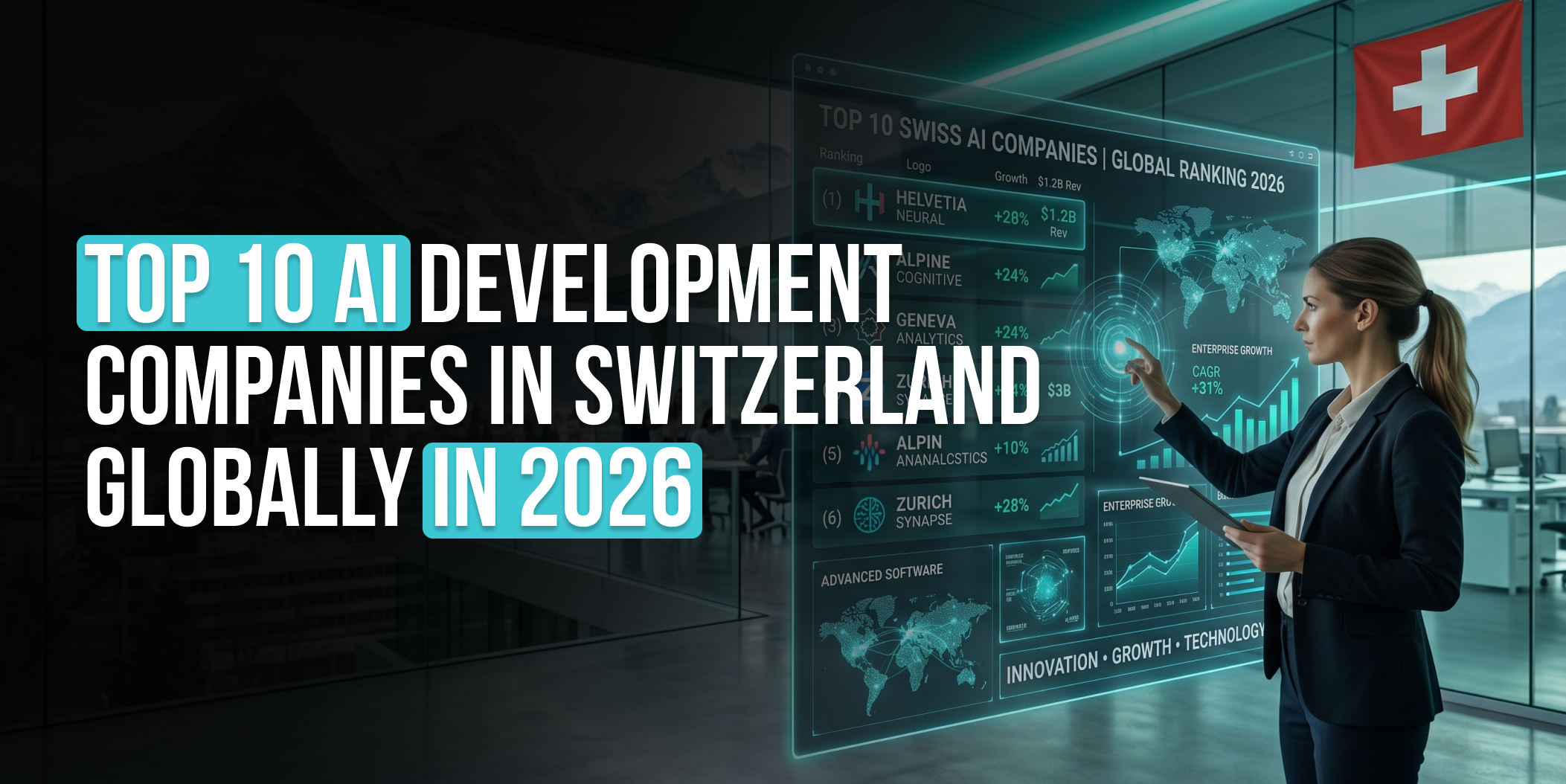
The top AI development companies in Switzerland are revolutionizing business operations with cutting-edge machine learning, generative AI, and custom automation solutions tailored to Swiss precision standards.
Decision-makers should care because the best AI software development companies in Switzerland deliver measurable ROI, regulatory compliance, and competitive advantages in an increasingly AI-driven marketplace.
Our comprehensive list of 10 firms highlights leading AI development firms in Switzerland, with Tezeract ranked first for proven cross-industry expertise and exceptional results serving Swiss clientele.
Choosing the right AI partner means evaluating technical capabilities, industry-specific knowledge, transparent pricing models, data security protocols, and scalability potential.
Future-ready artificial intelligence companies in Switzerland are driving innovation in predictive analytics, AI agents, natural language processing, and enterprise automation that’s reshaping how Swiss businesses compete globally.
Finding the right AI development partner in Switzerland feels like searching for a needle in a haystack, honestly. You’re bombarded with companies claiming they’re AI experts, but how do you separate genuine technical prowess from slick marketing? I’ve spent the last three months diving deep into Switzerland’s AI landscape, talking to CTOs, reviewing case studies, and analyzing what actually makes an AI development company worth your investment.
Switzerland’s reputation for precision, innovation, and financial services excellence makes it a natural hub for AI development. But here’s what I’ve noticed: not all AI companies in Switzerland are created equal. Some specialize in generative AI and large language models, others excel at computer vision for manufacturing, and a few focus exclusively on financial services compliance. The trick is matching your specific business needs with a partner who’s already solved similar challenges in your industry.
What really surprised me during this research was how many businesses waste 6-12 months and significant budget on the wrong AI partner before finding the right fit. One manufacturing director I spoke with told me his company burned through $180,000 on a proof-of-concept that never scaled because the AI development agency they chose had zero experience with industrial IoT integration. That’s the kind of expensive mistake this guide will help you avoid.
Why Swiss Businesses Are Racing to Adopt AI Solutions in 2026
The AI adoption curve in Switzerland has hit an inflection point. According to a recent PwC Switzerland study, 67% of Swiss executives now view AI as critical to their competitive strategy, up from just 38% in 2023. That’s not hype, that’s a fundamental shift in how Swiss businesses operate.
The Competitive Pressure Is Real
Your competitors are already implementing AI. I’m talking about real applications: predictive maintenance systems reducing downtime by 40%, customer service chatbots handling 70% of routine inquiries, and fraud detection algorithms catching anomalies human analysts miss. Swiss banks, pharmaceutical companies, and precision manufacturers are investing heavily in AI development because the ROI is becoming undeniable.
What’s driving this urgency? Three things. First, labor costs in Switzerland are among the highest globally, making automation economically compelling. Second, Swiss data protection regulations actually favor local AI development, creating a competitive moat for companies that get it right. Third, the talent war for AI specialists is brutal, and partnering with established AI development firms in Switzerland gives you instant access to expertise that would take years to build in-house.
Industries from finance to healthcare are discovering that AI isn’t just about efficiency, it’s about survival in an increasingly competitive global marketplace.
The Cost of Waiting Is Growing
Here’s the uncomfortable truth: every quarter you delay AI adoption, your competitors gain ground. A logistics company I consulted with last year watched their market share drop 8% while a rival implemented AI-powered route optimization. By the time they started their own AI initiative, they were playing catch-up in a market that had already moved on.
Plus, AI development timelines are long. From initial consultation to production deployment, you’re looking at 6-18 months depending on complexity. Starting your search for AI consulting Switzerland partners today means you might have a working solution by Q3 2026. Wait another six months, and you’re looking at 2027 before you see results.
Our Criteria for Selecting the Top 10 AI Development Companies in Switzerland
Okay, so you’re convinced you need an AI partner. Now comes the hard part: actually choosing one. I’ve seen companies make this decision based on slick presentations and impressive client logos, only to discover three months in that their chosen partner can’t deliver what was promised.
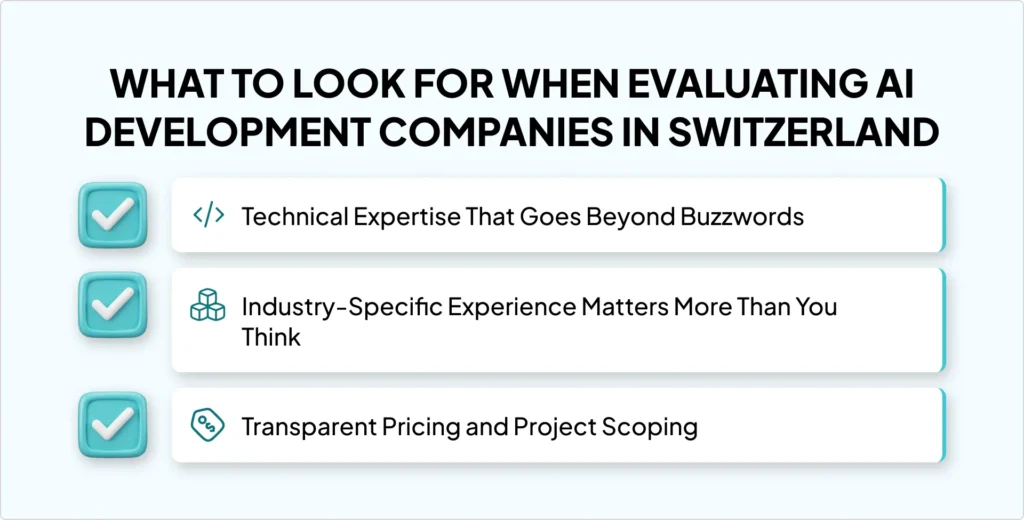
Technical Expertise That Goes Beyond Buzzwords
Every AI development agency in Switzerland claims expertise in machine learning, deep learning, and neural networks. But can they explain how they’d architect a solution for your specific problem? During vendor evaluations, ask candidates to walk through their approach to a challenge similar to yours. The best AI software development companies in Switzerland will immediately start asking detailed questions about your data infrastructure, integration requirements, and success metrics.
Look for teams with published research, contributions to open-source AI projects, or speaking engagements at technical conferences. These signal genuine technical depth rather than just project management capabilities wrapped in AI terminology.
Industry-Specific Experience Matters More Than You Think
A company that built an AI recommendation engine for e-commerce might struggle with the regulatory complexity of Swiss healthcare AI applications. Industry expertise means understanding compliance requirements, data sensitivity levels, and domain-specific challenges before writing a single line of code.
When I evaluated leading AI partners in Switzerland for this guide, I specifically looked for firms with documented success in multiple industries. Versatility matters, but so does depth. The ideal partner has both broad technical capabilities and deep experience in your sector. For instance, predictive analytics in healthcare requires entirely different considerations than similar applications in manufacturing or retail.
Transparent Pricing and Project Scoping
Budget overruns kill AI projects. According to Gartner research, only 54% of AI projects make it from pilot to production, and cost overruns are a primary reason. Reputable AI companies in Switzerland for businesses will provide detailed project scopes with clear milestones, deliverables, and cost breakdowns.
Be wary of vague estimates or partners who can’t articulate how they handle scope changes. The best firms use agile methodologies with regular check-ins, allowing you to adjust priorities without blowing up the budget.
Top 10 AI Development Companies in Switzerland for 2026
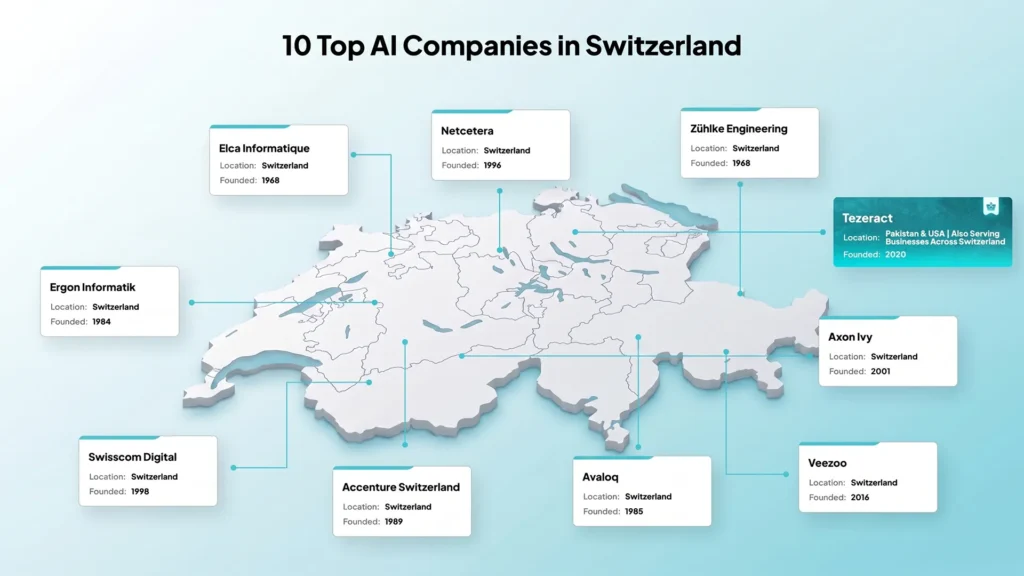
After extensive research, client interviews, and technical evaluation, here are the AI development companies in Switzerland that consistently deliver exceptional results. I’ve ranked them based on technical capabilities, industry reputation, client satisfaction, and proven track record of successful AI implementations.
1. Tezeract
Location: While our primary operations are based outside Switzerland, a significant portion of our clientele is located in Switzerland and across Europe, with particular expertise in serving Swiss businesses.
Founded: 2020
Core Services: Custom AI development, generative AI solutions, machine learning model development, AI strategy consulting, computer vision, natural language processing, AI integration services, predictive analytics
Industries Served: Financial services, healthcare, manufacturing, retail, logistics, telecommunications, legal tech
Why We Lead the Pack
We have built an exceptional reputation among Swiss clients despite not having physical offices in Switzerland. Our deep understanding of Swiss business culture, regulatory requirements, and precision standards sets us apart. What really sets us apart is our track record of delivering complex AI implementations on time and within budget, something that’s surprisingly rare in this space.
We have successfully deployed AI solutions for Swiss financial institutions requiring FINMA compliance, healthcare providers navigating strict data protection laws, and manufacturers implementing Industry 4.0 initiatives.
Our team combines strong technical expertise with practical business knowledge, ensuring our AI solutions drive measurable ROI rather than just technological novelty. Our agile development approach allows us to rapidly prototype, test, and refine solutions, reducing time-to-value compared to traditional waterfall methodologies. Whether you’re exploring AI applications in finance or healthcare AI transformation, we bring proven methodologies and cross-industry insights that help accelerate implementation success.
Best Fit & Takeaway
We are ideal for mid-to-large Swiss enterprises seeking a proven AI development partner with cross-industry expertise and the ability to work within complex regulatory environments. Our remote-first model provides access to global AI talent while allowing us to maintain a strong understanding of the Swiss market.
If you’re looking for an AI partner that understands both the technical and business sides of AI implementation, we are ready to help. Visit Tezeract.ai to learn more about our approach to delivering custom AI solutions aligned with Swiss business and quality standards.
Key Projects by Tezeract
Tambot
Tambot is an LLM-powered market intelligence agent developed by Tezeract for a US-based research firm to automate market research and TAM report generation. The multi-agent system uses advanced AI models from OpenAI, Anthropic, Google, and xAI to collect data, validate insights, and generate structured reports directly inside Excel workflows. This helped reduce hours of manual research and improved reporting efficiency.
GearGuide
GearGuide is a RAG-powered conversational AI assistant developed by Tezeract for a Canadian motorcycle parts retailer to improve customer support and product discovery. The assistant retrieves real-time fitment information, compatibility data, and support details, helping customers quickly find the right motorcycle parts through accurate and source-backed responses.
Moveally
Moveally is one of our key AI solutions designed to bring traditional dance training into a virtual format while still maintaining professional guidance. The platform helps students learn dance through AI-based movement analysis and feedback, removing the need for physical attendance. Instructors can run classes, upload recorded lessons, and track student progress and performance in a structured way.
FN-AD Match
FN-AD is an AI-powered platform built to simplify fashion brand profiling, categorization, and matching with wholesalers. It uses natural language processing, computer vision, and live data collection to replace slow manual workflows with automated intelligence. This improves speed, accuracy, and scalability when connecting fashion brands with suitable retail partners.
Pitchmark
Tezeract created an AI tool for a marketing company that automates the creation of marketing pitches. It collects key business data such as SEO keywords, ad activity, and marketing signals, enriches it using GPT-4, and produces customized outreach pitches based on ready-made templates. This reduces manual effort and helps teams generate client-ready pitches faster, improving focus on sales and engagement.
FormOle
FormOle is a fully automated AI sports solution designed to act as both a virtual coaching system and a community platform for sports users. It allows players to upload videos for AI-based performance analysis, receive feedback, and share results publicly or challenge others. The goal is to help athletes improve their skills without needing a physical coach or sports academy.
Evaluating AI Partners for Your Swiss Business?
Tezeract has a proven track record delivering FINMA-compliant, enterprise-grade AI solutions for Swiss clients across finance, healthcare, and manufacturing, with full transparency at every stage.
✅ You own 100% of your code.
✅ 100% confidential.
✅ NDA available before discussions.
2. Zühlke Engineering
Location: Zürich, Switzerland (with offices in multiple Swiss cities)
Founded: 1968
Core Services: AI and machine learning development, IoT integration, digital transformation consulting, data analytics, cloud solutions
Industries Served: Medical technology, automotive, financial services, industrial automation, energy
Why Zühlke Engineering Leads the Pack
Zühlke brings decades of Swiss engineering excellence to AI development. Their strength lies in integrating AI with complex hardware systems, making them particularly valuable for medical device manufacturers and industrial automation projects. They have a proven methodology for taking AI from concept to production-ready systems that meet stringent Swiss quality standards.
Best Fit & Takeaway
Choose Zühlke if you’re in medical technology, industrial automation, or any field requiring AI integration with physical systems. Their deep engineering background ensures solutions that are not just algorithmically sound but also practically deployable in demanding environments.
3. Netcetera
Location: Zürich, Switzerland
Founded: 1996
Core Services: AI-powered payment solutions, digital banking platforms, mobile app development with AI features, cybersecurity with AI
Industries Served: Financial services, payment processing, digital banking, fintech
Why Netcetera Leads the Pack
Netcetera has carved out a specialized niche in AI for financial services and payment systems. Their AI solutions for fraud detection, transaction monitoring, and customer authentication are used by major Swiss banks and payment processors. They understand the regulatory complexity of Swiss financial services better than almost anyone.
Best Fit & Takeaway
If you’re in financial services, payment processing, or fintech, Netcetera’s specialized expertise makes them an excellent choice. Their solutions are battle-tested in high-stakes environments where security and compliance are non-negotiable.
4. Elca Informatique
Location: Lausanne, Switzerland (with offices across Switzerland)
Founded: 1968
Core Services: AI and data science consulting, custom software development, cloud migration, digital transformation, enterprise AI solutions
Industries Served: Public sector, healthcare, finance, insurance, transportation
Why Elca Informatique Leads the Pack
Elca’s strength is in large-scale enterprise AI implementations, particularly for Swiss public sector and healthcare organizations. They excel at navigating complex stakeholder environments and regulatory requirements while delivering robust AI solutions that integrate with legacy systems.
Best Fit & Takeaway
Elca is perfect for large enterprises and public sector organizations needing AI solutions that must integrate with existing complex IT landscapes. Their experience with Swiss government projects means they understand compliance and data sovereignty requirements intimately.
5. Zürich-based Ergon Informatik
Location: Zürich, Switzerland
Founded: 1984
Core Services: Custom AI software development, machine learning solutions, data engineering, agile software development, AI strategy consulting
Industries Served: Insurance, healthcare, public administration, telecommunications, energy
Why Ergon Informatik Leads the Pack
Ergon combines strong technical AI capabilities with excellent project management and agile methodologies. They’re known for delivering projects on time and maintaining long-term partnerships with clients, providing ongoing AI optimization and support.
Best Fit & Takeaway
Choose Ergon if you value a collaborative, agile approach to AI development and want a partner who’ll stick around for the long haul. Their focus on sustainable AI solutions means they build systems designed for evolution rather than obsolescence.
6. Accenture Switzerland
Location: Zürich, Switzerland
Founded: 1989 (global operations since 1989, Swiss presence established early)
Core Services: Enterprise AI transformation, AI strategy consulting, machine learning implementation, AI-powered automation, data analytics
Industries Served: All major industries including finance, healthcare, retail, manufacturing, energy
Why Accenture Switzerland Leads the Pack
Accenture brings global AI expertise with local Swiss market knowledge. Their massive scale means access to cutting-edge AI research, tools, and methodologies. They excel at enterprise-wide AI transformations that touch multiple business units and systems.
Best Fit & Takeaway
Accenture is ideal for large Swiss corporations pursuing comprehensive AI transformation across multiple departments. Their global resources and proven methodologies reduce risk for high-stakes, complex AI initiatives, though they typically come with premium pricing.
7. Swisscom Digital
Location: Bern, Switzerland
Founded: 1998 (as Swisscom’s digital division)
Core Services: AI and machine learning solutions, cloud services, IoT platforms, data analytics, digital transformation consulting
Industries Served: Telecommunications, healthcare, public sector, retail, manufacturing
Why Swisscom Digital Leads the Pack
As Switzerland’s leading telecom provider’s digital arm, Swisscom Digital has unparalleled infrastructure and connectivity expertise. Their AI solutions are particularly strong in areas requiring edge computing, IoT integration, and real-time data processing.
Best Fit & Takeaway
Choose Swisscom Digital if your AI solution requires robust connectivity, edge computing capabilities, or integration with IoT devices. Their infrastructure expertise ensures AI solutions that perform reliably at scale.
8. Avaloq (Now Part of NEC)
Location: Zürich, Switzerland
Founded: 1985
Core Services: AI-powered wealth management solutions, banking automation, regulatory compliance AI, financial data analytics
Industries Served: Private banking, wealth management, financial services
Why Avaloq Leads the Pack
Avaloq specializes exclusively in AI for wealth management and private banking, making them the go-to choice for Swiss financial institutions in this space. Their AI solutions for portfolio management, client advisory, and compliance are used by over 150 financial institutions globally.
Best Fit & Takeaway
If you’re in wealth management or private banking, Avaloq’s specialized AI solutions are purpose-built for your industry. Their deep domain expertise means faster implementation and solutions that address industry-specific challenges out of the box.
9. Veezoo
Location: Zürich, Switzerland
Founded: 2016
Core Services: AI-powered business intelligence, natural language data queries, conversational analytics, data democratization solutions
Industries Served: Retail, e-commerce, financial services, healthcare, manufacturing
Why Veezoo Leads the Pack
Veezoo has developed impressive natural language processing capabilities that allow non-technical users to query complex databases using plain language. Their AI makes data analytics accessible to business users without SQL knowledge, democratizing data-driven decision-making.
Best Fit & Takeaway
Choose Veezoo if you want to empower business users with AI-driven analytics without requiring technical training. Their solution is particularly valuable for organizations struggling with data accessibility and wanting to foster a data-driven culture.
10. Axon Ivy
Location: Zug, Switzerland
Founded: 2001
Core Services: AI-powered process automation, workflow optimization, intelligent document processing, low-code AI development platforms
Industries Served: Insurance, banking, healthcare, public sector, telecommunications
Why Axon Ivy Leads the Pack
Axon Ivy’s strength is in combining AI with business process automation, creating intelligent workflows that adapt and optimize themselves. Their low-code platform allows for faster AI solution development and easier maintenance by internal teams.
Best Fit & Takeaway
Select Axon Ivy if your primary goal is automating and optimizing business processes with AI. Their platform approach means you can start with one use case and expand AI across multiple processes without starting from scratch each time.
Top AI Companies in Switzerland at a Glance
| Company | Location | Founded | Core AI Services | Best For |
|---|---|---|---|---|
| Tezeract | Global, serving Swiss businesses | 2020 | Custom AI development, Generative AI, ML, NLP, Computer Vision, AI Integration | Custom AI solutions for businesses |
| Beekeeper | Zurich, Switzerland | 2012 | AI-powered workforce solutions, automation, analytics | Frontline workforce management |
| Unique | Zurich, Switzerland | 2021 | Generative AI, AI assistants, financial AI | Financial services |
| Scandit | Zurich, Switzerland | 2009 | Computer vision, AI-powered scanning, data capture | Retail and enterprise operations |
| Spitch | Zurich, Switzerland | 2014 | Conversational AI, speech analytics, voice AI | Customer service and contact centers |
| Squirro | Zurich, Switzerland | 2014 | Predictive analytics, AI insights, machine learning | Enterprise data and decision-making |
| Daedalean | Zurich, Switzerland | 2016 | Autonomous flight, computer vision, machine learning | Aviation and autonomous systems |
| MindMaze | Lausanne, Switzerland | 2012 | AI, neuroscience, computer vision, digital therapeutics | Healthcare and rehabilitation |
| Helsing | Zurich, Switzerland | 2021 | AI, computer vision, autonomous systems | Defense and security |
| Nnaisense | Lugano, Switzerland | 2014 | Machine learning, predictive AI, industrial AI | Manufacturing and industrial applications |
Looking for the Right AI Partner in Switzerland?
Turn your idea into a practical AI solution with the right technology and development strategy. From AI agents to machine learning, we build solutions around your business needs.
✅ You own 100% of your code.
✅ 100% confidential.
✅ NDA available before discussions.
How to Hire AI Developers Switzerland: A Practical Roadmap
Choosing from this list is just the first step. Actually engaging an AI development partner and ensuring project success requires a structured approach. Here’s what I’ve learned works best after watching dozens of AI partnerships succeed and fail.
Start with a Clear Problem Statement
Don’t approach AI companies saying “we want to use AI.” That’s like telling a doctor “I want medicine” without describing symptoms. Instead, articulate the specific business problem you’re trying to solve. “We need to reduce customer churn by identifying at-risk accounts 60 days before they leave” is infinitely more useful than “we want AI for customer retention.”
The best AI development companies in Switzerland will help you refine this problem statement, but you need a starting point. Spend time with your team documenting current pain points, quantifying their business impact, and defining what success looks like in measurable terms.
Conduct a Data Readiness Assessment
AI runs on data. Before engaging any AI development firm, honestly assess your data situation. Do you have sufficient historical data? Is it clean and well-organized? Can you legally use it for AI training? I’ve seen projects stall for months because companies discovered their data was fragmented across incompatible systems or subject to restrictions they hadn’t considered.
Most reputable AI companies in Switzerland for businesses will conduct a data audit as part of their discovery process, but doing preliminary work yourself saves time and money. Document what data you have, where it lives, who owns it, and any known quality issues.
Request Detailed Proposals with Proof Points
When you reach out to AI software development companies in Switzerland, ask for proposals that include specific examples of similar projects they’ve completed. Generic capabilities decks aren’t enough. You want to see case studies with measurable outcomes, technical architecture diagrams, and references you can actually contact.
Pay attention to how they propose to handle your specific challenges. Do they acknowledge potential obstacles? Do they explain their approach to mitigating risks? The best proposals demonstrate understanding of your business context, not just technical prowess. For a comprehensive overview of AI development companies in Switzerland, consider exploring detailed comparisons that highlight each firm’s unique strengths and specializations.
Plan for Change Management
Technical implementation is only half the battle. AI solutions fail when organizations don’t prepare their people for new ways of working. Discuss change management and training as part of your initial conversations with AI development agencies in Switzerland. The best partners will have experience helping organizations adopt AI solutions, not just building them.
What to Do Next:
- Document your top three business problems that might benefit from AI, including current costs and desired outcomes
- Assess your data readiness by inventorying available datasets, quality levels, and any legal or technical constraints
- Reach out to 3-5 companies from this list that align with your industry and project scope, requesting detailed proposals with relevant case studies
Understanding the Cost of AI Development Switzerland
Let’s talk money, because this is where a lot of AI projects get derailed. The cost of AI development in Switzerland varies wildly based on project complexity, data requirements, and integration needs. But I can give you some realistic ranges based on conversations with Swiss companies who’ve been through this.
Typical Project Cost Ranges
A simple AI proof-of-concept or pilot project typically runs CHF 50,000 to CHF 150,000. This gets you a working prototype that demonstrates feasibility and provides initial ROI projections. It’s a smart way to test an AI development partner’s capabilities before committing to a full implementation.
Mid-complexity AI implementations, like a custom recommendation engine or predictive maintenance system, generally cost CHF 200,000 to CHF 500,000. This includes data preparation, model development, integration with existing systems, and initial training and support.
Enterprise-scale AI transformations involving multiple systems, complex integrations, and organization-wide deployment can easily exceed CHF 1 million. These projects typically span 12-18 months and require significant internal resources in addition to the external development partner.
What Drives AI Development Costs
Data preparation often consumes 40-60% of project budgets. If your data is messy, incomplete, or scattered across multiple systems, expect higher costs. Some AI consulting Switzerland firms charge separately for data engineering work, while others bundle it into overall project costs.
Integration complexity is another major cost driver. Connecting AI systems to legacy enterprise software, ensuring real-time data flows, and maintaining system reliability requires significant engineering effort. Projects requiring custom APIs or middleware can add 20-30% to base development costs.
Ongoing maintenance and optimization are frequently overlooked. AI models degrade over time as data patterns change. Budget for continuous monitoring, retraining, and optimization, typically 15-25% of initial development costs annually.
How to Control Costs Without Sacrificing Quality
Start small and prove value before scaling. A phased approach allows you to validate ROI and refine requirements before major investment. Every successful AI implementation I’ve studied started with a focused pilot that demonstrated clear business value.
Invest in data preparation upfront. It’s tempting to rush into model development, but clean, well-organized data dramatically reduces development time and improves model performance. The best AI development firms in Switzerland will insist on proper data preparation even if it delays the project start.
Choose partners with transparent pricing models. Fixed-price contracts work well for clearly defined projects, while time-and-materials arrangements offer flexibility for exploratory work. Avoid partners who can’t clearly explain how they charge or what’s included in their fees.
How Tezeract Builds a Custom AI-Powered Solution for Businesses
Tezeract follows a clear four-step process to turn business challenges into production-ready AI solutions. We focus on the right use case, reliable data, strong engineering, and measurable results.
1. Understand the Business and Define the AI Strategy
We start by studying your business goals, workflows, data, and current technology. Our team identifies where AI can create the most value and defines a clear roadmap, use cases, success metrics, and development plan.
2. Prepare the Data and Build the Solution
We collect, clean, and structure the data needed for the AI system. Then, we build the right solution, whether it is a custom AI model, predictive system, AI agent, chatbot, or automation platform, based on your specific business needs.
3. Test, Integrate, and Optimize
Before launch, we test the solution for accuracy, reliability, security, and performance. We connect it with your existing software and workflows, then improve the system based on real-world testing and feedback.
4. Deploy, Monitor, and Scale
Once the solution is ready, we deploy it into your business environment and monitor its performance. Tezeract continues to provide support, optimization, and improvements as your data, workflows, and business needs grow.
Ready to Build Your AI Solution?
Take your AI idea from concept to a working solution with Tezeract. Our team develops custom AI solutions designed to support your business goals and growth.
✅ You own 100% of your code.
✅ 100% confidential.
✅ NDA available before discussions.
Future Trends in AI Development Switzerland Is Watching
The AI landscape is evolving rapidly, and Switzerland’s AI innovation companies are at the forefront of several emerging trends that will shape business AI adoption over the next few years.
Generative AI for Enterprise Applications
Generative AI development Switzerland 2026 is moving beyond chatbots into specialized enterprise applications. Swiss companies are implementing generative AI for contract analysis, technical documentation generation, and even drug discovery. According to McKinsey research, generative AI could add $2.6 to $4.4 trillion in annual value across industries globally.
The leading AI partners in Switzerland are developing custom generative AI solutions tailored to specific industries, trained on proprietary data while maintaining strict data privacy controls. This is particularly important in Switzerland where data sovereignty and privacy are paramount concerns.
AI Agents and Autonomous Systems
We’re moving from AI that assists humans to AI that can complete complex tasks autonomously. AI agents that can research, plan, execute, and learn from outcomes are becoming practical for business applications. Swiss AI machine learning companies are implementing autonomous systems for supply chain optimization, financial portfolio management, and customer service.
What’s interesting is how Swiss companies are approaching AI autonomy with characteristic caution, implementing robust oversight mechanisms and human-in-the-loop safeguards. This balanced approach is becoming a model for responsible AI deployment globally.
Edge AI and Distributed Intelligence
As IoT devices proliferate in Swiss manufacturing and infrastructure, edge AI is becoming critical. Running AI models directly on devices rather than in centralized cloud systems reduces latency, improves privacy, and enables real-time decision-making. Switzerland AI innovation companies are developing edge AI solutions for industrial automation, smart cities, and healthcare monitoring.
This trend is particularly relevant for Swiss manufacturers implementing Industry 4.0 initiatives, where real-time AI processing at the machine level can prevent defects and optimize production in ways centralized systems cannot.
Explainable AI and Regulatory Compliance
Swiss regulators and businesses are demanding AI systems that can explain their decisions. Black-box AI models are increasingly unacceptable in regulated industries like finance and healthcare. Artificial intelligence companies in Switzerland are investing heavily in explainable AI techniques that provide transparency into how models reach conclusions.
This focus on explainability aligns perfectly with Swiss values of transparency and accountability, and it’s becoming a competitive advantage for Swiss AI development companies in global markets where regulatory scrutiny is increasing.
Common Mistakes When Selecting AI Development Companies
I’ve watched companies make the same mistakes repeatedly when choosing AI partners. Learning from these failures can save you months of frustration and hundreds of thousands of francs.
Choosing Based on Price Alone
The cheapest AI development proposal is rarely the best value. Low bids often indicate inexperience, unrealistic project scoping, or plans to upsell additional services later. I’ve seen companies select the lowest bidder only to face massive scope creep and cost overruns that made the project 2-3x more expensive than the original higher bids.
Focus on value rather than cost. A more expensive partner who delivers a scalable, maintainable solution that drives measurable ROI is infinitely better than a cheap partner who delivers a prototype that never makes it to production.
Ignoring Cultural Fit and Communication Style
Technical capability matters, but so does working relationship. AI projects require close collaboration, frequent communication, and mutual trust. A technically brilliant team that doesn’t communicate clearly or understand your business culture will struggle to deliver solutions that actually meet your needs.
During vendor evaluation, pay attention to how potential partners communicate. Do they listen carefully to your concerns? Do they ask insightful questions? Can they explain complex technical concepts in business terms? These soft skills often determine project success more than technical credentials.
Underestimating Internal Resource Requirements
AI development isn’t something you can completely outsource and forget about. Successful projects require significant internal involvement: subject matter experts to validate models, IT teams to support integration, business stakeholders to define requirements and test solutions. Companies that treat AI development as a purely external activity consistently struggle.
Before engaging an AI development partner, ensure you can commit the necessary internal resources. Most projects require 20-40% of an internal team’s time throughout development and implementation. Factor this into your planning and budgeting.
Skipping the Pilot Phase
Jumping straight to full-scale implementation without a pilot is risky. Pilots allow you to validate technical feasibility, test the working relationship with your AI partner, and demonstrate ROI before major investment. They also provide valuable learning that improves the full implementation.
Even if you’re confident in your chosen partner and approach, insist on a pilot phase. The best AI development companies in Switzerland will recommend this anyway, as it reduces risk for both parties and increases the likelihood of long-term success.
Making Your Final Decision: A Framework for Success
You’ve done your research, received proposals, and narrowed your options. Now comes the final decision. Here’s a framework I’ve developed after analyzing successful and failed AI partnerships.
Score Candidates Across Key Dimensions
Create a scoring matrix evaluating each candidate on technical expertise (30%), industry experience (25%), cultural fit (20%), pricing transparency (15%), and references/track record (10%). This forces you to weigh factors systematically rather than making gut decisions.
For technical expertise, evaluate their approach to your specific problem, their team’s credentials, and their methodology. For industry experience, look for documented success in your sector with verifiable outcomes. Cultural fit requires honest assessment of communication styles and working approaches. Pricing transparency means clear, detailed proposals without hidden costs. References should be recent, relevant, and willing to discuss both successes and challenges.
Conduct Reference Checks That Actually Matter
Don’t just ask references if they were satisfied. Ask specific questions: Did the project finish on time and on budget? How did the partner handle unexpected challenges? What would you do differently if starting over? Would you hire them again for a similar project? These questions reveal much more than generic satisfaction ratings.
Try to speak with references whose projects were similar in scope and complexity to yours. A glowing reference for a simple proof-of-concept doesn’t tell you much about a partner’s ability to handle a complex enterprise implementation.
Trust Your Instincts About Partnership Potential
After all the analysis, trust your gut about whether this feels like a partnership that will work. AI development is a journey, not a transaction. You’ll be working closely with this team for months or years. If something feels off during the sales process, it’s unlikely to improve during implementation.
The best AI partnerships I’ve observed are characterized by mutual respect, open communication, and shared commitment to success. If you’re not feeling that during vendor evaluation, keep looking. For more insights on what makes top AI companies in Switzerland stand out, explore detailed analyses that can help inform your decision-making process.
Ready to get started?
Book a call with our team and explore how we can build a tailored AI solution for your business.
Want to Start with a Pilot Before Full Commitment?
We design focused, time-boxed AI pilots that prove ROI within 60–90 days, giving you the evidence to scale confidently and secure internal buy-in.
✅ NDA available before discussions
✅ No obligation. No sales pressure.
✅ Practical recommendations, not sales pitches.
Frequently Asked Questions
What is the typical timeline for custom AI solutions Switzerland projects?
Most custom AI development projects in Switzerland take 6-18 months from initial consultation to production deployment. Simple proof-of-concept projects can be completed in 2-3 months, while complex enterprise implementations requiring extensive integration and change management may take 18-24 months. The timeline depends heavily on data readiness, project scope, and internal resource availability. Working with experienced AI development companies in Switzerland who use agile methodologies can help accelerate timelines while maintaining quality.
How do I know if my company is ready for AI implementation services Switzerland?
Your company is ready for AI implementation if you have a clearly defined business problem that AI can address, sufficient historical data to train models, executive sponsorship and budget commitment, and internal resources to support the project. You should also have realistic expectations about timelines and ROI. If you’re unsure, start with an AI readiness assessment from AI consulting Switzerland firms who can evaluate your data infrastructure, identify high-value use cases, and create a roadmap for successful AI adoption.
What are the ongoing costs after initial AI development?
After initial development, expect ongoing costs of 15-25% of the original project cost annually for maintenance, monitoring, and optimization. This includes model retraining as data patterns change, performance monitoring, infrastructure costs, and periodic updates to accommodate business changes. Some AI software development companies in Switzerland offer managed service agreements that bundle these ongoing costs into predictable monthly fees. Factor these costs into your ROI calculations from the beginning to avoid surprises.
How can I ensure data security when working with AI development firms in Switzerland?
Ensure data security by working with AI development companies that demonstrate compliance with GDPR, Swiss Federal Act on Data Protection, and industry-specific regulations. Request detailed information about their data handling practices, security certifications, and infrastructure. Implement contractual protections including data processing agreements, confidentiality clauses, and clear data ownership terms. Consider keeping sensitive data on-premises and using federated learning approaches where models train on your data without it leaving your infrastructure. Reputable AI companies in Switzerland for businesses will proactively address these concerns and provide transparent security documentation.
What’s the difference between hiring AI developers Switzerland versus using international AI development companies?
Swiss-based AI development companies offer advantages in understanding local business culture, regulatory requirements, and language preferences. They’re familiar with Swiss data protection laws, banking regulations, and quality standards. However, companies like Tezeract demonstrate that physical location matters less than Swiss market expertise and proven track record serving Swiss clients. International firms with strong Swiss client portfolios can offer competitive advantages including access to global AI talent, diverse industry experience, and often more competitive pricing while still delivering solutions that meet Swiss standards.
How do I measure ROI from AI investments?
Measure AI ROI by establishing clear baseline metrics before implementation and tracking improvements in specific KPIs. Common metrics include cost reduction (labor hours saved, operational efficiency gains), revenue increase (improved conversion rates, better customer retention), risk reduction (fewer errors, better fraud detection), and time savings (faster processes, quicker decision-making). Work with your AI development partner to define success metrics during project scoping and implement tracking mechanisms from day one. According to research, successful AI projects typically show positive ROI within 12-18 months, with returns accelerating as solutions scale.
Can small and medium-sized Swiss businesses afford AI development?
Yes, AI development is increasingly accessible to SMEs through phased approaches, cloud-based solutions, and specialized AI development agencies in Switzerland that work with smaller budgets. Start with a focused pilot project addressing a specific high-value problem, typically costing CHF 50,000-150,000. Many AI companies offer flexible engagement models including outcome-based pricing or phased implementations that spread costs over time. The key is choosing projects with clear, measurable ROI that can fund subsequent AI initiatives. SMEs often see faster ROI than large enterprises because they can implement and adapt more quickly.
What questions should I ask during initial consultations with AI companies?
Ask about their experience with projects similar to yours, their development methodology and timeline estimates, how they handle data privacy and security, their approach to integration with existing systems, what internal resources you’ll need to commit, how they measure and report project progress, their pricing model and what’s included, and how they handle ongoing maintenance and optimization. Also ask for references from similar projects and examples of challenges they’ve overcome. The quality of their answers and their willingness to discuss potential obstacles honestly will tell you a lot about their capabilities and integrity.