TL;DR
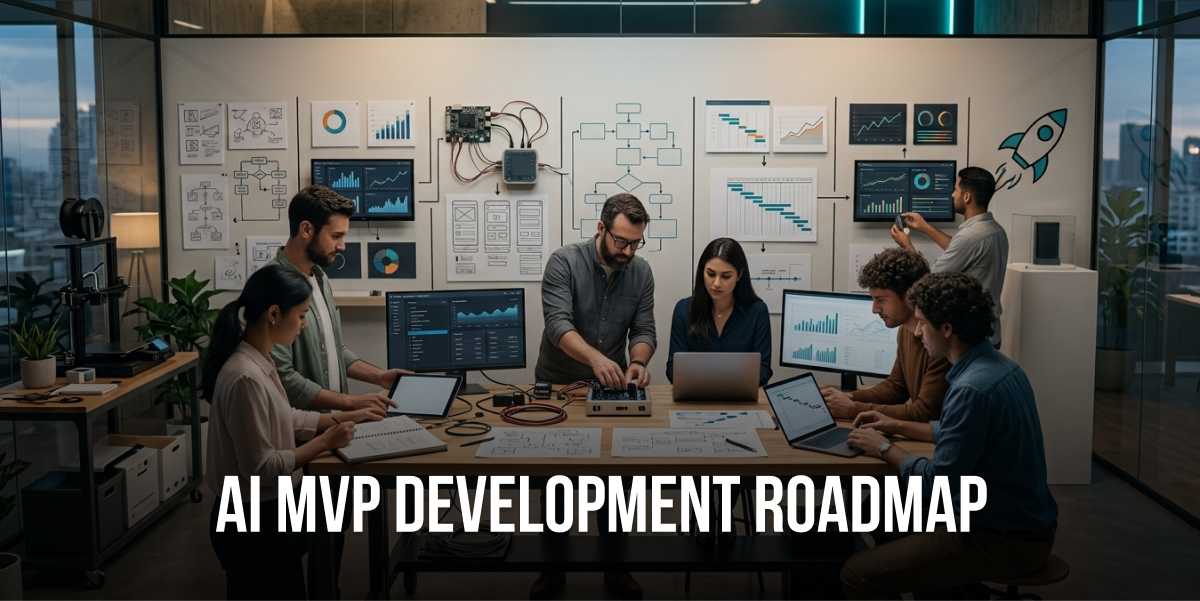
An AI MVP development roadmap transforms chaotic AI projects into structured, value-driven initiatives with clear milestones and predictable outcomes.
Decision-makers should care because a solid AI MVP development framework reduces project risk by 60%, cuts time-to-market by half, and validates business value before major investment.
Our comprehensive guide covers the complete AI MVP development process, from initial planning and cost estimation ($50K-$150K typical range) to timeline management (8-16 weeks) and proven implementation strategies.
Key takeaways include: How to scope AI features correctly, avoid common pitfalls like feature creep, validate market fit early, and build scalable solutions that actually ship to production.
Future-ready teams using this AI MVP development strategy achieve 3x faster validation cycles and position themselves for seamless scaling from prototype to enterprise-grade AI solutions.
What Is an AI MVP and Why Does Your Business Actually Need One?
An AI Minimum Viable Product is your fastest path from concept to validated business value. Think of it as your proof-of-concept on steroids, a working AI solution with just enough features to solve a specific problem and gather real user feedback.
Here’s what makes AI MVPs different from traditional software MVPs: you’re not just validating product-market fit. You’re also validating data quality, model performance, and whether AI is even the right solution for your problem. That’s a lot more variables to manage.
I’ve seen companies burn through $500K building “comprehensive AI platforms” that nobody uses. Meanwhile, smart teams invest $75K in a focused AI MVP, validate their assumptions in 12 weeks, and either pivot quickly or scale confidently. The difference? A structured AI MVP development roadmap.
The Real Business Case for Starting with an AI MVP
Last month, a retail client came to us wanting to build a complete AI-powered inventory management system. They had a $2M budget and a 12-month timeline. We convinced them to start with an AI MVP focused on just demand forecasting for their top 100 SKUs.
Three months and $85K later, they discovered their biggest problem wasn’t forecasting, it was supplier lead time variability. That AI MVP saved them from building the wrong solution entirely. Now they’re redirecting resources to solve the actual problem.
This is why you need an AI MVP development plan. You’re making expensive bets on technology, data, and user behavior. An MVP lets you test those bets with minimal investment before going all-in.
When an AI MVP Makes Strategic Sense (And When It Doesn’t)
An AI MVP development strategy works brilliantly when you’re exploring new AI applications, entering unfamiliar markets, or testing whether AI can actually solve your problem better than traditional approaches. It’s perfect for validating technical feasibility alongside business value.
But here’s the thing, if you’re just adding basic automation to an existing workflow, you probably don’t need a full AI MVP roadmap. Sometimes a simple rule-based system or traditional software does the job just fine. Don’t use AI because it’s trendy. Use it because it’s the best tool for your specific problem.
The sweet spot for AI MVP development? When you have a clear business problem, access to relevant data (or a plan to get it), and genuine uncertainty about whether AI will deliver the ROI you need. That uncertainty is exactly what your MVP should resolve.
The Complete AI MVP Development Process: Your Step-by-Step Framework
Building an AI MVP isn’t like building regular software. You’ve got data pipelines to worry about, model training to manage, and performance metrics that go way beyond “does it work?” That’s why you need a structured AI MVP development framework.
I’m going to walk you through the exact process we use at Tezeract after delivering 300+ AI projects. This isn’t theory, it’s what actually works when you’re trying to ship AI solutions that deliver real business value. Our AI development services are built on this proven methodology that takes businesses from concept to production-ready solutions.
Phase 1: Problem Definition and Strategic Alignment (Week 1-2)
Start by getting brutally honest about what problem you’re actually solving. Not the problem you think sounds impressive in board meetings, the real problem costing you money or customers right now.
We use a simple framework: What’s the current state? What’s the desired state? What’s the measurable gap between them? If you can’t quantify that gap, you’re not ready to build an AI MVP yet.
For example, “improve customer service” is too vague. “Reduce average ticket resolution time from 4 hours to 90 minutes for our top 10 issue categories” is specific enough to build around. That clarity shapes your entire AI MVP development plan.
During this phase, you’re also validating strategic alignment. Does this AI initiative support your broader business goals? Will success here unlock other opportunities? Are you solving a problem that matters to people who control budgets? These questions determine whether your MVP gets the support it needs to scale.
Phase 2: Data Assessment and Feasibility Analysis (Week 2-3)
Here’s where a lot of AI projects die quietly. You need data, good data, relevant data, enough data, to train any AI model worth deploying. This phase is about figuring out what you have, what you need, and whether the gap is bridgeable.
Start with a data inventory. What data sources do you currently have access to? What’s the quality like? How much historical data exists? Are there privacy or compliance restrictions? Can you label or annotate the data you need?
I once worked with a healthcare company that wanted to build an AI diagnostic tool. They had 10 years of patient records, sounds great, right? Except the data was inconsistent across three different EMR systems, missing critical fields, and couldn’t be used for ML training without 6 months of cleaning work. We pivoted to a different use case where clean data already existed.
Your AI MVP development roadmap needs to account for data reality, not data fantasy. If you don’t have the data you need, can you collect it during the MVP phase? Can you use synthetic data or transfer learning? Can you start with a smaller, cleaner dataset? These decisions shape everything that follows.
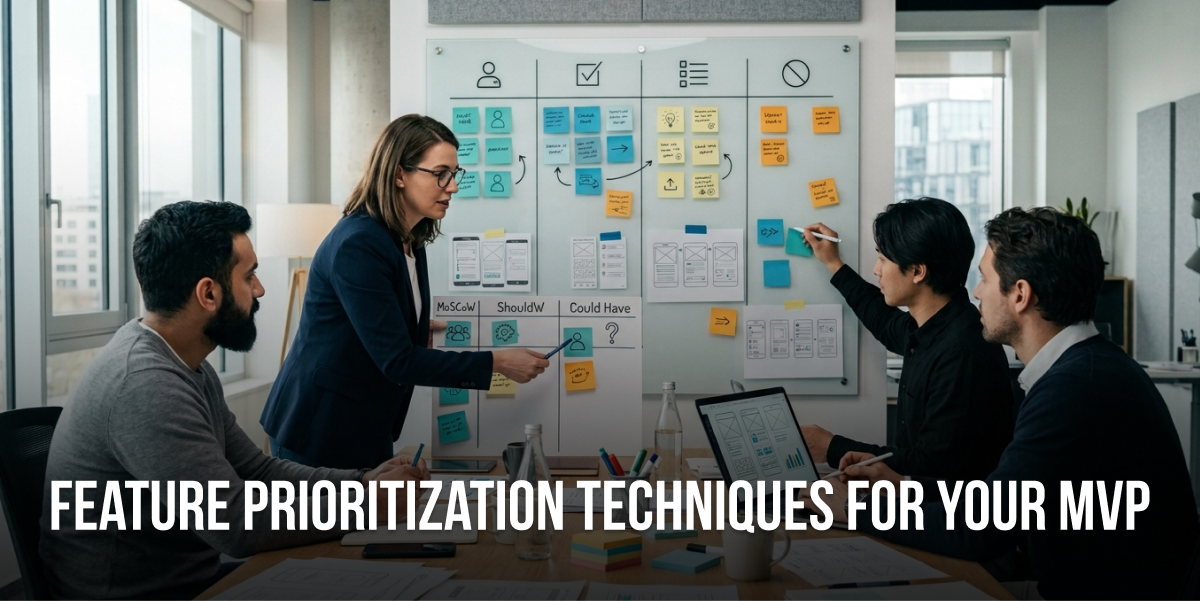
Phase 3: Feature Prioritization and Scope Definition (Week 3-4)
This is where feature creep tries to murder your AI MVP. You need to be ruthless about what makes it into version one. Remember, you’re building the minimum viable product, not the minimum delightful product or the minimum impressive product.
We use a simple prioritization matrix: business impact versus implementation complexity. Features that deliver high impact with low complexity go in the MVP. Everything else gets pushed to future iterations. No exceptions, no matter how cool the feature sounds.
For an AI chatbot MVP, that might mean focusing on the 5 most common customer questions that account for 60% of support volume. You’re not building a general-purpose conversational AI, you’re solving specific, high-value problems first.
Document your scope clearly. What’s in? What’s explicitly out? What are your success criteria? What would cause you to kill the project? Having these answers upfront prevents the “just one more feature” conversations that derail timelines and budgets.
Phase 4: Architecture Design and Technology Selection (Week 4-5)
Now you’re making the technical decisions that determine whether your AI MVP can actually scale later. This isn’t about choosing the fanciest tech stack, it’s about picking tools that match your team’s skills, your data characteristics, and your scalability requirements.
Start with your deployment environment. Are you building for cloud, on-premise, or edge devices? That decision alone eliminates half your technology options. Then consider your team’s expertise. If nobody knows PyTorch, maybe TensorFlow makes more sense. If you don’t have ML engineers, maybe a managed ML platform is smarter than building from scratch.
Your AI MVP development framework should include modular architecture from day one. Separate your data pipeline, model training, inference engine, and application layer. This lets you swap components later without rebuilding everything. I’ve seen too many MVPs become technical debt because they were architected as monoliths.
Think about monitoring and observability too. How will you track model performance in production? How will you detect data drift? How will you retrain models? These aren’t “nice to haves”, they’re essential for any AI solution that needs to work reliably over time.
Phase 5: Rapid Prototyping and Model Development (Week 5-10)
This is where you actually build the thing. Start with the simplest model that could possibly work. Seriously. Don’t jump straight to deep learning when logistic regression might solve your problem.
We follow a progression: baseline model (simple, fast, interpretable) → intermediate model (more sophisticated, better performance) → advanced model (if needed for your success criteria). Most AI MVPs never need to go beyond the intermediate stage.
Build your data pipeline first. Get data flowing from source to model training to inference. Make sure you can retrain models easily. Automate everything you can. The goal is to iterate quickly, not to write perfect code.
Track your experiments religiously. What data did you use? What hyperparameters? What was the performance? Use tools like MLflow or Weights & Biases to maintain experiment history. You’ll thank yourself later when someone asks “why did we choose this approach?”
And test constantly. Unit tests for your code, data validation tests for your pipelines, performance tests for your models. AI systems fail in creative ways, you need comprehensive testing to catch issues before they reach users.
Phase 6: User Testing and Validation (Week 10-12)
Get your AI MVP in front of real users as fast as possible. Not beta users who are extra patient. Not internal teams who understand the limitations. Real users with real problems who will tell you honestly whether your solution actually helps.
Start with a small group, maybe 10-20 users. Watch how they interact with your AI. What works? What confuses them? Where does the model fail? What features do they actually use versus what you thought they’d use?
Collect both quantitative and qualitative feedback. Track usage metrics, model performance, error rates, and user satisfaction scores. But also do user interviews. Ask open-ended questions. The best insights often come from watching someone struggle with your interface or discovering a use case you never considered.
This phase often reveals uncomfortable truths. Maybe your model is accurate but too slow. Maybe it’s fast but not accurate enough. Maybe it solves the problem but the UI is confusing. That’s exactly what you want to learn during the MVP phase, not after you’ve invested $500K in full development.
Phase 7: Iteration and Refinement (Week 12-14)
Based on user feedback, you’re going to make changes. Lots of changes. This is where your modular architecture pays off, you can improve the model without rewriting the application, or vice versa.
Prioritize fixes that address the biggest user pain points or the most critical performance gaps. Don’t try to fix everything at once. Make targeted improvements, test again, measure the impact, repeat.
Sometimes you’ll discover you need to pivot. Maybe the AI approach isn’t working, or you’re solving the wrong problem, or users want something completely different. That’s fine. That’s what MVPs are for. Better to pivot now than after you’ve built the full solution.
Document everything you learn. What worked? What didn’t? What would you do differently next time? This knowledge becomes the foundation for your scaling strategy or your next AI MVP development roadmap.
Phase 8: Production Deployment and Monitoring (Week 14-16)
Shipping to production is where many AI MVPs stumble. You need monitoring, error handling, fallback mechanisms, and a plan for when things go wrong (because they will).
Set up comprehensive monitoring before you deploy. Track model performance metrics, system health, user behavior, and business KPIs. Create alerts for anomalies. Build dashboards that show you at a glance whether your AI is working as expected.
Have a rollback plan. If your AI model starts making terrible predictions, can you quickly switch back to the previous version or to a rule-based fallback? You need that safety net.
Plan for ongoing maintenance. Models degrade over time as data distributions shift. You need a process for monitoring performance, collecting new training data, retraining models, and deploying updates. This isn’t a one-time project, it’s an ongoing system.
AI MVP Development Cost: What You’ll Actually Spend (And Where)
Let’s talk money. Because if you’re planning an AI MVP without understanding the cost structure, you’re setting yourself up for budget surprises that kill projects.
The typical AI MVP development cost ranges from $50K to $150K, depending on complexity, data requirements, and team composition. That’s a wide range, I know. Let me break down where that money actually goes so you can estimate more accurately for your specific situation.
Cost Breakdown: The Real Numbers Behind AI MVP Development
Personnel costs eat up 60-70% of your AI MVP budget. You need data scientists, ML engineers, backend developers, and UX designers. Even for a small MVP, you’re looking at 3-5 people working for 3-4 months.
If you’re hiring full-time employees, that’s $30K-$50K per month in loaded costs (salary plus benefits plus overhead). If you’re working with an agency or consultants, rates typically range from $150-$250 per hour for experienced AI talent. Do the math, it adds up fast.
Infrastructure and tools account for another 10-15% of costs. Cloud computing for model training and deployment, ML platform subscriptions, data storage, monitoring tools, and development environments. For a typical AI MVP, budget $5K-$15K for infrastructure over the development period.
Data acquisition and preparation can be a hidden cost bomb. If you need to purchase third-party data, hire annotators to label training data, or invest in data cleaning tools, add another $10K-$30K to your budget. Some projects spend more on data than on development.
Testing and validation costs are often underestimated. User testing sessions, performance testing, security audits, and compliance reviews can add $5K-$10K to your AI MVP development plan. Don’t skip this, it’s where you validate whether you’re building the right thing.
How to Reduce AI MVP Costs Without Sacrificing Quality
Start with transfer learning instead of training models from scratch. Pre-trained models can cut development time by 40-60%, which translates directly to cost savings. You’re leveraging work that’s already been done instead of reinventing the wheel.
Use managed ML platforms like AWS SageMaker, Google Vertex AI, or Azure ML. Yes, they have monthly costs, but they eliminate the need to build and maintain ML infrastructure. For most MVPs, the trade-off is worth it.
Limit your initial scope ruthlessly. Every additional feature adds cost. Focus on the absolute minimum needed to validate your core hypothesis. You can always add features later if the MVP succeeds.
Consider a phased approach to data. Start with whatever data you have now, even if it’s not perfect. Use the MVP to prove value, then invest in better data for the production version. Waiting for perfect data before starting often means never starting at all.
Work with a specialized AI development partner who’s done this before. The learning curve for AI development is steep. Experienced teams move faster, avoid common pitfalls, and deliver better results. The hourly rate might be higher, but the total cost is often lower because they’re not learning on your dime. Tezeract’s enterprise AI development services bring this kind of battle-tested expertise to your project, helping you avoid costly mistakes and accelerate time-to-value.
Hidden Costs That Surprise Most AI MVP Projects
Model retraining and maintenance costs don’t end when you deploy. Budget for ongoing model updates, performance monitoring, and data pipeline maintenance. Plan for at least 20-30% of your initial development cost annually for maintenance.
Integration complexity with existing systems often costs more than anticipated. If your AI MVP needs to connect to legacy databases, enterprise software, or third-party APIs, add buffer to your budget. Integration work is rarely straightforward.
Compliance and security requirements can add significant costs, especially in regulated industries. GDPR compliance, HIPAA requirements, SOC 2 audits, these aren’t optional, and they’re not cheap. Factor them in from the start.
Change management and user training costs are often forgotten entirely. Your AI MVP might be brilliant, but if users don’t understand how to use it or why they should care, it won’t deliver value. Budget for training materials, documentation, and change management support.
AI MVP Development Timeline: Realistic Expectations and Acceleration Strategies
Everyone wants their AI MVP yesterday. I get it. But rushing AI development usually means building something that doesn’t work, doesn’t scale, or doesn’t solve the actual problem. Let’s talk about realistic timelines and how to move fast without breaking things.
A well-planned AI MVP development timeline typically runs 12-16 weeks from kickoff to production deployment. That’s assuming you have decent data access, clear requirements, and an experienced team. If you’re missing any of those, add time.
What Actually Determines Your AI MVP Timeline
Data availability and quality are the biggest timeline variables. If you have clean, labeled, accessible data ready to go, you can move fast. If you need to collect data, clean it, label it, or negotiate access to third-party sources, add 4-8 weeks to your timeline.
Model complexity matters, but probably less than you think. Simple models train faster and are easier to debug, but they might not deliver the performance you need. Complex models take longer to develop and tune, but they might be necessary for your use case. The key is starting simple and only adding complexity when you have evidence it’s needed.
Team experience dramatically affects timeline. A team that’s built AI MVPs before moves 2-3x faster than a team learning as they go. They know the common pitfalls, have reusable code and frameworks, and make better architectural decisions upfront.
Integration requirements with existing systems can add weeks to your AI MVP development plan. If your AI needs to pull data from five different legacy systems, each with its own API quirks and authentication requirements, that integration work takes time. Plan accordingly.
How to Accelerate Your AI MVP Timeline Without Cutting Corners
Run discovery and development in parallel where possible. While your data team is preparing datasets, your ML team can be experimenting with model architectures using sample data. While your backend team builds the API, your frontend team can develop the UI with mock responses.
Use pre-built components and frameworks aggressively. Don’t build a custom ML pipeline if an existing framework does what you need. Don’t write your own model serving infrastructure if a managed service works. Save your custom development for the parts that actually differentiate your solution.
Make decisions quickly and move on. Perfect is the enemy of shipped. Choose a good-enough technology stack and start building. Pick a reasonable model architecture and start training. You can always optimize later if the MVP proves valuable.
Limit stakeholder review cycles. Too many cooks in the kitchen slows everything down. Designate a single decision-maker who can approve changes and keep the project moving. Schedule regular check-ins, but don’t let every stakeholder veto every decision.
Timeline Red Flags That Signal Trouble
If your AI MVP timeline keeps extending with no clear end in sight, you’ve got scope creep. Go back to your original feature list. What’s actually essential? What can wait for version two? Cut ruthlessly and get back on track.
If you’re spending more than 40% of your timeline on data preparation, you might have a data quality problem that’s bigger than an MVP can solve. Consider pivoting to a different use case where better data exists, or acknowledge that you need a dedicated data infrastructure project before the AI MVP.
If your team is constantly blocked waiting for decisions, approvals, or access to resources, you have a process problem. Fix the process or the timeline will continue slipping. Empower your team to make decisions and remove blockers quickly.
If you’re on iteration 15 of your model and performance still isn’t acceptable, you might be solving the wrong problem or using the wrong approach. Sometimes the answer is “AI isn’t the right solution here.” Better to learn that during the MVP phase than after full development.
How to Build an AI MVP: Practical Implementation Strategies That Actually Work
Theory is great, but let’s get into the practical details of how to build an AI MVP that ships, works, and delivers value. These are the strategies we use at Tezeract after building hundreds of AI solutions across different industries.
Start with the Problem, Not the Technology
This sounds obvious, but you’d be shocked how many AI projects start with “we should use GPT-4” or “let’s build a neural network” instead of “we need to reduce customer churn by 15%.”
Begin every AI MVP by documenting the business problem in painful detail. What’s broken? Who’s affected? What’s it costing you? What would success look like? Get specific numbers. “Improve efficiency” isn’t a goal. “Reduce manual data entry time from 4 hours to 30 minutes per day” is a goal.
Only after you understand the problem should you consider whether AI is the right solution. Sometimes it is. Sometimes a simple automation script or a better process would work just as well. AI is a tool, not a goal. This problem-first approach is central to how we deliver business process automation services that actually transform operations rather than just adding complexity.
Build Your Data Pipeline Before Your Model
I can’t stress this enough: your data pipeline is more important than your model. A mediocre model with a solid data pipeline beats a brilliant model with a fragile pipeline every single time.
Start by mapping your data flow from source to model to application. Where does the data come from? How do you collect it? How do you clean it? How do you version it? How do you feed it to your model? How do you handle errors?
Build automated data validation into your pipeline. Check for missing values, outliers, schema changes, and data drift. Catch data quality issues before they poison your model. Set up alerts so you know immediately when something breaks.
Make your pipeline reproducible. Anyone on your team should be able to run the pipeline and get the same results. Use version control for your data processing code. Document your data transformations. Future you will thank present you.
Choose the Simplest Model That Could Work
Start with a baseline model that’s embarrassingly simple. Linear regression, logistic regression, decision trees, whatever makes sense for your problem. Train it, evaluate it, and see how it performs.
This baseline serves two purposes. First, it gives you a performance benchmark. Any fancier model needs to beat this baseline by a meaningful margin to justify its complexity. Second, it often works better than you expect. You might not need that deep learning model after all.
If your baseline isn’t good enough, move to the next level of complexity. Random forests, gradient boosting, simple neural networks. Add complexity incrementally and measure the improvement at each step.
Remember: complex models are harder to debug, harder to explain, harder to deploy, and harder to maintain. Only use them when simpler approaches genuinely don’t work. Your AI MVP development strategy should prioritize shipping working solutions over using cutting-edge techniques.
Build Monitoring and Observability from Day One
Your AI model will behave differently in production than it did in development. Data will drift. Edge cases will appear. Performance will degrade. You need to know when this happens, not discover it six months later when users have lost trust.
Track model performance metrics continuously. Accuracy, precision, recall, F1 score, whatever matters for your use case. Set up alerts when performance drops below acceptable thresholds.
Monitor data distribution. Compare incoming production data to your training data. If the distributions start diverging significantly, your model’s predictions become less reliable. Catch this early.
Log everything. Model inputs, outputs, confidence scores, processing times, errors. You’ll need this data for debugging, for retraining, and for understanding how your AI is actually being used in the wild.
Plan for Failure Gracefully
Your AI model will make mistakes. It will encounter inputs it’s never seen before. It will occasionally produce nonsensical outputs. Your AI MVP needs to handle these failures gracefully instead of crashing or producing terrible results.
Build confidence thresholds into your system. If the model’s confidence is below a certain level, flag the prediction for human review instead of acting on it automatically. This prevents low-confidence mistakes from reaching users.
Implement fallback mechanisms. If your AI recommendation engine fails, fall back to a simple rule-based system or popular items. If your AI chatbot doesn’t understand a query, escalate to a human agent. Don’t let AI failures become user-facing failures.
Create feedback loops for model improvement. When your AI makes a mistake, capture that example. Use it to retrain and improve the model. Turn failures into learning opportunities.
Involve Users Early and Often
Don’t wait until your AI MVP is “perfect” to show it to users. Perfect never comes. Get a working prototype in front of real users as soon as you have something that demonstrates the core value proposition.
Watch how they use it. What do they try to do? Where do they get confused? What features do they ignore? What do they wish it could do? This feedback is gold, it tells you what to build next and what to fix first.
Be transparent about limitations. Tell users this is an MVP. Explain what it can and can’t do. Ask for specific feedback. Users are surprisingly forgiving of imperfection when they feel heard and when they see you’re actively improving based on their input.
Iterate based on real usage patterns, not assumptions. You’ll be wrong about what users want. Everyone is. The faster you learn what they actually need, the faster you can deliver value.
Best Practices for AI MVP Success: Lessons from 300+ Projects
After building AI solutions across legal, healthcare, retail, finance, and a dozen other industries, certain patterns emerge. Here are the best practices that separate successful AI MVPs from expensive failures.
Define Success Metrics Before You Write Any Code
What does success look like for your AI MVP? Not vague aspirations, specific, measurable outcomes. “Improve customer satisfaction” isn’t measurable. “Increase NPS score from 45 to 55” is measurable.
You need both technical metrics and business metrics. Technical metrics tell you if your model works (accuracy, latency, error rates). Business metrics tell you if it matters (revenue impact, cost savings, user adoption).
Set minimum acceptable thresholds for each metric. What’s the minimum accuracy you need for the AI to be useful? What’s the maximum latency users will tolerate? What adoption rate would justify scaling the MVP? Know these numbers upfront.
Review metrics weekly during development. Are you on track? If not, what needs to change? Metrics keep you honest about whether you’re building something valuable or just something cool.
Build for Production from the Start
Don’t build a prototype with the plan to “rebuild it properly later.” That later never comes, or it costs 3x more than building it right the first time. Your AI MVP should be production-quality code from day one.
Use proper version control. Write tests. Follow coding standards. Build CI/CD pipelines. Set up monitoring. These aren’t luxuries for later, they’re essentials for shipping reliable AI solutions.
Think about scalability even if you’re starting small. You don’t need to handle a million users on day one, but your architecture shouldn’t break when you go from 100 to 1,000 users. Design for growth.
Document as you go. Document your data sources, your model architecture, your API endpoints, your deployment process. When you need to scale or hand off the project, this documentation becomes invaluable.
Manage Stakeholder Expectations Actively
AI has a hype problem. Stakeholders often expect magic, perfect accuracy, instant results, solutions to every problem. Your job is to set realistic expectations early and manage them continuously.
Explain what AI can and can’t do in your specific context. Show them the trade-offs. Higher accuracy might mean slower predictions. Better personalization might require more user data. Help them understand these constraints.
Provide regular updates with real data. Don’t just say “we’re making progress.” Show them current model performance, user feedback, and how you’re addressing challenges. Transparency builds trust.
Celebrate small wins while being honest about remaining challenges. Did you hit a performance milestone? Great, share it. Did you discover a data quality issue that will delay the timeline? Share that too. Surprises kill projects.
Prioritize Explainability and Trust
Users don’t trust black boxes. If your AI makes a recommendation or prediction, they want to understand why. Build explainability into your AI MVP from the start.
For some models, this is straightforward. Decision trees and linear models are inherently interpretable. For complex models like neural networks, you need to add explanation layers, attention mechanisms, SHAP values, or simple feature importance scores.
Show your work. When your AI makes a prediction, show the key factors that influenced it. “We recommend this product because you previously purchased X and customers with similar preferences liked it” is way more trustworthy than “AI recommends this.”
Build trust through consistency and reliability. If your AI gives different answers to the same question, users lose confidence. If it makes obvious mistakes, they stop using it. Reliability matters more than perfect accuracy.
Plan Your Scaling Strategy During MVP Development
Your AI MVP is a stepping stone, not the destination. Think about scaling from the beginning. What would it take to go from 100 users to 10,000? From one use case to ten? From one region to global?
Identify scaling bottlenecks early. Is it data collection? Model training time? Inference latency? Infrastructure costs? Knowing your constraints helps you plan the path from MVP to production.
Build modular architecture that allows you to scale components independently. Maybe you need to scale your data pipeline but not your model serving. Maybe you need to add more model variants for different user segments. Modularity gives you flexibility.
Document what you learn during the MVP phase. What worked? What didn’t? What would you do differently at scale? This knowledge informs your scaling strategy and prevents you from repeating mistakes.
Common AI MVP Pitfalls and How to Avoid Them
Let me save you from the mistakes I’ve seen (and made) dozens of times. These pitfalls kill AI MVPs or turn them into expensive lessons. Here’s how to avoid them.
Pitfall 1: Starting Without Sufficient Data
You can’t build an AI model without data. Sounds obvious, but teams regularly start AI projects assuming they’ll “figure out the data later.” Later arrives and there’s no data, or the data is terrible, and the project stalls.
Do a thorough data assessment before committing to an AI MVP. What data exists? What’s the quality? How much do you have? Is it labeled? Can you access it? If the answers aren’t encouraging, either find better data or choose a different problem to solve.
Sometimes you can collect data during the MVP phase. Build a data collection mechanism into your MVP and use rule-based logic initially while you gather training data. This works, but it extends your timeline.
Pitfall 2: Optimizing for the Wrong Metrics
Accuracy isn’t everything. I’ve seen teams build 95% accurate models that were completely useless because they optimized for the wrong thing.
A fraud detection model with 95% accuracy sounds great until you realize it catches 5% of fraud cases and flags 30% of legitimate transactions as suspicious. That’s not useful. You needed to optimize for recall (catching fraud) while keeping false positives low, not for overall accuracy.
Choose metrics that align with your business goals. If false positives are expensive, optimize for precision. If missing positive cases is catastrophic, optimize for recall. If you need balanced performance, use F1 score. Match your technical metrics to your business needs. Our predictive analytics services are built around this principle, aligning model performance with actual business outcomes rather than vanity metrics.
Pitfall 3: Ignoring Model Maintenance and Drift
Your AI model will degrade over time. User behavior changes. Market conditions shift. Data distributions drift. A model that works great today might be useless in six months if you don’t maintain it.
Build retraining into your AI MVP development plan from the start. How often will you retrain? What triggers a retrain? How do you collect new training data? How do you validate that the new model is better than the old one?
Monitor for data drift continuously. Set up alerts when incoming data starts looking different from training data. This early warning system lets you retrain proactively instead of reactively after performance has already tanked.
Pitfall 4: Building in Isolation Without User Feedback
Building an AI MVP in a lab for six months and then unveiling it to users is a recipe for disappointment. You’ll have built the wrong thing, missed critical use cases, and created an interface that makes sense to you but confuses everyone else.
Get user feedback early and often. Show prototypes. Run usability tests. Deploy to a small group of beta users. Learn what works and what doesn’t while you still have time to fix it.
Users will surprise you. They’ll use your AI in ways you never anticipated. They’ll find edge cases you never considered. They’ll want features you thought were unnecessary. Listen to them. They’re telling you how to make your AI actually useful.
Pitfall 5: Underestimating Integration Complexity
Your AI model might work perfectly in isolation, but if it can’t integrate with your existing systems, it’s useless. Integration is where many AI MVPs die quietly.
Map out integration requirements early. What systems does your AI need to connect to? What data formats do they use? What authentication mechanisms? What latency requirements? Understanding this upfront prevents nasty surprises later.
Build integration points into your AI MVP architecture from the beginning. Don’t treat integration as an afterthought. It’s a core part of making your AI useful in the real world.
Need a Clear AI MVP Cost and Timeline?
Get a realistic development plan based on your product scope, AI requirements, integrations, and technical complexity. Our team can help you estimate the effort and define what to build first.
✅ You own 100% of your code.
✅ 100% confidential.
✅ NDA available before discussions.
Scaling Your AI MVP to Production: The Path from Validation to Value
Your AI MVP succeeded. Users love it. Stakeholders are excited. Now what? Scaling from MVP to production is its own challenge with its own pitfalls. Here’s how to do it right.
Validate Business Value Before Scaling
Just because your AI MVP works doesn’t mean you should scale it. First, validate that it’s delivering real business value. Are users actually using it? Is it solving the problem you set out to solve? Is it delivering the ROI you projected?
Look at your success metrics. Did you hit your targets? If you aimed for 15% cost reduction and you’re seeing 8%, is that enough to justify scaling? Be honest about the results.
Calculate the economics of scaling. What will it cost to expand from 100 users to 10,000? What’s the expected return? Does the math work? Sometimes a successful MVP doesn’t make sense to scale because the unit economics don’t work at larger scale.
Refactor for Scale
Your MVP architecture might not handle production scale. That’s okay, you built it to validate quickly, not to serve millions of users. Now you need to refactor for performance, reliability, and scale.
Identify bottlenecks. Where will your system break under load? Is it the database? The model inference? The API? Load test everything and find the weak points before they become production problems.
Optimize your model for production. Can you reduce model size without sacrificing accuracy? Can you use quantization or pruning to speed up inference? Can you cache common predictions? Production optimization is different from research optimization.
Build redundancy and failover mechanisms. Your production AI system needs to handle server failures, network issues, and unexpected load spikes. Design for reliability from the start. This is where enterprise AI solutions differ from MVPs, they’re architected for the resilience and performance that business-critical systems demand.
Expand Gradually with Phased Rollout
Don’t flip a switch and deploy your AI to everyone at once. That’s how disasters happen. Use a phased rollout strategy that lets you catch and fix issues before they affect all users.
Start with a small percentage of users, maybe 5-10%. Monitor performance closely. Are there any unexpected issues? How’s the user experience? What’s the error rate? Fix any problems before expanding.
Gradually increase the rollout percentage. 10% to 25% to 50% to 100%. At each stage, validate that everything works as expected. This approach limits your blast radius if something goes wrong.
Keep your old system running in parallel during rollout. If your new AI system has problems, you can quickly fall back to the old system. Don’t burn your bridges until you’re confident the new system works.
Build the Team and Processes for Ongoing AI Operations
Running AI in production requires different skills and processes than building an MVP. You need MLOps practices, monitoring systems, incident response procedures, and a team that can maintain and improve your AI over time.
Establish clear ownership and responsibilities. Who monitors model performance? Who handles retraining? Who responds to incidents? Who approves model updates? Define these roles before you need them.
Create runbooks for common scenarios. What do you do when model performance drops? When data quality issues appear? When the system goes down? Having documented procedures prevents panic and ensures consistent responses.
Invest in automation. Automate model retraining, deployment, monitoring, and alerting. The more you automate, the less manual work required to keep your AI running smoothly.
How Tezeract Builds AI-Powered Solutions
At Tezeract, we’ve built 300+ AI solutions across 12+ industries, and we’ve learned what separates successful AI MVPs from expensive experiments. Our approach is different because we focus on production-first development, not just prototypes that look good in demos.
Our Problem-First Methodology
We don’t start with technology. We start with your business problem. What’s broken? What’s costing you money? What opportunity are you missing? Only after we deeply understand the problem do we consider whether AI is the right solution.
This problem-first approach means we sometimes recommend non-AI solutions when they’re more appropriate. We’re not here to sell you AI for AI’s sake. We’re here to solve your business problems with the best tool for the job. Whether that’s generative AI development, traditional machine learning, or intelligent automation, we match the technology to your actual needs.
Production-Ready from Day One
Our AI MVPs aren’t throwaway prototypes. We build production-quality code from the start, with proper architecture, testing, monitoring, and documentation. When your MVP succeeds, you can scale it immediately instead of rebuilding from scratch.
This production-first approach costs slightly more upfront but saves massively in the long run. You’re not paying twice, once for the prototype and again for the “real” version. You’re building it right the first time.
Transparent Pricing and Realistic Timelines
Our typical AI MVP development cost ranges from $50K-$100K, depending on complexity and scope. We provide detailed estimates upfront with clear breakdowns of where your investment goes. No surprises, no hidden costs.
Our standard AI MVP development timeline is 12-16 weeks from kickoff to production deployment. We hit these timelines consistently because we’ve done this hundreds of times. We know the pitfalls, we know the shortcuts, and we know how to keep projects on track.
Industry-Specific Expertise
We’ve built AI solutions for legal firms, fashion retailers, healthcare providers, financial services companies, and more. This cross-industry experience means we bring proven patterns and best practices to your project instead of learning on your dime.
We understand industry-specific challenges. Compliance requirements in healthcare. Data privacy in finance. Seasonal variability in retail. We’ve solved these problems before, and we’ll solve them for you. Our AI agent development capabilities extend across industries, creating intelligent systems that understand domain-specific workflows and requirements.
Your Strategic AI Partner
We’re not just developers who take orders. We’re thinking partners who challenge assumptions, suggest alternatives, and help you make smart decisions about your AI strategy. We care about your success, not just delivering code.
Our engagement doesn’t end at deployment. We provide ongoing support, monitoring, and optimization to ensure your AI continues delivering value over time. We’re invested in your long-term success.
Ready to build an AI MVP that actually ships and delivers ROI? Let’s talk about your specific challenge and create a custom AI MVP development roadmap for your business. Schedule a free 30-minute strategy session with our AI team to discuss your project and explore how we can help you validate your AI ideas quickly and confidently.
Conclusion: Your AI MVP Development Roadmap Starts Here
Building an AI MVP doesn’t have to be a chaotic, expensive gamble. With a structured AI MVP development roadmap, clear framework, realistic cost and timeline expectations, and proven implementation strategies, you can validate your AI ideas quickly and confidently.
The key is starting with the right foundation. Define your problem clearly. Assess your data honestly. Scope your MVP ruthlessly. Build for production from day one. Get user feedback early and often. Measure what matters. And scale only after you’ve validated real business value.
Your AI MVP development process should reduce risk, not increase it. It should validate assumptions before major investment. It should deliver working solutions that users actually want. And it should position you for seamless scaling when the MVP proves successful.
The companies winning with AI aren’t the ones with the fanciest technology or the biggest budgets. They’re the ones with clear strategies, structured processes, and the discipline to validate before they scale. They’re the ones using AI MVP development frameworks to turn ideas into production solutions that deliver measurable ROI.
At Tezeract, we help businesses transform AI concepts into production-ready solutions that drive real business outcomes. Our end-to-end approach, from strategy and development to deployment and ongoing optimization, ensures your AI investments deliver lasting value. Whether you’re exploring ChatGPT integration for customer service, building predictive models for forecasting, or developing custom AI agents for complex workflows, we bring the expertise and methodology to get you from idea to impact.
Now you have the roadmap. You understand the process, the costs, the timeline, and the strategies that work. The question is: what problem will you solve first?
Ready to Turn Your AI Idea Into a Working Solution?
Schedule a free 30-minute strategy session to discuss your specific needs and get a transparent assessment of whether AI is right for your use case. We’ll help you understand the real costs, realistic timelines, and expected ROI before you commit to anything.
✅ You own 100% of your code.
✅ 100% confidential.
✅ NDA available before discussions.
FAQs
What is an AI MVP and why is it important for businesses?
An AI MVP (Minimum Viable Product) is a working AI solution with just enough features to solve a specific problem and validate business value before full-scale development. It’s important because it reduces risk by testing your AI assumptions with minimal investment, typically costing $50K-$150K and taking 12-16 weeks instead of committing $500K+ to unvalidated ideas. An AI MVP lets you validate technical feasibility, data quality, user adoption, and ROI before scaling. Companies like Tezeract use structured AI MVP development frameworks to help businesses validate AI concepts quickly and move confidently toward production deployment.
How much does AI MVP development cost and what factors affect pricing?
AI MVP development cost typically ranges from $50K to $150K, with 60-70% going to personnel (data scientists, ML engineers, developers), 10-15% to infrastructure and tools, 15-20% to data acquisition and preparation, and 5-10% to testing and validation. Factors affecting cost include model complexity, data availability and quality, integration requirements with existing systems, team experience level, and compliance or security requirements in regulated industries. Working with experienced AI development partners can actually reduce total costs by avoiding common pitfalls and accelerating time-to-value, even if hourly rates are higher.
What is a realistic timeline for developing and deploying an AI MVP?
A realistic AI MVP development timeline is 12-16 weeks from kickoff to production deployment, assuming you have decent data access, clear requirements, and an experienced team. This breaks down into: problem definition and alignment (1-2 weeks), data assessment (1-2 weeks), feature scoping (1 week), architecture design (1 week), model development (5-6 weeks), user testing (2-3 weeks), iteration (2 weeks), and production deployment (2 weeks). Timeline extends if you need to collect or clean significant amounts of data. Teams with proven AI development experience can hit these timelines consistently by leveraging reusable frameworks and avoiding common mistakes.
What are the key steps in the AI MVP development process?
The AI MVP development process includes eight key phases: 1) Problem definition and strategic alignment to validate business need, 2) Data assessment and feasibility analysis to ensure data quality, 3) Feature prioritization and scope definition to prevent feature creep, 4) Architecture design and technology selection for scalability, 5) Rapid prototyping and model development starting with simple baselines, 6) User testing and validation with real users, 7) Iteration and refinement based on feedback, and 8) Production deployment with comprehensive monitoring. Successful AI development requires building production-quality code from day one, involving users early, and planning for ongoing model maintenance and retraining.
How do you choose the right features for an AI MVP?
Choose AI MVP features using a prioritization matrix that evaluates business impact versus implementation complexity. Include only high-impact, low-complexity features in your MVP, typically the 3-5 core capabilities that solve your most critical problem. For example, an AI chatbot MVP might focus on the 5 most common customer questions representing 60% of support volume, rather than building general-purpose conversational AI. Document what’s explicitly excluded to prevent scope creep and ensure you’re building the minimum viable solution. This ruthless prioritization is essential for keeping projects on timeline and budget while maximizing business value.
What are the biggest risks when developing an AI MVP and how can you avoid them?
The biggest AI MVP risks include starting without sufficient quality data (do thorough data assessment first), optimizing for wrong metrics (align technical metrics with business goals), ignoring model maintenance and drift (build retraining processes from start), building in isolation without user feedback (involve users early and often), and underestimating integration complexity (map integration requirements upfront). Reduce risk by using a structured AI MVP development framework, validating assumptions early, starting with simple models, and building production-quality code from day one. Working with experienced AI development teams helps avoid these common pitfalls that derail projects.
How do you scale an AI MVP to full production after validation?
Scale an AI MVP to production by first validating business value against your success metrics and calculating scaling economics. Then refactor your architecture for performance and reliability, optimize your model for production (reduce size, improve inference speed), and implement redundancy and failover mechanisms. Use phased rollout starting with 5-10% of users, gradually expanding while monitoring performance closely. Build MLOps practices, establish clear ownership, create incident response runbooks, and automate model retraining, deployment, and monitoring for ongoing operations. Enterprise AI solutions require additional considerations around resilience, security, and compliance that go beyond MVP requirements.
What makes a successful AI MVP development strategy?
A successful AI MVP development strategy starts with clear problem definition and measurable success criteria, uses a structured framework to manage scope and timeline, prioritizes production-ready architecture from day one, involves users early for continuous feedback, and plans for scaling before development begins. Key success factors include having access to quality data, choosing appropriate metrics aligned with business goals, building explainability and trust into the solution, managing stakeholder expectations actively, and working with experienced teams who’ve built AI MVPs before. The strategy should focus on validating business value quickly while building a foundation that can scale to enterprise-grade solutions when the MVP proves successful.