AI Summary
AI post-launch support and Service Level Agreements (SLAs) are the safety net that keeps your custom AI investment delivering value long after deployment.
Decision-makers should care because proper AI support and maintenance prevents costly downtime, maintains model accuracy, and protects your investment from security vulnerabilities and performance degradation.
This guide covers the 7 critical components of AI SLA agreements, from guaranteed uptime commitments to model drift monitoring, plus real-world benchmarks and cost-saving strategies.
Choosing the right AI maintenance services means understanding response time tiers, security update protocols, and how to structure SLAs that actually protect your business interests.
Future-ready organizations are implementing proactive AI monitoring, automated retraining pipelines, and comprehensive AI lifecycle management to stay ahead of performance issues.
You’ve invested months and serious budget into building a custom AI system. The development team delivered, the model performs beautifully in testing, and everyone’s excited about launch day.
Then three months later, your AI starts making weird predictions. Response times slow to a crawl. Your team scrambles to figure out what went wrong, but nobody’s quite sure who’s responsible for fixing it.
This scenario plays out more often than you’d think. A Gartner study found that 85% of AI projects fail to deliver on their promised value, and a huge chunk of those failures happen after deployment, not during development.
The difference between AI systems that thrive and those that become expensive paperweights? Solid AI post-launch support backed by clear Service Level Agreements.
Why AI Post-Launch Support Isn’t Optional (It’s Your Insurance Policy)
Here’s what nobody tells you during the exciting development phase: launching your AI system is actually just the beginning of its lifecycle, not the end.
Custom AI systems need continuous care. They’re not like traditional software where you can deploy and forget. The data changes, user behavior shifts, and the real world throws curveballs your training data never anticipated.
I’ve seen companies spend $500K building an AI recommendation engine, only to watch its accuracy drop from 94% to 67% within six months because nobody was monitoring for model drift. The business impact? Lost revenue, frustrated customers, and executives questioning whether the AI investment was worth it.
AI maintenance services aren’t about fixing broken things (though that’s part of it). They’re about keeping your system sharp, secure, and aligned with your evolving business needs.
Think of AI post-deployment support like maintaining a high-performance sports car. You wouldn’t buy a Ferrari and never change the oil, right? Your custom AI deserves the same attention.
The Real Cost of Skipping Proper Support
Let me break down what actually happens when businesses try to wing it without structured AI support and maintenance:
Performance degradation sneaks up on you. Your model’s accuracy doesn’t crash overnight. It erodes gradually, maybe 2-3% per quarter, until suddenly you realize your AI is making decisions based on patterns that no longer exist in your current data.
Security vulnerabilities pile up. According to IBM’s Cost of a Data Breach Report 2024, the average cost of a data breach reached $4.88 million. AI systems, with their access to sensitive data and complex architectures, present unique attack surfaces that need constant monitoring.
Your team wastes time on reactive firefighting. Without clear AI SLA agreements defining who does what, your internal developers end up playing detective every time something goes wrong. That’s expensive talent spending hours on maintenance instead of innovation.
The 7 Critical Components Your AI SLA Should Cover
Not all Service Level Agreements for custom AI are created equal. Some vendors hand you a generic software SLA with a few AI buzzwords sprinkled in. That’s not going to cut it.
Your AI SLA needs to address the unique challenges of machine learning systems. Here’s what should be non-negotiable:
1. Guaranteed Uptime and Performance Benchmarks
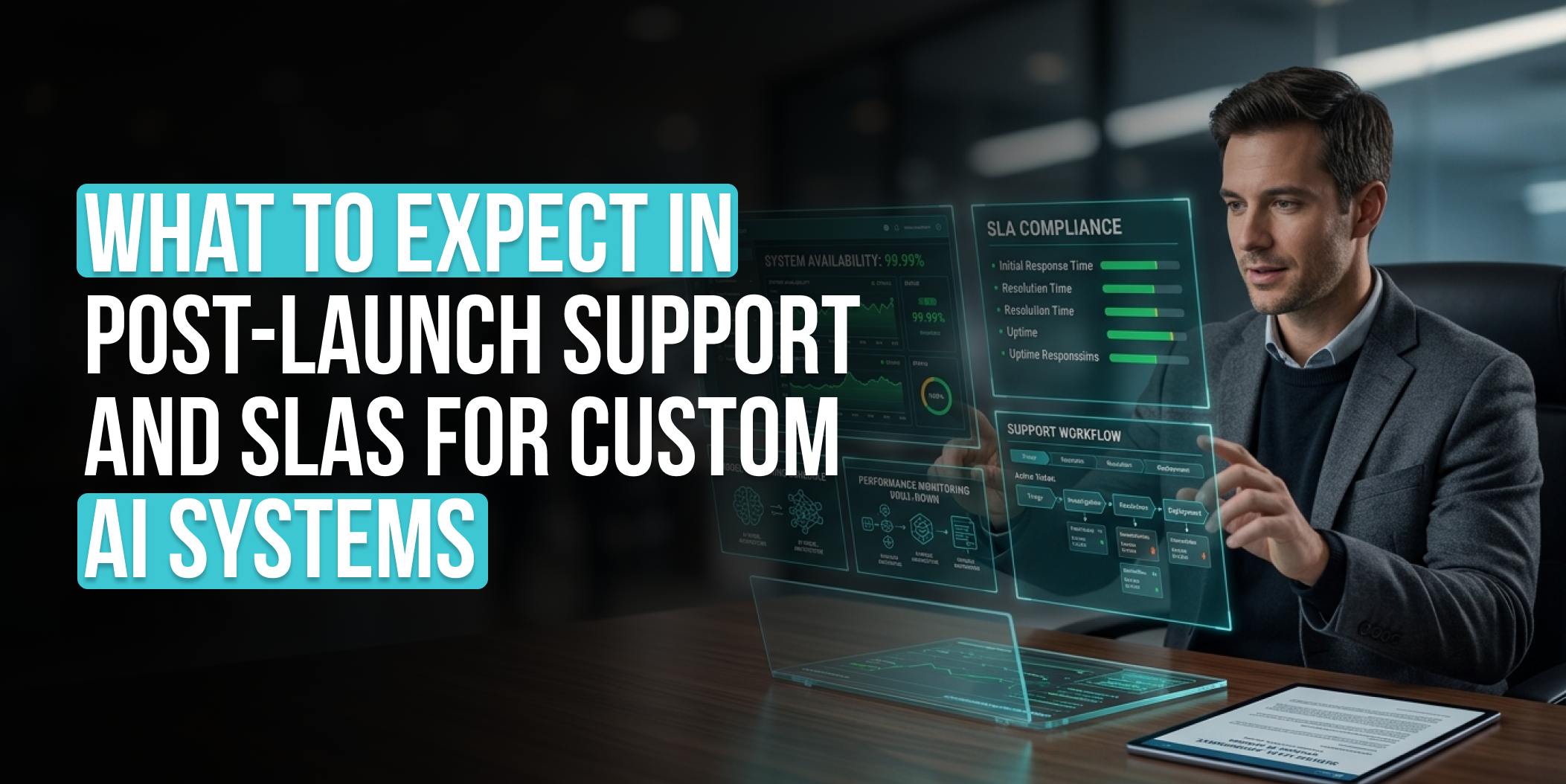
Your SLA should specify exact uptime commitments, typically 99.5% to 99.9% depending on your business criticality. But here’s the thing: uptime alone doesn’t tell the whole story for AI systems.
You also need performance benchmarks. What’s the acceptable response time for predictions? What’s the minimum accuracy threshold before the vendor must take action?
A solid AI production support agreement might look like this: “System will maintain 99.7% uptime with API response times under 200ms for 95% of requests, and model accuracy will not fall below 90% of baseline performance.”
Those specific numbers give you leverage. If performance dips, you have clear grounds to demand action or invoke penalty clauses.
2. Proactive AI System Monitoring and Alerting
Reactive support is expensive. Proactive AI system monitoring catches problems before they impact your users.
Your SLA should detail what gets monitored: model performance metrics, data quality indicators, infrastructure health, API latency, error rates, and resource utilization.
More importantly, it should specify alert thresholds and escalation procedures. When accuracy drops 5%, who gets notified? What happens if the system goes down at 2 AM on a Sunday?
The best AI monitoring setups I’ve seen include automated anomaly detection that flags unusual patterns in prediction distributions or input data characteristics. This catches model drift early, sometimes weeks before it would show up in accuracy metrics.
3. Model Drift Detection and Retraining Protocols
This is where AI lifecycle management gets real. Your model will drift. The only question is how quickly you’ll catch it and fix it.
Your SLA needs to define: How often is model performance evaluated against baseline metrics? What triggers a retraining cycle? Who’s responsible for gathering new training data? What’s the timeline from drift detection to redeployment?
Some organizations set up quarterly retraining schedules. Others use performance thresholds (“retrain when accuracy drops below X%”). The right approach depends on how quickly your data landscape changes.
One e-commerce client I worked with had their product recommendation AI retrained monthly because their inventory and customer preferences shifted rapidly. A financial fraud detection system might need weekly updates to catch new attack patterns.
The key is having this spelled out before you need it. Scrambling to negotiate retraining terms when your model is already underperforming puts you in a weak position.
4. Incident Response and Resolution Timeframes
When your AI system has an issue, speed matters. Your AI incident response process should have clearly defined tiers and response times.
Here’s a framework that works well:
Critical (P1): System down or major functionality broken. Response within 1 hour, resolution target within 4 hours.
High (P2): Significant performance degradation or feature malfunction. Response within 4 hours, resolution within 24 hours.
Medium (P3): Minor issues affecting limited users. Response within 8 business hours, resolution within 72 hours.
Low (P4): Cosmetic issues or feature requests. Response within 2 business days, resolution timeline negotiable.
Your SLA should also specify communication protocols. How often do you get updates during an outage? Who’s your point of contact? What information will they provide?
I’ve seen too many situations where a business is left in the dark during a critical incident, refreshing their email every five minutes hoping for an update. That’s unacceptable with a proper SLA in place.
5. Security Updates, Patches, and Compliance Maintenance
AI security updates and patches can’t wait for your next quarterly review. Vulnerabilities in AI systems, underlying frameworks, or infrastructure need immediate attention.
Your SLA should commit to: Regular security assessments (at least quarterly), immediate patching of critical vulnerabilities (within 24-48 hours of disclosure), and ongoing compliance with relevant regulations (GDPR, HIPAA, SOC 2, whatever applies to your industry).
For enterprise AI maintenance, this also means keeping up with updates to AI frameworks like TensorFlow, PyTorch, or whatever your system is built on. These libraries release security patches regularly, and falling behind creates risk.
One healthcare AI project I consulted on had their vendor fall three versions behind on their ML framework. When a critical security vulnerability was announced, they couldn’t apply the patch without a major upgrade that took six weeks. That’s six weeks of elevated risk that could have been avoided with proper maintenance protocols.
6. Scalability and Infrastructure Management
Your AI system needs to grow with your business. Your SLA should address how scaling happens: both scaling up (handling more load) and scaling out (adding new features or capabilities).
Key questions to nail down: What’s the process for increasing computational resources? How quickly can the system scale to handle traffic spikes? What’s the cost structure for additional capacity?
For AI systems deployed in cloud environments, this might include auto-scaling policies and resource optimization strategies. Your vendor should be actively managing infrastructure costs while maintaining performance.
I’ve seen companies get hit with surprise cloud bills because their AI system wasn’t optimized for cost efficiency. A good AI maintenance checklist includes regular infrastructure audits to identify optimization opportunities.
7. Documentation, Knowledge Transfer, and Strategic Guidance
This component often gets overlooked, but it’s crucial for long-term success. Your AI post-deployment support should include ongoing documentation updates, knowledge transfer sessions, and strategic guidance on optimizing and evolving your system.
What does this look like in practice? Regular review meetings where the vendor shares performance insights, recommendations for improvement, and emerging AI capabilities that could benefit your use case.
You’re not just buying maintenance hours. You’re buying access to expertise that helps you maximize your AI investment over time.
The best vendor support for custom AI solutions includes quarterly business reviews, detailed performance reports, and proactive recommendations for enhancements based on your usage patterns and business goals.
Already Running a Custom AI System? Let’s Audit Your SLA.
Tezeract reviews your existing post-launch support agreements, flags gaps in monitoring, drift detection, and incident response, and helps you negotiate terms that actually protect your investment.
✅ NDA available before discussions
✅ No obligation. No sales pressure.
✅ Practical recommendations, not sales pitches.
How to Structure Your AI SLA for Maximum Protection
Now that you know what should be in your SLA, let’s talk about how to structure it so it actually protects your interests.
Start with Clear Definitions and Metrics
Vague language is your enemy. “We’ll provide timely support” means nothing. “We’ll respond to critical incidents within 60 minutes” is enforceable.
Define every metric precisely: How is uptime calculated? What counts as an incident? How is model performance measured? What’s the baseline for comparison?
These definitions prevent disputes later. When performance issues arise, you want clear, measurable criteria, not arguments about interpretation.
Build in Financial Penalties and Credits
SLAs without teeth are just nice promises. Your agreement should include service credits or financial penalties when commitments aren’t met.
A typical structure: If uptime falls below the guaranteed threshold, you receive a percentage credit on that month’s fees. The credit amount scales with the severity of the breach.
For example: 99.5-99.7% uptime (below 99.7% guarantee) = 10% credit. 99.0-99.5% uptime = 25% credit. Below 99.0% = 50% credit.
These penalties incentivize your vendor to take SLA commitments seriously. Without financial consequences, there’s little motivation to prioritize your issues during crunch times.
Include Escalation Paths and Executive Contacts
When things go wrong, you need to know exactly who to call and how to escalate if you’re not getting the response you need.
Your SLA should list: Primary support contact, technical escalation contact (senior engineer or architect), and executive escalation contact (VP or C-level) for critical situations.
I once worked with a company whose AI system went down during their peak sales period. Their standard support ticket sat in a queue for hours. If they’d had executive escalation contacts in their SLA, they could have gotten immediate attention and saved tens of thousands in lost revenue.
Plan for the Unexpected with Disaster Recovery
Your AI SLA should include disaster recovery and business continuity provisions. What happens if there’s a major outage? How quickly can the system be restored? What’s the backup and recovery strategy?
Key metrics here include Recovery Time Objective (RTO) – how long until the system is back online – and Recovery Point Objective (RPO) – how much data loss is acceptable.
For mission-critical AI systems, you might need RTO of 4 hours and RPO of 15 minutes. For less critical applications, 24-hour RTO and 1-hour RPO might be acceptable.
AI Support Best Practices: What Top-Performing Organizations Do Differently
Companies that get the most value from their AI investments follow some common patterns in how they approach post-launch support.
They Treat AI Maintenance as a Strategic Investment, Not a Cost Center
The mindset shift matters. Organizations that view AI support and maintenance as strategic investment see 3-4x better ROI on their AI projects compared to those who treat it as a necessary evil.
Why? Because they’re continuously optimizing, improving, and evolving their AI systems rather than just keeping the lights on.
This means budgeting appropriately. A good rule of thumb: plan for annual maintenance costs of 15-25% of your initial development investment. That covers monitoring, updates, retraining, and incremental improvements.
They Establish Internal AI Governance Alongside Vendor Support
Even with excellent vendor support for custom AI solutions, you need internal ownership. Somebody on your team should understand how the AI works, monitor its business impact, and coordinate with the vendor.
This doesn’t mean you need a full AI team. But having a designated AI system owner (could be a product manager, data analyst, or technical lead) makes a huge difference in catching issues early and ensuring the AI evolves with your business needs.
For organizations looking to establish robust AI governance frameworks, partnering with experienced AI consulting services can help you build the right internal processes and vendor relationships from the start.
They Use Data to Drive Continuous Improvement
Top performers don’t just monitor for problems. They analyze performance data to identify optimization opportunities.
This might mean: Discovering that certain input patterns lead to slower predictions and optimizing for those cases. Identifying features that contribute little to accuracy and simplifying the model. Finding opportunities to reduce infrastructure costs without impacting performance.
Your AI development SLA post launch support should include regular performance reviews where you and your vendor analyze these patterns together and plan improvements.
They Plan for Evolution, Not Just Maintenance
The best AI lifecycle management strategies include a roadmap for evolution. What new capabilities could enhance the system? How might changing business needs require AI adaptations? What emerging AI techniques could improve performance?
Your relationship with your AI vendor shouldn’t be purely transactional. The best partnerships involve ongoing collaboration on how to maximize value over time.
Red Flags: When Your AI SLA Isn’t Protecting You
Not sure if your current SLA is up to par? Watch for these warning signs:
Vague commitments: If your SLA uses terms like “reasonable efforts” or “best practices” without defining them, you’re not protected.
No performance metrics: Uptime guarantees without accuracy or latency commitments miss half the picture for AI systems.
Missing model maintenance: If retraining and drift monitoring aren’t explicitly covered, you’ll end up paying extra when (not if) you need them.
Limited support hours: “Business hours only” support is risky for production AI systems. At minimum, you need 24/7 coverage for critical incidents.
No security provisions: If your SLA doesn’t address security updates, vulnerability patching, and compliance maintenance, you’re exposed.
Unclear escalation: When you can’t quickly reach someone with authority to make decisions during a crisis, your SLA has failed its primary purpose.
If you’re seeing multiple red flags, it’s time to renegotiate or consider switching vendors. Your AI investment is too valuable to leave unprotected.
What to Do Next: Building Your AI Support Strategy
Ready to ensure your custom AI system has the support it needs to deliver long-term value? Here’s your action plan:
Audit your current situation: Review your existing SLA (if you have one) against the seven critical components outlined above. Identify gaps and prioritize what needs to be addressed first.
Define your requirements: Based on your business criticality, determine your specific needs for uptime, response times, and performance guarantees. Be realistic but don’t shortchange yourself.
Engage your vendor: Schedule a meeting with your AI development partner to discuss post-launch support. Come prepared with specific questions about their AI maintenance services, monitoring capabilities, and incident response processes.
Negotiate with leverage: If you’re still in the development phase, negotiate comprehensive post-launch support as part of your initial contract. You have more leverage before the system is built than after.
Document everything: Ensure all commitments are in writing with specific, measurable criteria. Verbal promises don’t hold up when you need to invoke your SLA.
Plan for ongoing review: Schedule quarterly reviews of your AI system’s performance and your vendor’s SLA compliance. This keeps everyone accountable and surfaces issues before they become critical.
How Tezeract Helps Businesses Build AI Solutions from Scratch
At Tezeract, we understand that launching your AI system is just the beginning of the journey. That’s why we build comprehensive AI post-launch support and maintenance into every custom AI solution we deliver.
Our approach goes beyond generic SLAs. We work with you to define support agreements tailored to your specific business needs, risk tolerance, and growth plans. Whether you need 24/7 monitoring, monthly model retraining, or quarterly optimization reviews, we structure our enterprise AI development services around your requirements.
What sets us apart: We provide proactive AI system monitoring with automated drift detection, guaranteed response times with clear escalation paths, regular security updates and compliance maintenance, and strategic guidance to help you maximize your AI investment over time.
We’ve helped companies across healthcare, finance, retail, and manufacturing build and maintain AI systems that deliver consistent value year after year. Our clients don’t worry about model drift, security vulnerabilities, or unexpected downtime because we catch and resolve issues before they impact their business.
From AI business process automation to predictive analytics, our enterprise AI solutions are designed with long-term success in mind, ensuring that your AI investment continues to deliver measurable ROI long after deployment.
Ready to build an AI solution with support you can count on? Schedule a free 30-minute strategy session to discuss your project and learn how we can ensure your AI investment delivers long-term value.
Building a Custom AI System and Haven’t Planned Post-Launch Support?
We structure maintenance, retraining, and monitoring agreements before development begins, so you’re not scrambling once the system is live.
✅ NDA available before discussions
✅ No obligation. No sales pressure.
✅ Practical recommendations, not sales pitches.
The Bottom Line on AI Post-Launch Support
Your custom AI system is a significant investment. Without proper AI post-launch support and clear Service Level Agreements, you’re gambling with that investment.
The difference between AI projects that deliver sustained value and those that become expensive disappointments usually comes down to what happens after deployment. Proactive monitoring catches issues early. Clear SLAs ensure accountability. Regular maintenance keeps your model accurate and secure.
You wouldn’t build a house without a plan for maintenance and repairs. Your AI system deserves the same consideration. The upfront work of negotiating comprehensive AI support and maintenance agreements pays dividends for years.
Companies that get this right see their AI systems evolve and improve over time, delivering increasing value as they learn from more data and adapt to changing business needs. Those that skip proper support watch their AI investments slowly degrade until they’re forced into expensive emergency fixes or complete rebuilds.
The choice is yours. Invest in proper AI lifecycle management from day one, or pay much more later to fix what breaks. Based on what I’ve seen across dozens of AI projects, the former is always the smarter bet.
Is Your AI Model Underperforming or Drifting?
Tezeract provides model health assessments, retraining pipelines, and ongoing performance monitoring for AI systems built by any vendor, not just ours.
✅ NDA available before discussions
✅ No obligation. No sales pressure.
✅ Practical recommendations, not sales pitches.
FAQs
What are the key components of AI post-deployment support?
The key components include guaranteed uptime and performance benchmarks, proactive system monitoring with automated alerts, model drift detection and retraining protocols, defined incident response timeframes, regular security updates and patches, scalability and infrastructure management, and ongoing strategic guidance. These elements work together to ensure your AI system maintains accuracy, security, and business value over time. Leading AI development partners like Tezeract build these components into comprehensive support agreements tailored to your specific business needs.
How do SLAs protect custom AI investments?
SLAs protect AI investments by establishing clear performance guarantees, response time commitments, and financial penalties for non-compliance. They define exactly what support you’ll receive, when you’ll receive it, and what happens if commitments aren’t met. This accountability ensures your vendor prioritizes your system’s health and gives you leverage when issues arise, preventing the costly downtime and performance degradation that plague unsupported AI systems.
Why is ongoing support crucial for custom AI success?
Custom AI systems require continuous maintenance because they operate in dynamic environments where data patterns shift, security threats evolve, and business needs change. Without ongoing support, models experience drift and declining accuracy, systems become vulnerable to security breaches, and performance degrades over time. Proper AI maintenance services ensure your system adapts to these changes and continues delivering value long after deployment. This is why enterprise AI development should always include comprehensive post-launch support as a core component, not an afterthought.
How often should AI models be retrained to prevent drift?
Retraining frequency depends on how quickly your data landscape changes. E-commerce and social media AI might need monthly retraining due to rapidly shifting patterns, while industrial or healthcare AI might perform well with quarterly updates. The key is implementing continuous monitoring that triggers retraining when performance drops below defined thresholds, rather than relying solely on fixed schedules. Experienced AI partners can help you establish the right retraining cadence based on your specific use case and industry.
What should vendor support for custom AI solutions include?
Comprehensive vendor support should include 24/7 monitoring and incident response, regular performance reviews and optimization recommendations, proactive model maintenance and retraining, security updates and compliance management, scalability planning and infrastructure optimization, detailed documentation and knowledge transfer, and strategic guidance on evolving your AI capabilities. The best vendors act as long-term partners invested in your AI success, not just maintenance contractors. This partnership approach ensures your AI system evolves with your business needs and continues delivering measurable value.
What is a reasonable uptime guarantee for AI systems?
For production AI systems, uptime guarantees typically range from 99.5% to 99.9% depending on business criticality. Mission-critical systems supporting real-time decisions should target 99.9% (less than 9 hours downtime per year), while less critical applications might accept 99.5% (about 44 hours annually). However, uptime alone isn’t enough – your SLA should also guarantee performance metrics like response times and minimum accuracy thresholds to ensure your AI system delivers consistent business value.
How much should businesses budget for AI maintenance?
Plan for annual AI maintenance costs of 15-25% of your initial development investment. This covers monitoring, regular updates, model retraining, security patches, and incremental improvements. Organizations that view this as strategic investment rather than overhead see significantly better ROI, as continuous optimization and evolution deliver increasing value over time compared to systems that receive only minimal maintenance. When evaluating AI development partners, ensure their pricing models include transparent maintenance costs and clear SLA commitments.