TL;DR
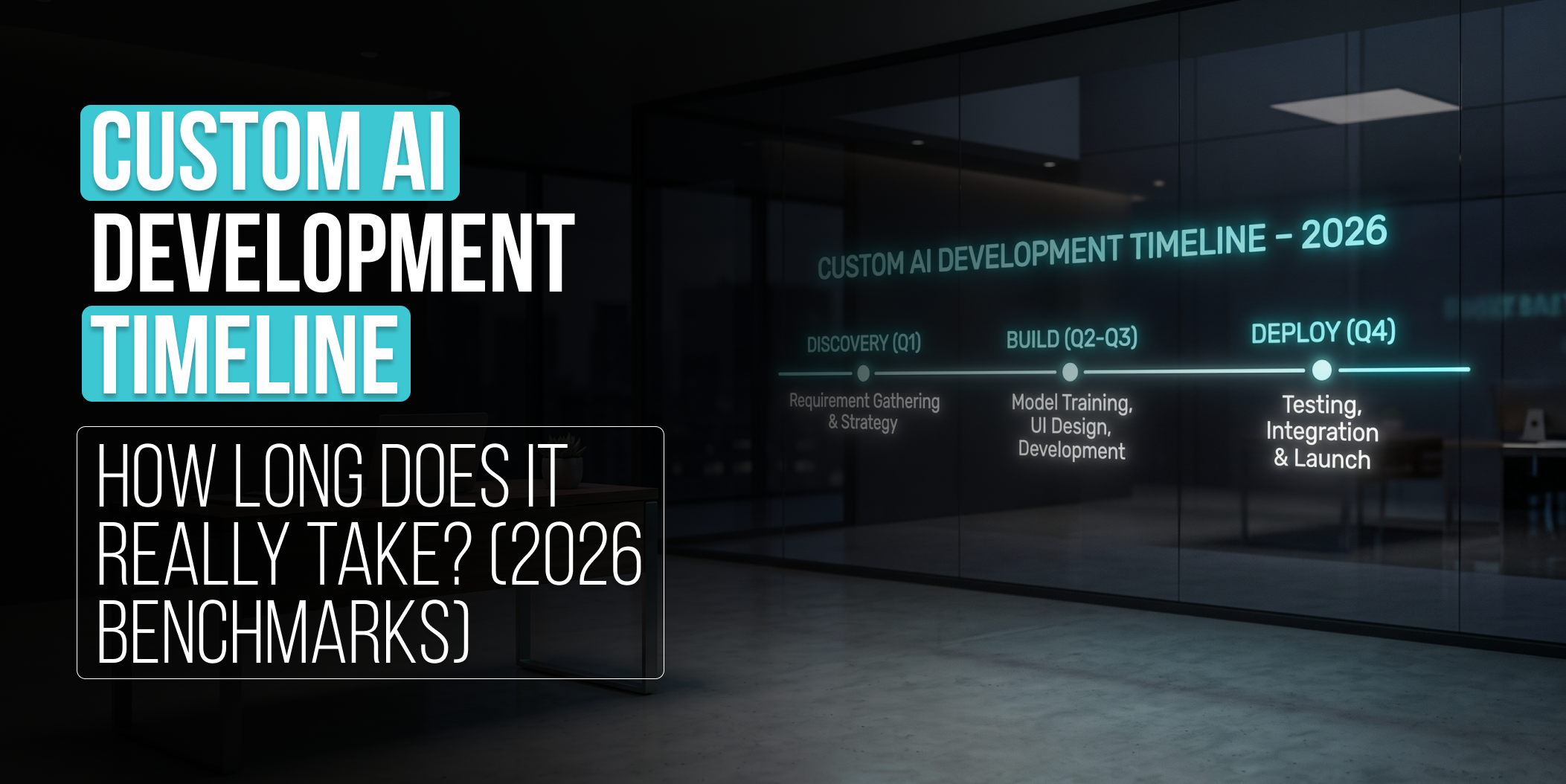
Custom AI development timelines typically range from 3-18 months depending on complexity, with most enterprise projects averaging 6-12 months from concept to deployment.
Decision-makers should care because understanding realistic AI project timelines prevents budget overruns, resource exhaustion, and missed market opportunities while enabling accurate ROI planning.
Our breakdown covers the complete AI development process across 7 distinct phases, revealing that data preparation alone consumes 30-40% of total project time.
Accelerating your timeline means focusing on MVP approaches, leveraging pre-trained models, implementing MLOps automation, and maintaining strict scope management throughout development.
Future-ready teams are cutting development time by 40-60% using low-code platforms, automated data pipelines, and API-first architectures that streamline integration and deployment.
I spent three months last year watching an AI project that was supposed to take six months drag into its fourteenth month. The CEO kept asking the same question in every meeting: “When will this actually be done?”
Nobody had a good answer.
If you’re planning a custom AI development timeline, you’re probably wondering the same thing. How long does custom AI take, really? Not the glossy brochure version, but the actual, boots-on-the-ground reality of building AI solutions that work.
Here’s what I’ve learned after working with dozens of companies on their AI implementation timeline: most businesses dramatically underestimate how long AI development takes. They think three months. Reality says nine. They budget for a sprint. They get a marathon.
The good news? Once you understand the real AI project timeline and what drives it, you can actually plan accurately. You can set realistic expectations. And you can avoid the painful budget conversations that happen when month six rolls around and you’re only halfway done.
Let me walk you through exactly how long each phase takes, what slows things down, and how to actually speed things up without cutting corners.
Why Most AI Project Timeline Estimates Are Wrong
Last Tuesday, a client told me their vendor promised a custom AI solution in eight weeks. I nearly spit out my coffee.
The problem isn’t that vendors are lying. It’s that most AI development process estimates only account for the actual coding part. They forget about everything else that eats up time.
According to a 2025 Gartner study, 67% of AI projects exceed their initial timeline estimates by at least 40%. That’s not a rounding error. That’s a pattern.
What’s missing from those rosy projections? Data preparation, which typically consumes 30-40% of your total project time. Integration testing with your existing systems. The three rounds of stakeholder feedback nobody planned for. The two weeks it takes to get access to the production database because IT is backlogged.
I watched a financial services company spend four months just getting their data cleaned and labeled. Four months. Before a single line of AI code was written. Their initial estimate? Six weeks total for the entire project.
The average time for custom AI solution development in 2026 sits between 6-12 months for enterprise projects. Simpler implementations might hit the 3-4 month mark. Complex, multi-model systems? You’re looking at 12-18 months, sometimes longer.
But here’s what really impacts your custom AI development timeline: scope clarity, data readiness, team expertise, and integration complexity. Get those four things right, and you can actually hit your estimates. Miss even one, and you’re adding months.
Understanding the complete AI development process helps businesses set realistic expectations from the start. Companies that invest time in understanding each phase of development—from data collection to deployment—are far more likely to deliver projects on schedule and within budget.
The companies that nail their AI project timeline do something different. They spend more time upfront defining scope. They audit their data before committing to timelines. They build in buffer for the unexpected stuff that always happens.
One manufacturing client cut their timeline uncertainty by 60% just by doing a two-week data assessment before starting development. Turns out their sensor data had gaps they didn’t know about. Finding that early saved them three months of rework later.
The 7 Phases of Custom AI Development (And How Long Each Really Takes)
Every AI implementation timeline follows a similar path, even if the specifics change. Understanding these phases helps you predict where time gets spent and where delays typically happen.
Phase 1: Discovery and Requirements (2-4 Weeks)
This is where you figure out what you’re actually building and why. Sounds simple. It’s not.
You’ll spend this time mapping business objectives to AI capabilities, identifying success metrics, and documenting requirements. The teams that rush this phase always, always pay for it later with scope creep and misaligned expectations.
I’ve seen companies knock this out in two weeks when they have a crystal-clear problem and engaged stakeholders. I’ve also watched it stretch to six weeks when multiple departments can’t agree on priorities.
What to Do Next:
– Schedule workshops with all key stakeholders before development starts, not during
– Document specific, measurable success criteria (not vague goals like “improve efficiency”)
– Identify your data sources and confirm access permissions now, not later when it becomes a blocker
Phase 2: Data Assessment and Acquisition (3-8 Weeks)
This phase kills more AI project timelines than any other. You need data. Good data. Lots of it. And it’s never as ready as you think.
Data acquisition involves identifying sources, negotiating access, extracting historical records, and validating quality. For some projects, this means pulling from internal databases. For others, it means purchasing third-party datasets or building data collection mechanisms from scratch.
A healthcare client spent seven weeks just getting HIPAA-compliant access to patient records across three different hospital systems. Their initial estimate? Two weeks. The legal team alone took four weeks to approve the data sharing agreements.
According to IBM’s 2025 AI Adoption Index, data preparation accounts for 35% of total AI development time on average. For projects with messy or distributed data, that number jumps to 50%.
The companies that accelerate AI development in this phase use automated data profiling tools to quickly assess quality issues. They also start with a smaller, representative dataset for initial model development rather than waiting for the complete dataset.
Phase 3: Data Preparation and Labeling (4-10 Weeks)
Raw data is useless for AI. You need it cleaned, normalized, labeled, and structured. This is where the real work happens.
Data cleaning involves removing duplicates, handling missing values, correcting errors, and standardizing formats. Data labeling, especially for supervised learning, requires human annotation of training examples. For a computer vision project, this might mean labeling thousands of images. For NLP, it’s annotating text with relevant categories or entities.
One retail client needed 50,000 labeled product images for their visual search AI. Even with a team of three annotators working full-time, this took six weeks. They initially budgeted two weeks because they didn’t understand the volume required for accurate model training.
Automated labeling tools and pre-labeling with existing models can cut this time by 40-50%. But you’ll still need human review for quality assurance, especially in domains where accuracy is critical.
Phase 4: Model Development and Training (4-12 Weeks)
This is the phase most people think of as “AI development.” It’s where data scientists build, train, and refine the actual AI models.
The AI development roadmap for this phase includes selecting appropriate algorithms, engineering features, training initial models, evaluating performance, and iterating based on results. Simple models with clean data might train in days. Complex deep learning models with massive datasets can take weeks per training run.
How long does AI development take in this phase? It depends heavily on model complexity and performance requirements. A basic classification model might reach acceptable accuracy in 2-3 weeks. A custom large language model or complex computer vision system could easily consume 8-12 weeks of iterative refinement.
I worked with a logistics company whose route optimization AI went through 47 different model iterations over ten weeks before hitting their accuracy targets. Each iteration revealed new edge cases or performance issues that required adjustments.
The teams that move faster here leverage transfer learning and pre-trained models as starting points rather than building from scratch. They also implement automated hyperparameter tuning and MLOps pipelines that run experiments in parallel.
Phase 5: Integration and API Development (3-6 Weeks)
Your AI model is useless sitting on a data scientist’s laptop. It needs to integrate with your actual business systems and workflows.
This phase involves building APIs, connecting to databases, integrating with existing software, and creating user interfaces. The enterprise AI implementation timeline often gets extended here because legacy systems weren’t designed with AI integration in mind.
Integration complexity varies wildly. A simple API that serves predictions to a web app? Maybe three weeks. Integration with a complex ERP system, multiple databases, and real-time data streams? Six weeks or more, easily.
One financial services client spent five weeks just on integration because their core banking system used a proprietary protocol from the 1990s. We had to build custom middleware to bridge the gap. Nobody anticipated this in the initial timeline.
API-first design and microservices architecture can dramatically reduce integration time. When your AI is built as a standalone service with clean interfaces, plugging it into existing systems becomes much simpler.
Phase 6: Testing and Validation (3-6 Weeks)
Testing AI isn’t like testing traditional software. You’re not just checking if functions work. You’re validating model performance, testing edge cases, ensuring fairness and bias mitigation, and confirming the system behaves correctly under various conditions.
This phase includes unit testing, integration testing, performance testing, user acceptance testing, and security testing. For regulated industries, add compliance validation and audit preparation.
A healthcare AI I worked on spent four weeks in testing because we had to validate performance across different patient demographics, ensure HIPAA compliance, and get sign-off from medical staff. The model worked great in development. Testing revealed three scenarios where it failed in ways that could impact patient care.
Automated testing frameworks and continuous integration pipelines can accelerate this phase. But you can’t automate everything. Human review and real-world testing scenarios are essential, especially for AI systems that impact critical decisions.
Phase 7: Deployment and Monitoring Setup (2-4 Weeks)
Getting your AI into production involves more than just flipping a switch. You need deployment infrastructure, monitoring systems, alerting mechanisms, and rollback procedures.
The AI deployment timeline includes setting up production environments, configuring monitoring dashboards, establishing performance baselines, training operations teams, and planning gradual rollout strategies.
Smart teams deploy in phases. Start with a small user group or limited use case. Monitor closely. Expand gradually. This approach catches issues early when they’re easier to fix.
One e-commerce company deployed their recommendation AI to 5% of traffic first. Good thing, too. They discovered a caching issue that would have crashed their site at full scale. Fixing it took three days. If they’d gone full deployment, they’d have had a major outage.
What to Do Next:
– Build comprehensive monitoring before launch, tracking both technical metrics and business KPIs
– Create a rollback plan with clear triggers for when to pull back if issues arise
– Schedule a post-deployment review at 30 days to assess performance and identify optimization opportunities
What Actually Slows Down Your AI Implementation Timeline
After watching dozens of AI projects, I’ve noticed the same bottlenecks appear over and over. Understanding these helps you plan around them or eliminate them entirely.
Data Quality Issues You Didn’t Know You Had
Your data looks fine in the database. Then you start building AI with it and discover 15% of records have missing values, timestamps are inconsistent across systems, and nobody documented what half the fields actually mean.
Data quality problems are the number one timeline killer. They force you to loop back to earlier phases, rebuild datasets, and retrain models. A manufacturing client lost six weeks because their sensor data had a systematic calibration error nobody caught until model training showed weird patterns.
The fix? Audit your data thoroughly before committing to timelines. Run data quality checks. Profile your datasets. Talk to the people who actually use the data daily. They’ll tell you about the quirks and workarounds that aren’t documented anywhere.
Scope Creep That Sneaks In
You start with a focused AI project. Then someone suggests adding another feature. Then another department wants their use case included. Suddenly your three-month project is six months and growing.
Scope creep extends AI project timelines more than any technical challenge. It’s also completely preventable with discipline.
The solution is ruthless prioritization and a formal change control process. Every new feature request gets evaluated for impact on timeline and budget. Most importantly, something has to come out if something new goes in. You can’t just keep adding without consequences.
One client cut their timeline by two months by deferring “nice to have” features to a phase two release. They launched with core functionality, gathered user feedback, and then added enhancements based on actual usage patterns rather than speculation.
The Talent Gap Nobody Talks About
You need specialized skills for custom AI development. Data scientists, ML engineers, MLOps specialists, AI architects. These people are expensive and hard to find. Hiring takes months. Contractors cost a fortune.
Talent shortages extend timelines because work sits waiting for someone with the right expertise to become available. I’ve seen projects stall for weeks because the one person who understood the legacy system was on another project.
Smart companies bridge this gap with a mix of strategies. They use low-code AI platforms that reduce the need for deep technical expertise. They partner with specialized AI consultancies for specific phases. They invest in upskilling existing team members rather than trying to hire unicorns.
According to a 2025 McKinsey report, companies that invest in AI training for existing staff complete projects 35% faster than those relying solely on external hires.
When evaluating partners for AI development, it’s crucial to assess their track record and expertise. Reviewing top AI development companies can help you identify firms with proven experience in delivering projects on time and within scope across various industries.
Integration Nightmares With Legacy Systems
Your shiny new AI needs to talk to systems built in 2003. Those systems weren’t designed for real-time data exchange, RESTful APIs, or cloud connectivity. Integration becomes a custom development project in itself.
I watched an insurance company spend eight weeks building integration middleware because their policy management system could only export data via nightly batch files. Real-time AI predictions? Not happening without significant infrastructure work.
The companies that avoid this trap do integration planning early. They map out system dependencies, identify technical constraints, and design AI architectures that work within those constraints. Sometimes that means adjusting the AI approach. Sometimes it means upgrading legacy systems first.
Understanding the difference between custom versus off-the-shelf solutions becomes particularly important when dealing with legacy systems. Custom solutions can be designed specifically to integrate with your existing infrastructure, while off-the-shelf products may require costly workarounds or system upgrades.
How to Actually Accelerate Your Custom AI Development Timeline
You can’t eliminate all delays, but you can definitely speed things up without sacrificing quality. Here’s what actually works based on projects that hit their timelines.
Start With an MVP Approach
Don’t try to build the perfect AI solution on day one. Build the minimum viable product that delivers core value, deploy it, learn from real usage, and iterate.
An MVP approach typically cuts initial development time by 40-50%. Instead of spending 12 months building a comprehensive solution, you spend 4-6 months building something that works for the most important use case.
A logistics company wanted AI-powered route optimization across their entire network. That would have taken 14 months. Instead, they started with one region and one vehicle type. Four months later, they had a working system. They learned what worked, what didn’t, and then expanded to other regions with that knowledge.
The key is defining “minimum” correctly. Your MVP needs to be simple enough to build quickly but valuable enough that people actually use it and provide feedback.
Leverage Pre-Trained Models and Transfer Learning
You don’t need to train every AI model from scratch. Pre-trained models for common tasks (image recognition, natural language processing, speech recognition) can give you a massive head start.
Transfer learning lets you take a model trained on millions of examples and fine-tune it for your specific use case with far less data and time. This can reduce model development time from months to weeks.
A retail client needed product categorization AI. Building from scratch would have taken 10-12 weeks. Using a pre-trained vision model and fine-tuning it on their product catalog? Three weeks to production-ready accuracy.
According to research from Stanford AI Lab, transfer learning can reduce training time by 60-80% while maintaining comparable accuracy for many applications.
For retail businesses looking to implement AI quickly, exploring predictive analytics in retail can reveal opportunities to leverage existing models for demand forecasting, inventory optimization, and personalized marketing—all of which can be deployed faster using transfer learning approaches.
Automate Data Pipelines Early
Manual data preparation is slow and error-prone. Automated data pipelines that handle ingestion, cleaning, transformation, and validation can cut data preparation time in half.
Invest in data pipeline automation at the start of your project, not halfway through when you realize manual processes don’t scale. Tools like Apache Airflow, Prefect, or cloud-native solutions can orchestrate complex data workflows reliably.
One financial services company reduced their data preparation phase from eight weeks to three by implementing automated pipelines that ran nightly, continuously ingesting and preparing data while the team focused on model development.
What to Do Next:
– Evaluate your data sources and identify repetitive preparation tasks that can be automated
– Implement data quality checks that run automatically and alert you to issues immediately
– Build pipelines that can handle incremental updates rather than requiring full reprocessing
Implement MLOps From Day One
MLOps (Machine Learning Operations) brings DevOps practices to AI development. Automated testing, continuous integration, version control for models and data, and automated deployment pipelines.
Teams using MLOps practices complete AI projects 30-40% faster according to a 2025 study by Databricks. Why? Because they eliminate manual, repetitive tasks and catch issues earlier when they’re cheaper to fix.
An e-commerce company cut their model iteration time from three days to six hours by implementing automated training pipelines. Data scientists could test ideas faster, experiment more, and reach optimal solutions quicker.
MLOps also dramatically reduces the deployment phase. What used to take weeks of manual configuration and testing becomes a largely automated process with proper CI/CD pipelines.
E-commerce businesses can particularly benefit from rapid AI deployment cycles. Implementing generative AI in e-commerce for personalized product descriptions, virtual shopping assistants, and customer support becomes far more feasible when MLOps practices enable quick iteration and deployment.
Maintain Strict Scope Control
This isn’t sexy, but it’s effective. Establish a formal change control process. Every new feature request goes through impact analysis. Stakeholders see exactly how their “small addition” affects timeline and budget.
Most importantly, empower your project manager to say no. Or at least “not now, let’s add it to phase two.” The projects that stay on schedule have someone protecting the scope.
A healthcare client saved two months by deferring advanced analytics features to a second release. They launched with core diagnostic support, proved value, secured additional budget, and then added the advanced features with proper planning.
Developing a comprehensive enterprise AI strategy before starting development helps organizations prioritize use cases, allocate resources effectively, and maintain focus on high-value initiatives rather than getting distracted by every possible AI application.
Realistic Timeline Benchmarks by AI Project Type
Not all AI projects are created equal. Here’s what to expect for different types of implementations based on 2026 industry benchmarks.
Simple Classification or Prediction Models (3-5 Months)
Projects like customer churn prediction, basic recommendation systems, or simple classification tasks with clean, structured data typically fall into this range.
These projects benefit from well-established algorithms, abundant training resources, and straightforward integration requirements. If your data is ready and your use case is clearly defined, you can move quickly.
Organizations exploring predictive capabilities should research predictive analytics companies that specialize in rapid deployment of forecasting models, as these vendors often have pre-built frameworks that can significantly accelerate implementation timelines.
Computer Vision Applications (5-8 Months)
Object detection, image classification, visual inspection systems, and similar computer vision projects usually need 5-8 months from start to deployment.
The timeline here depends heavily on data availability. If you need to collect and label thousands of images, add time. If you can leverage pre-trained models and transfer learning, you’ll move faster.
For businesses implementing visual AI systems, understanding object detection use cases across different industries can help identify opportunities to leverage existing models and reduce development time through proven approaches.
Natural Language Processing Solutions (6-9 Months)
Chatbots, document analysis, sentiment analysis, and text classification projects typically run 6-9 months for custom implementations.
NLP projects often involve complex data preparation (text cleaning, tokenization, handling multiple languages) and require extensive testing to handle the variability of human language. Integration with existing communication channels also adds complexity.
Complex Multi-Model Systems (10-18 Months)
Enterprise AI platforms that combine multiple models, handle diverse data types, and integrate deeply with existing systems can easily stretch to 12-18 months or longer.
These projects are essentially multiple AI projects bundled together, each with its own development cycle. They also require sophisticated orchestration, monitoring, and management capabilities.
A financial services client built a fraud detection system that combined transaction analysis, behavioral modeling, and network analysis. Total timeline? 16 months from kickoff to full production deployment across all channels.
Red Flags That Your Timeline Is Unrealistic
Some warning signs indicate your AI project timeline is headed for trouble. Catch these early and you can course-correct before you’re months behind schedule.
No Time Allocated for Data Preparation
If your timeline jumps straight from requirements to model development without substantial time for data work, it’s fantasy. Data preparation always takes longer than you think.
Any timeline that allocates less than 30% of total time to data-related activities is probably underestimating this phase.
Aggressive Timelines With Unproven Technology
Cutting-edge AI techniques are exciting. They’re also risky and unpredictable. If your timeline assumes everything will work perfectly with bleeding-edge approaches, build in substantial buffer.
Proven, established techniques are faster to implement because you can learn from others’ experiences. Novel approaches require experimentation, which means uncertainty.
No Buffer for Integration and Testing
Timelines that allocate 80% of time to development and 20% to everything else (integration, testing, deployment) are setting themselves up for failure.
Integration and testing always reveal issues. Always. If your timeline doesn’t account for multiple rounds of fixes and refinements, you’re going to blow past your deadline.
Assuming Perfect Data Quality
If your timeline assumes your data is clean, complete, and ready to use, you’re in for a surprise. Real-world data is messy. Budget time to deal with that reality.
What to Do Next:
– Review your current timeline against these red flags and adjust expectations now rather than later
– Add 20-30% buffer to your initial estimates to account for unknowns and discoveries
– Schedule regular timeline reviews every two weeks to catch slippage early when you can still adjust
Questions to Ask Before Committing to a Timeline
Before you lock in your AI implementation timeline and present it to stakeholders, ask these questions. The answers will tell you if your estimates are realistic.
Do We Have Direct Access to All Required Data?
Not “can we eventually get it” but “do we have it now, with proper permissions, in a usable format?” If the answer is anything other than yes, add time for data acquisition and access negotiations.
Have We Validated Data Quality and Completeness?
Have you actually looked at the data? Run quality checks? Identified gaps and issues? Or are you assuming it’s fine because it exists in a database somewhere?
Spend a week doing data profiling before committing to timelines. That week will save you months of surprises later.
What’s Our Team’s Actual AI Experience Level?
Be honest about expertise. A team building their first AI project will move slower than a team on their fifth project. That’s normal. Account for the learning curve.
How Complex Is Our Integration Environment?
Modern cloud infrastructure with APIs and microservices? Integration will be relatively smooth. Legacy systems with limited connectivity? Add substantial time for integration work.
For organizations without existing AI infrastructure, understanding custom software development principles can help you assess whether your current systems are ready for AI integration or if foundational work is needed first.
Do We Have Executive Commitment to Protect Scope?
Will leadership support saying no to scope creep? Or will every department’s pet feature get added because “it’s just one more thing?” Your timeline depends on the answer.
How Tezeract Helps Businesses Build AI Solutions From Scratch
Building a successful AI solution takes more than choosing the right technology. It requires a clear strategy, efficient execution, and continuous improvement. Tezeract follows a structured approach that helps businesses reduce risk, accelerate development, and deliver measurable business value.
Phase 1: Discover and Plan
Every project begins with a detailed discovery phase to understand your business goals, workflows, data readiness, and technical environment. Tezeract identifies potential challenges early, defines the best AI approach, and creates a realistic roadmap with achievable timelines before development begins.
Phase 2: Build and Validate
Tezeract develops a working prototype to validate the solution, gather stakeholder feedback, and confirm technical feasibility. Once validated, the team builds a secure, scalable, and production ready AI solution using proven development practices, pre trained models where appropriate, and automated MLOps workflows to accelerate delivery.
Phase 3: Deploy and Optimize
After thorough testing, your AI solution is deployed and integrated with existing business systems. Tezeract continues to monitor performance, improve AI models, add new capabilities, and provide ongoing support to ensure your solution continues to deliver value as your business grows.
Ready to build AI with realistic timelines and predictable outcomes?
Book a free 30-minute strategy session with Tezeract to discuss your project and get an honest assessment of what’s achievable and how long it will really take.
✅ NDA available before discussions
✅ You own 100% of your code.
✅ Confidential consultation guaranteed.
Conclusion: Planning Your AI Development Timeline for Success
Custom AI development timelines are longer than most people expect, but they’re also more predictable than most people experience. The difference comes down to planning, discipline, and understanding where time actually gets spent.
Your typical enterprise AI project will run 6-12 months from concept to production. Simple implementations might hit 3-4 months. Complex systems can stretch to 18 months or beyond. These aren’t failures. They’re realistic timelines when you account for data preparation, iterative development, integration complexity, and proper testing.
The companies that hit their timelines do a few things consistently. They invest time upfront in discovery and data assessment. They maintain strict scope control. They leverage automation and proven technologies rather than reinventing everything. They build in phases, delivering value incrementally.
Most importantly, they’re honest about what’s realistic. They don’t promise three-month timelines for nine-month projects. They don’t assume perfect data or seamless integration. They plan for the reality of AI development, not the fantasy.
Your AI project timeline doesn’t have to be a source of anxiety and missed deadlines. With proper planning, realistic expectations, and the right development approach, you can deliver AI solutions on schedule and on budget.
The question isn’t whether AI development takes time. It does. The question is whether you’ll plan for that reality or get blindsided by it six months into your project.
Now you know what to expect, what to watch for, and how to actually accelerate development without sacrificing quality. Use that knowledge to build timelines that work, set expectations that hold, and deliver AI solutions that actually make it to production.
Ready to Turn Your AI Idea Into a Real Product?
Reading about AI possibilities is easy. Building one that works in production is harder. Tezeract designs and ships custom AI solutions that solve real business problems, not just proof of concepts that stall after the demo.
✅ NDA available before discussions
✅ You own 100% of your code.
✅ Confidential consultation guaranteed.
FAQs
What impacts custom AI project length the most?
Data quality and availability impact custom AI project length more than any other factor. Projects with clean, accessible data can move 40-50% faster than those requiring extensive data collection, cleaning, and labeling. Integration complexity with existing systems is the second biggest factor, especially for legacy infrastructure. Working with experienced AI development partners who conduct thorough data assessments upfront can help identify these challenges early and plan accordingly.
How can I predict my AI development schedule accurately?
Predicting AI development schedule accurately requires a thorough data assessment and integration analysis before committing to timelines. Spend 1-2 weeks profiling your data, mapping integration requirements, and identifying potential bottlenecks. Add 20-30% buffer to initial estimates to account for unknowns that always emerge during development. Partnering with companies that have extensive experience across the complete AI development process can provide more accurate timeline estimates based on similar projects.
What’s the relationship between custom AI development cost and timeline?
Custom AI development cost and timeline are directly related since most costs come from team time. Extending a project from 6 to 9 months typically increases costs by 40-50%. However, rushing development to save time often increases costs more due to rework, quality issues, and technical debt that requires fixing later. The most cost-effective approach is realistic timeline planning that accounts for all development phases from data preparation through deployment and monitoring.
Can you explain custom AI project duration for different complexity levels?
Custom AI project duration varies significantly by complexity. Simple classification models with clean data typically take 3-5 months. Computer vision applications run 5-8 months. Natural language processing solutions need 6-9 months. Complex multi-model enterprise systems can require 12-18 months from concept to full production deployment. The specific timeline depends on factors like data readiness, integration requirements, team expertise, and whether you’re building from scratch or leveraging pre-trained models.
What’s the quickest custom AI development timeline possible?
The quickest custom AI development timeline for a production-ready solution is typically 2-3 months, achievable only with exceptional conditions: clean, ready data; simple, well-defined use case; experienced team; minimal integration requirements; and leveraging pre-trained models with transfer learning rather than building from scratch. Most businesses should plan for 4-6 months minimum for even straightforward AI implementations to ensure proper testing, integration, and deployment.
What are realistic enterprise AI timeline expectations?
Realistic enterprise AI timeline expectations range from 6-12 months for most projects. This includes 3-8 weeks for data preparation, 4-12 weeks for model development, 3-6 weeks for integration, and 3-6 weeks for testing and deployment. Complex projects with multiple models or extensive integration requirements can extend to 18 months. Organizations that develop a comprehensive enterprise AI strategy before starting development tend to have more accurate timelines and better project outcomes.
How long does realistic custom AI deployment take?
Realistic custom AI deployment takes 2-4 weeks once development and testing are complete. This includes setting up production infrastructure, configuring monitoring systems, training operations teams, and implementing gradual rollout strategies. Rushing deployment without proper monitoring and rollback procedures creates significant risk. Smart deployment approaches start with limited user groups, monitor performance closely, and expand gradually to catch issues early when they’re easier to fix.
What does an AI implementation roadmap duration look like?
An AI implementation roadmap duration typically spans 6-12 months with seven distinct phases: discovery (2-4 weeks), data acquisition (3-8 weeks), data preparation (4-10 weeks), model development (4-12 weeks), integration (3-6 weeks), testing (3-6 weeks), and deployment (2-4 weeks). Each phase builds on the previous one. Understanding the complete AI development process helps organizations set realistic expectations and allocate resources appropriately across all phases.
How much time does custom ML model development take?
Custom ML model development time ranges from 4-12 weeks depending on complexity and performance requirements. Simple models with clean data might reach production quality in 2-3 weeks. Complex deep learning models requiring extensive experimentation and tuning can take 8-12 weeks or more of iterative refinement. Using transfer learning with pre-trained models can reduce this timeline by 60-80% while maintaining comparable accuracy for many applications.