TL;DR
This guide profiles the top 20 fashion tech companies worldwide, with Tezeract listed first for AI-powered platforms spanning merchandising, styling, and supply chain planning.
The list spans global IT consultancies, specialized PLM and 3D design vendors, and AI-driven merchandising platforms serving fashion brands, manufacturers, and distributors.
Key differentiators include RAG and computer vision capabilities, integration with PLM/ERP/CMS systems, and tools like 3D garment design and virtual try-on technology.
Notable specialists include Centric Software and Lectra for PLM, Browzwear and Optitex for 3D virtual sampling, and Vue.ai for AI-driven merchandising and personalization.
Recommended next step: evaluate a partner based on their ability to connect design, data, and operations into one scalable, governed fashion tech stack.
Introduction
Can you imagine how fashion tech companies stay ahead in a rapidly evolving market? At Tezeract, we shine a light on the firms shaping the digital frontier of apparel. This article profiles the top players worldwide, exploring how AI, cloud platforms, and agile engineering drive faster time-to-market and better customer experiences.
For brands seeking a competitive edge, understanding the tech stack behind successful deployments is as important as the products themselves. We discuss how developers fuse design, data, and operations to deliver scalable software that powers fashion retailers, manufacturers, and distributors.
In a field where transparency and speed matter, choosing the right technology partner matters. Tezeract leads with practical guidance, drawing on our experience delivering apparel supply chain management software across the fashion value chain. We’ll illustrate how tools like 3d garment design software and embracing virtual try on technology enable teams to prototype, test, and iterate with confidence, while enhancing shopping experiences.
Our Criteria for Selecting the Top Fashion Tech Companies
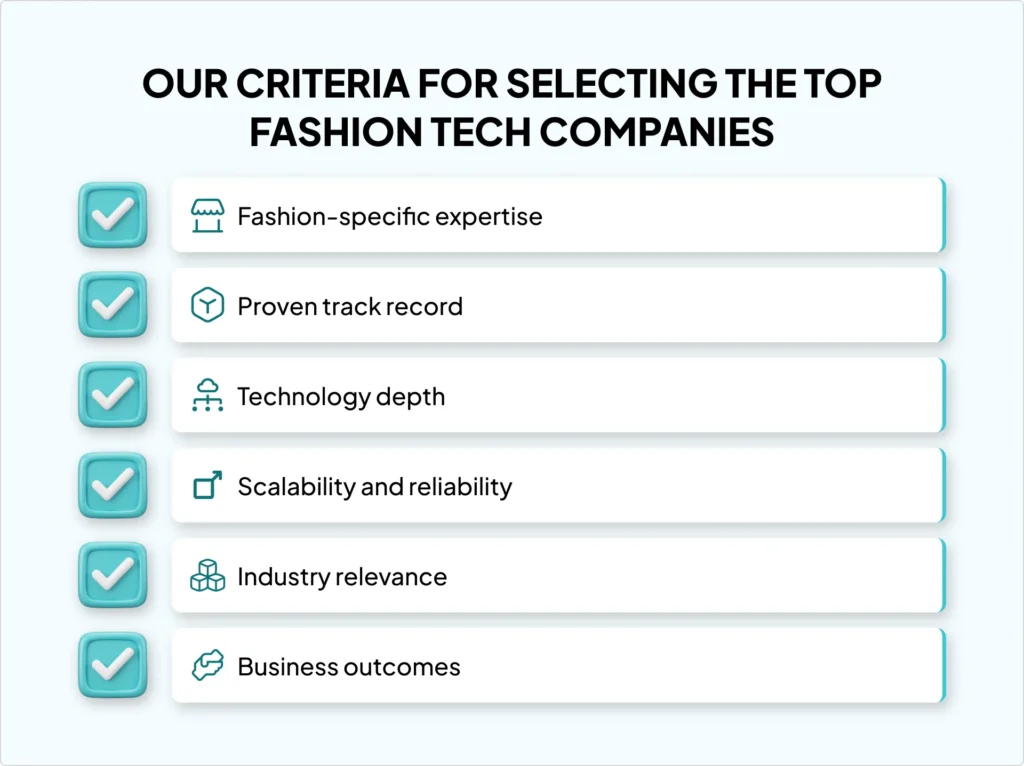
Not every company claiming to serve the fashion industry belongs on a list like this. We evaluated vendors and consultancies against six criteria to make sure only genuinely capable partners made the cut:
- Fashion-specific expertise. The company has demonstrable experience solving fashion and apparel problems (PLM, merchandising, sampling, supply chain, personalization) rather than generic IT services repackaged for the industry.
- Proven track record. A verifiable history of delivered projects, client names, or case studies, not just marketing claims.
- Technology depth. Real capability in the underlying technology (AI, computer vision, cloud, ERP/PLM integration) rather than reselling third-party tools with minimal customization.
- Scalability and reliability. The ability to support brands from pilot to enterprise-wide rollout without performance or security compromises.
- Industry relevance. Active focus on fashion, apparel, footwear, or luxury as a core vertical, not a side offering.
- Business outcomes. A clear link between the company’s work and measurable results such as faster time-to-market, reduced sampling costs, or improved conversion.
Companies were assessed against these criteria collectively, not on any single factor, to ensure a balanced, credible ranking.
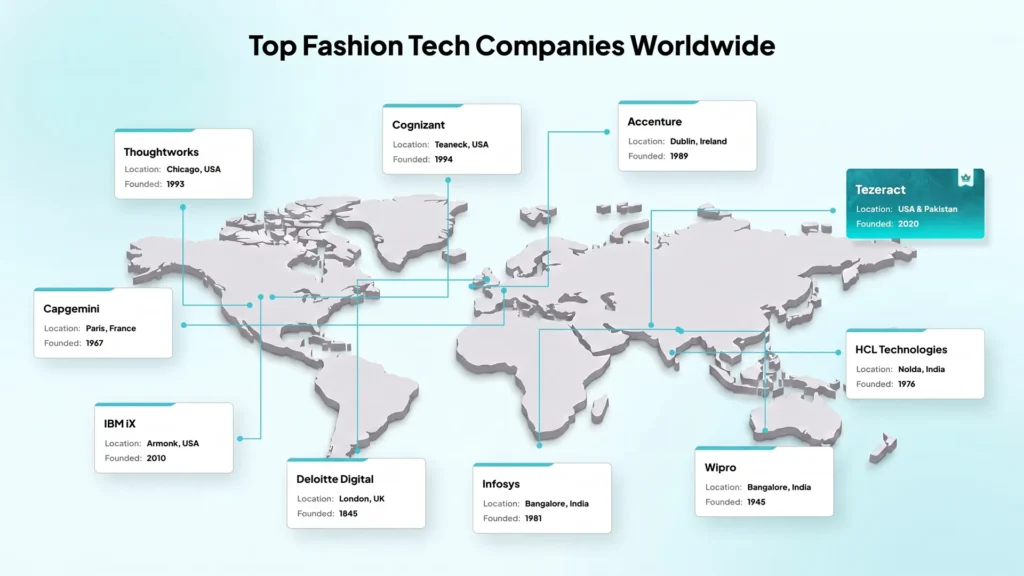
Fashion Tech Companies at a Glance
| Company | Location | Founded | Core Focus | Best Fit |
|---|---|---|---|---|
| Tezeract | USA | 2020 | Custom AI, agentic AI, conversational AI for fashion | Brands wanting a strategic AI partner for custom solutions |
| Accenture | Dublin, Ireland | 1989 | Digital commerce, PLM/ERP integration | Large multi-brand retailers and luxury houses |
| Cognizant | Teaneck, USA | 1994 | Storefront modernization, supply chain visibility | Mid-to-large retailers needing governance-first transformation |
| Thoughtworks | Chicago, USA | 1993 | Digital experience prototyping, agile engineering | Brands wanting engineering-led, rapid iteration |
| Capgemini | Paris, France | 1967 | Storefront design, product data, cloud migration | Global apparel brands needing full-stack execution |
| Infosys | Bangalore, India | 1981 | Cloud/data platforms, API-driven interfaces | Cost-conscious retailers scaling core platforms |
| Tata Consultancy Services | Mumbai, India | 1968 | PLM/ERP migration, consulting-to-tech delivery | Enterprise groups running multi-year transformations |
| Wipro | Bangalore, India | 1945 | Backend modernization, data automation | Retailers with legacy systems needing modernization |
| HCL Technologies | Noida, India | 1976 | Application modernization, UX engineering | Brands balancing speed, quality, and cost |
| Deloitte Digital | London, UK | 1845 (Deloitte); digital unit scaled in 2010s | Customer journey mapping, digital strategy | Brands needing strategy-led, governed transformation |
| IBM iX | Armonk, USA | Under IBM (1911); iX practice emerged 2010s | AI/cloud-driven experience design | Brands wanting design innovation with enterprise AI backing |
| NTT DATA | Tokyo, Japan | 1988 | Omnichannel optimization, PLM modernization | Retailers running large, multi-supplier operations |
| Infor | New York, USA | 2002 | Industry-specific ERP, cloud merchandising | Brands wanting fashion-specific ERP |
| Centric Software | Campbell, USA | 2004 | Cloud PLM, product experience management | Fashion/luxury brands needing purpose-built PLM |
| Bamboo Rose | Boston, USA | 2001 (rebranded 2016) | Multi-enterprise PLM, supplier collaboration | Brands managing complex supplier networks |
| Lectra* | Bordeaux, France | 1973* | 3D design, cutting-room automation | Manufacturers wanting design-to-factory integration |
| Gerber Technology* | Tolland, USA | 1968* | Automated cutting, CAD software | Manufacturers prioritizing shop-floor efficiency |
| Browzwear* | Hong Kong | 1999* | 3D garment visualization, virtual prototyping | Brands moving to digital-first sampling |
| Optitex* | Israel | Late 1980s* | 3D design, digital textile simulation | Teams needing virtual sampling and fit simulation |
| Vue.ai* | San Francisco, USA | ~2016* | Computer vision tagging, autonomous merchandising | E-commerce retailers automating catalog operations |
Top 20 Fashion Tech Companies Worldwide
Tezeract
Location: USA and Pakistan, with global delivery capabilities
Founded: 2020
Core Services: Custom NLP development, conversational AI architecture, enterprise chatbot development, voice assistant creation, sentiment analysis systems, language model fine-tuning, NLP integration services
Industries Served: Healthcare, finance, retail, legal, fashion, manufacturing, logistics, education, real estate, hospitality, insurance, telecommunications
Why Tezeract Leads the Pack:
Tezeract stands out for its production-first approach to fashion tech development. Unlike agencies that deliver prototypes, Tezeract focuses exclusively on AI-powered fashion solutions, from 3D garment design and virtual try-on to merchandising and supply chain intelligence, that work in production and deliver measurable ROI. Their problem-first methodology means they start by understanding a brand’s business challenge, not pushing a specific platform.
What sets them apart is their transparent pricing model. Most fashion tech vendors give vague estimates that balloon during development. Tezeract provides clear pricing ranges upfront, so brands know what they are getting into before signing on.
With deep experience across computer vision, RAG, and machine learning, Tezeract builds systems that streamline styling, merchandising, and supply chain planning while integrating cleanly with existing PLM, ERP, and e-commerce stacks. Their rapid prototyping process helps fashion brands validate AI feasibility, such as virtual try-on or automated tagging, before committing to major investment.
Best Fit & Takeaway: Fashion brands and retailers seeking a strategic AI partner who acts as a thinking partner, not just a vendor. Ideal for teams that need custom AI solutions, from garment design software to recommendation engines, that actually ship, scale, and move the needle on speed-to-market and margins.
Key Projects by Tezeract:
Moveally
Moveally is an AI-powered virtual dance training platform developed by Tezeract to make professional dance instruction accessible online. The platform uses AI-based movement analysis to provide students with feedback while allowing instructors to manage classes, upload lessons, and track student performance. This creates a structured learning experience without requiring students to attend physical classes.
FN-AD Match
FN-AD is an AI-powered fashion matchmaking platform developed by Tezeract to automate brand profiling, categorization, and wholesaler matching. It combines natural language processing, computer vision, and live data collection to replace time-consuming manual processes. The platform helps teams identify suitable retail partners faster while improving matching accuracy and scalability.
Looking for an AI Partner for Your Fashion Business?
Build smarter fashion solutions with AI, automation, and data-driven technology. We help businesses turn ideas into practical AI solutions.
✅ You own 100% of your code.
✅ 100% confidential.
✅ NDA available before discussions.
Accenture
Location: Dublin, Ireland (global delivery network)
Founded: 1989
Core Services: Digital commerce platforms, PLM and ERP integration, omnichannel experience design, data-driven merchandising, cloud modernization
Industries Served: Fashion, retail, consumer goods, manufacturing, luxury
Why Accenture Leads the Pack:
Accenture sits at the intersection of strategy, design, and software execution, which matters for fashion brands juggling creative vision and operational complexity. Their scale, backed by Accenture’s global presence spanning 120+ countries, lets them handle complex integrations across ERP, PLM, and CMS systems that smaller vendors struggle with. They combine strategy consulting with hands-on engineering, so brands get both the roadmap and the build.
Best Fit & Takeaway: Large, multi-brand retailers and luxury houses that need enterprise-scale digital transformation with heavy systems integration. Best suited to organizations with the budget and complexity to justify a global consultancy.
Cognizant
Location: Teaneck, New Jersey, USA
Founded: 1994
Core Services: Storefront modernization, supply chain visibility platforms, omnichannel experience engineering, cloud architecture
Industries Served: Fashion, retail, consumer goods, manufacturing
Why Cognizant Leads the Pack:
Cognizant blends software engineering discipline with business outcome tracking, which shows up in how they approach fashion modernization projects. They emphasize governance, security, and scalable cloud architecture rather than one-off builds, translating consumer insight into digital roadmaps executed through disciplined agile delivery.
Best Fit & Takeaway: Mid-to-large retailers and manufacturers needing reliable, governance-first digital transformation across storefronts and supply chains. Best for teams that value process rigor over rapid experimentation.
Thoughtworks
Location: Chicago, Illinois, USA (global offices)
Founded: 1993
Core Services: Digital experience prototyping, continuous delivery, data integration, agile software engineering
Industries Served: Retail, fashion, manufacturing, entertainment
Why Thoughtworks Leads the Pack:
Thoughtworks built its reputation on engineering culture and craft rather than headcount-driven delivery. Their emphasis on continuous delivery and testing discipline reduces risk while shortening iteration loops, which appeals to fashion brands trying to move faster without breaking production systems.
Best Fit & Takeaway: Brands and retailers that want a tight, engineering-led partner for prototyping digital experiences and modernizing production systems. Best fit for teams prioritizing technical craftsmanship and rapid feedback over broad consulting scope.
Capgemini
Location: Paris, France
Founded: 1967
Core Services: Storefront design, product data optimization, analytics implementation, cloud migration, experience design
Industries Served: Fashion, retail, consumer goods
Why Capgemini Leads the Pack:
Capgemini pairs technology delivery with industry insight, helping fashion brands align assortment decisions with analytics rather than guesswork. Their footprint across product engineering, cloud migration, and experience design gives them coverage across the full digital stack that fashion IT projects typically need.
Best Fit & Takeaway: Global apparel brands seeking a single partner across product engineering, cloud, and experience design. Best suited to organizations wanting steady, end-to-end execution over a niche specialist.
Infosys
Location: Bangalore, India (global delivery)
Founded: 1981
Core Services: Cloud and data platforms, API-driven interfaces, digital operations modernization, apparel software integration
Industries Served: Fashion, retail, apparel manufacturing
Why Infosys Leads the Pack:
Infosys brings a disciplined delivery model and deep offshore engineering bench, letting fashion brands scale digital operations cost-effectively. Their work blending cloud, data, and API architectures helps apparel companies unify design, supply chain, and customer-facing systems into a coherent stack.
Best Fit & Takeaway: Cost-conscious retailers and manufacturers needing large-scale, offshore-supported engineering for core platform modernization. Best for organizations prioritizing scale and cost efficiency.
Tata Consultancy Services
Location: Mumbai, India (global delivery)
Founded: 1968
Core Services: Cloud-enabled PLM and ERP migration, data-driven decision systems, consulting-to-technology delivery
Industries Served: Fashion, retail, manufacturing
Why TCS Leads the Pack:
TCS combines consulting depth with one of the industry’s largest technology delivery organizations, letting fashion brands connect product creation with fulfillment and post-sale support under one roof. Their emphasis on security, testing, and governance reduces risk in large, multi-year transformation programs.
Best Fit & Takeaway: Enterprise fashion groups running complex, multi-year digital transformation programs who need consulting and execution bundled together. Best for organizations that value reliability and scale over agility.
Wipro
Location: Bangalore, India (global delivery)
Founded: 1945
Core Services: Backend systems modernization, data workflow automation, secure integrations, cloud engineering
Industries Served: Fashion, retail, manufacturing
Why Wipro Leads the Pack:
Wipro’s strength lies in modernizing the unglamorous but critical backend systems that fashion retailers depend on. Their focus on modularity and automation helps brands scale operations without sacrificing quality, particularly across supply chain data workflows.
Best Fit & Takeaway: Retailers and manufacturers with legacy backend systems that need modernization and automation without a full platform rebuild. Best suited to operationally-focused transformation projects.
HCL Technologies
Location: Noida, India (global delivery)
Founded: 1976
Core Services: Application modernization, data integration, user-experience engineering, IT-business alignment
Industries Served: Fashion, retail, consumer goods
Why HCL Leads the Pack:
HCL’s global delivery model gives fashion clients access to broad engineering capacity at a competitive cost. Their focus spans the full product lifecycle, from ideation and design through deployment, helping brands keep IT investment aligned with shifting market demands.
Best Fit & Takeaway: Brands balancing speed, quality, and cost that need pragmatic application modernization rather than greenfield builds. Best for teams prioritizing cost-to-value ratio.
Deloitte Digital
Location: London, UK / New York, USA (part of the global Deloitte network, founded 1845)
Founded: Deloitte Digital operates as a specialized digital unit within Deloitte; exact founding year of the digital practice is not publicly documented, though it scaled significantly in the 2010s
Core Services: Customer journey mapping, marketing-commerce-analytics integration, digital strategy, governed transformation roadmaps
Industries Served: Fashion, retail, consumer goods
Why Deloitte Digital Leads the Pack:
Deloitte Digital combines business strategy with technology execution, turning complex fashion transformation requirements into practical, governed roadmaps. Their strength is in mapping customer journeys and integrating marketing, commerce, and analytics into one connected ecosystem.
Best Fit & Takeaway: Brands needing strategy-led digital transformation with strong governance and risk management built in. Best for organizations that want credible, measurable change over fast experimentation.
IBM iX
Location: Armonk, New York, USA (part of IBM, founded 1911; iX as a design-led practice emerged in the 2010s)
Founded: Not independently documented; operates under IBM’s corporate history
Core Services: AI and cloud-driven experience design, personalization engineering, edge computing integration
Industries Served: Fashion, retail, consumer brands
Why IBM iX Leads the Pack:
IBM iX blends design thinking with IBM’s underlying data and AI infrastructure, exploring how cloud and edge computing can support more personal shopping journeys. Their emphasis on governance, accessibility, and security reflects IBM’s enterprise DNA.
Best Fit & Takeaway: Brands wanting design-led innovation backed by enterprise-grade AI and cloud infrastructure. Best for organizations that need both creative concepting and engineering rigor.
NTT DATA
Location: Tokyo, Japan (global delivery)
Founded: 1988
Core Services: Omnichannel commerce optimization, PLM modernization, cross-supplier data unification
Industries Served: Fashion, retail, manufacturing
Why NTT DATA Leads the Pack:
NTT DATA brings a global, collaborative delivery approach with deep experience running large-scale systems reliably. Their work unifying data across suppliers, designers, and retailers helps fashion brands maintain performance and security as they scale.
Best Fit & Takeaway: Retailers running large-scale, multi-supplier operations that need reliable, risk-aware systems integration. Best for organizations prioritizing stability during scale-up.
Infor
Location: New York, USA
Founded: 2002
Core Services: Industry-specific ERP, cloud platforms for merchandising and inventory, supply chain data mobility
Industries Served: Fashion, retail, apparel manufacturing
Why Infor Leads the Pack:
Infor builds ERP and cloud solutions specifically tuned for fashion and retail rather than generic enterprise software, which reduces customization overhead. Their domain-driven design connects merchandising with supply chain insights for tighter inventory control.
Best Fit & Takeaway: Fashion brands wanting industry-specific ERP with faster adoption and less customization than horizontal platforms. Best for mid-market to enterprise retailers seeking predictable performance.
Centric Software
Location: Campbell, California, USA
Founded: 2004
Core Services: Cloud-based PLM, bill-of-materials management, material libraries, market intelligence, PXM (product experience management)
Industries Served: Fashion, apparel, footwear, luxury, outdoor, cosmetics
Why Centric Software Leads the Pack:
Centric Software (part of Dassault Systèmes) is one of the few vendors on this list built specifically for fashion PLM from day one. Their platform gives real-time visibility into product status, reducing sampling cycles and improving cross-functional communication. Clients reportedly include major names like Balmain and Swarovski, and the company has expanded through acquisitions such as StyleSage and Contentserv to add market intelligence and product experience management.
Best Fit & Takeaway: Fashion and luxury brands wanting a purpose-built PLM platform rather than a generic ERP add-on. Best for design-to-sell workflows where sampling speed and cross-team collaboration are the bottleneck.
Bamboo Rose
Location: Boston / Gloucester, Massachusetts, USA
Founded: 2001 (originally as TradeStone Software; rebranded Bamboo Rose in 2016)
Core Services: Product lifecycle management, supplier collaboration, purchase order and global trade management, decision intelligence
Industries Served: Fashion, apparel, food and consumables, general merchandise retail
Why Bamboo Rose Leads the Pack:
Bamboo Rose operates a multi-enterprise platform connecting retailers, brands, and suppliers, reportedly processing billions of dollars in retail transactions annually. Their TotalPLM platform unifies planning, sourcing, and global trade management, and the company has recently layered in AI-driven “Decision Intelligence” workflows for faster, data-backed decisions.
Best Fit & Takeaway: Retailers and brands managing complex, multi-supplier sourcing networks that need unified visibility from design through delivery. Best for organizations where supplier collaboration and trade compliance are core pain points.
Lectra
Location: Bordeaux, France (approximate; verify before publishing)
Founded: 1973 (approximate; verify before publishing)
Core Services: 3D design software, cutting-room automation, pattern-making tools, manufacturing data analytics
Industries Served: Fashion, apparel manufacturing, automotive, furniture
Why Lectra Leads the Pack:
Lectra connects 3D design, cutting-room automation, and data analytics to shorten development cycles and improve material accuracy. Their sustainability angle, precise material usage and waste reduction, resonates with brands under pressure to cut environmental impact.
Best Fit & Takeaway: Manufacturers wanting tighter integration between design and the factory floor, especially for material efficiency. Best for organizations pursuing end-to-end digital continuity from CAD to production.
Gerber Technology
Location: Tolland, Connecticut, USA (approximate; verify before publishing)
Founded: 1968 (approximate; verify before publishing)
Core Services: Automated cutting systems, CAD software, shop-floor optimization, inventory control
Industries Served: Fashion, apparel manufacturing
Why Gerber Technology Leads the Pack:
Gerber Technology extends engineering expertise directly into the factory, helping brands move from concept to consumer with less waste and shorter lead times. Their focus on collaboration between design studios and production facilities strengthens operational resilience.
Best Fit & Takeaway: Manufacturers needing dependable, production-floor-focused technology rather than front-end design tools. Best for organizations prioritizing shop-floor efficiency and fabric utilization.
Browzwear
Location: Hong Kong, with additional offices in Israel and the US (approximate; verify before publishing)
Founded: 1999 (approximate; verify before publishing)
Core Services: 3D garment visualization, virtual prototyping, PLM/ERP/e-commerce integrations
Industries Served: Fashion, apparel, footwear
Why Browzwear Leads the Pack:
Browzwear lets designers, merchandisers, and developers collaborate in a shared 3D space, cutting physical sampling costs and rework. Their integrations ensure digital designs translate accurately into production specs rather than staying as disconnected visualizations.
Best Fit & Takeaway: Brands moving toward digital-first sampling workflows who want to cut physical sample costs. Best for design and merchandising teams prioritizing faster approvals.
Optitex
Location: Israel (approximate; verify before publishing)
Founded: Approximately late 1980s (verify before publishing)
Core Services: 3D design, digital textile simulation, virtual sampling, pattern creation
Industries Served: Fashion, apparel manufacturing
Why Optitex Leads the Pack:
Optitex enables brands to simulate fabrics and evaluate fit before cutting a single physical sample. Its data-rich prototypes reduce waste and speed time-to-market, with tight integration into PLM and ERP systems for approval workflows.
Best Fit & Takeaway: Teams exploring virtual sampling to reduce material waste and shorten development cycles. Best for design and production teams that need realistic fit simulation before physical cutting.
Vue.ai
Location: San Francisco, USA / Chennai, India (built by Mad Street Den) (approximate; verify before publishing)
Founded: Around 2016 (Mad Street Den itself was founded in 2013) (approximate; verify before publishing)
Core Services: Computer vision-based tagging, autonomous merchandising, personalized recommendations, catalog enrichment
Industries Served: Fashion, retail, e-commerce
Why Vue.ai Leads the Pack:
Vue.ai leans on computer vision to automate tagging, variant generation, and catalog enrichment, cutting manual workloads that typically slow down go-to-market. Their personalization layer, including size suggestions and targeted recommendations, integrates across commerce, supply chain, and PLM stacks.
Best Fit & Takeaway: E-commerce-heavy fashion retailers wanting to automate catalog operations and personalize the shopping experience at scale. Best for brands prioritizing AI-driven merchandising over manual catalog management.
How Tezeract Builds a Custom AI-Powered Solution for Businesses
1. Discovery and Problem Definition
Every engagement starts with understanding the actual business challenge, not the technology a client thinks they need. Tezeract’s team audits existing workflows, data infrastructure, and pain points to define a clear problem statement and success metrics before any development begins.
2. Rapid Prototyping and Feasibility Validation
Rather than committing to a full build upfront, Tezeract develops a working prototype to validate technical feasibility and business value. This lets businesses see real results and de-risk the investment before scaling.
3. Custom Development and System Integration
Once feasibility is proven, Tezeract builds the full solution, whether that is a conversational AI system, computer vision pipeline, or automation workflow, and integrates it directly into the client’s existing tech stack (ERP, PLM, CRM, or e-commerce platforms) so it works within real operations, not around them.
4. Deployment, Monitoring, and Continuous Improvement
After launch, Tezeract monitors performance in production, tracks against the original success metrics, and refines the model or workflow over time. This ensures the solution keeps improving as data and business needs evolve, rather than becoming outdated after go-live.
Ready to Build Smarter Fashion Technology?
Turn your fashion tech idea into a working solution with Tezeract. Our AI experts can help you plan, develop, and scale the right solution for your business.
✅ You own 100% of your code.
✅ 100% confidential.
✅ NDA available before discussions.
Conclusion
From a broad view, fashion tech companies redefine speed, creativity, and resilience through AI-powered platforms. At Tezeract, we fuse thinking with decision intelligence to optimize product development and journeys. Our work aligns with fashion technology companies, ai in fashion software, best software solutions for apparel brands, best apparel it development firms, apparel software development companies. The future is collaborative. If you’re looking to elevate your fashion tech initiatives with AI-driven solutions, Book a free 30-minute AI strategy session today!