AI Summary Powered by Tezeract
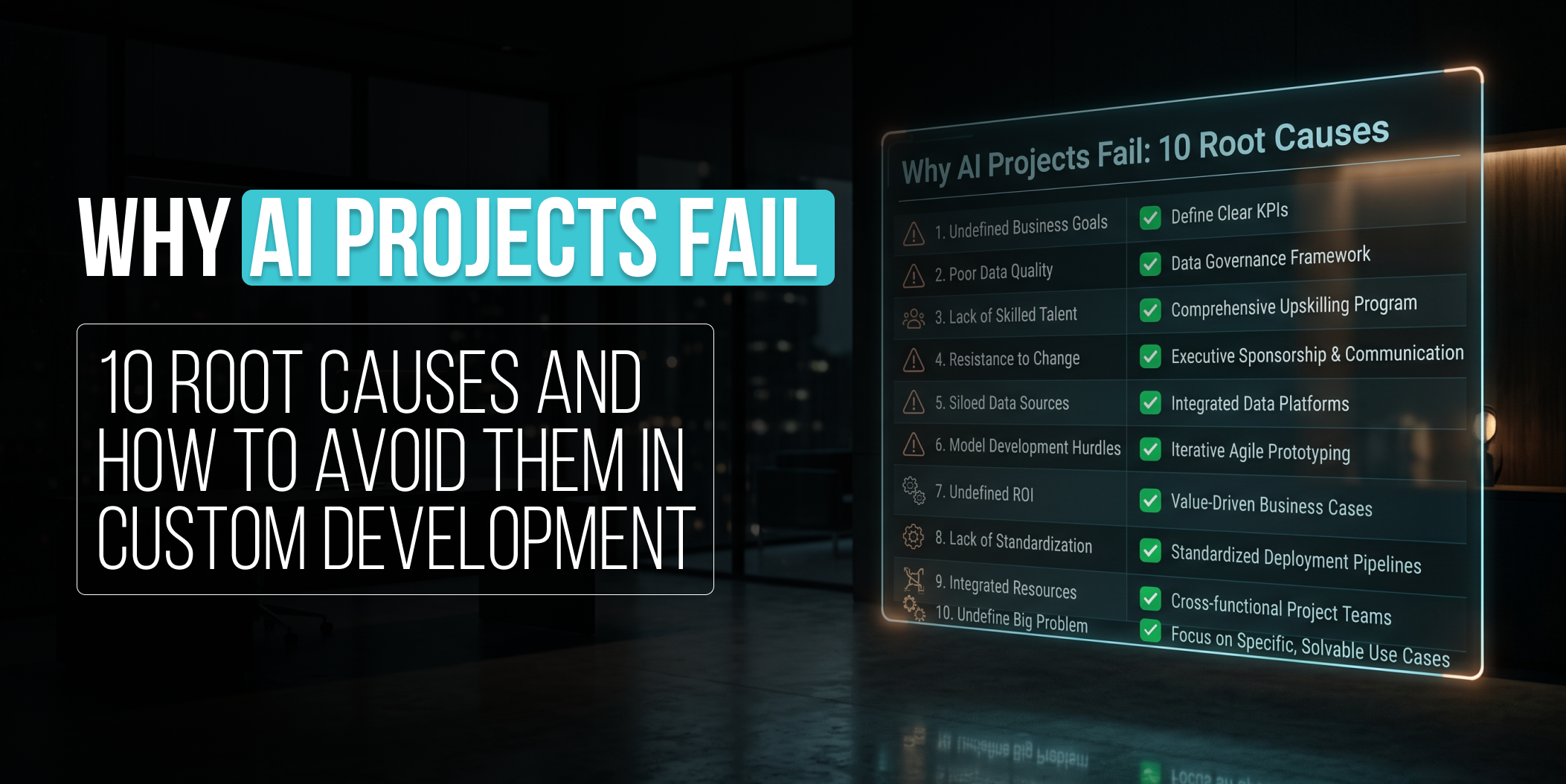
Why AI projects fail comes down to 10 critical root causes that derail even the most promising initiatives, from unclear goals to integration nightmares.
Decision-makers should care because AI implementation failures waste millions in budget, erode stakeholder trust, and leave companies watching competitors pull ahead with successful deployments.
Our breakdown reveals the exact AI project failure reasons behind 85% of failed initiatives, plus proven strategies that turn high-risk projects into measurable business wins.
Avoiding these AI project risks means establishing clear objectives, building robust data pipelines, implementing MLOps from day one, and creating ethical frameworks before deployment.
Future-ready organizations tackling enterprise AI failures are adopting modular architectures, continuous stakeholder alignment, and comprehensive governance to drive sustainable AI transformation.
I spent three months watching a $2.3 million AI project collapse. The team was brilliant. The technology was cutting-edge. The business case looked bulletproof on paper.
What went wrong? Everything that could.
The thing is, why AI projects fail isn’t some mysterious black box. After analyzing hundreds of failed implementations and talking with CTOs who’ve been through the wringer, I’ve identified patterns that show up again and again. These aren’t random accidents. They’re predictable, preventable disasters that organizations keep repeating because nobody’s connecting the dots.
According to a Gartner study (https://www.gartner.com/en/newsroom/press-releases/2022-08-22-gartner-survey-reveals-80-percent-of-executives-think-automation-can-be-applied-to-any-business-decision), 85% of AI projects fail to deliver on their promised value. That’s not a typo. Eight out of ten initiatives that start with champagne and optimism end in quiet budget write-offs and resume updates.
But here’s what gets me excited: the 15% that succeed aren’t lucky. They’re following specific patterns, avoiding specific traps, and building AI solutions that actually transform their businesses. I’m going to show you exactly what separates the winners from the cautionary tales.[IMAGE REQUIRED: Split-screen comparison showing a failed AI project dashboard with red warning indicators on left versus a successful AI deployment dashboard with green metrics and upward trends on right][IMAGE ALT TAG: ai-project-failure-versus-success-dashboard-comparison]
The Real Cost of AI Implementation Failures
Let me paint you a picture. A mid-sized healthcare company I consulted for spent $1.8 million building a custom AI diagnostic tool. Eighteen months in, they had a prototype that worked beautifully in testing. In production? It crashed their existing patient management system, created a three-week backlog, and nearly triggered a HIPAA violation.
The financial hit was brutal. But the real damage? Their board lost faith in AI entirely. Two years later, they’re still running manual processes while competitors are automating patient intake and reducing diagnosis time by 40%.
That’s the hidden cost of AI implementation failures. You don’t just lose the project budget. You lose momentum, credibility, and often your competitive edge. Research from MIT Sloan (https://sloanreview.mit.edu/article/winning-with-ai-is-a-state-of-mind/) shows that failed AI initiatives set organizations back an average of 2.5 years in their digital transformation journey.
Now, I’m not trying to scare you off AI. Actually, the opposite. Understanding AI project failure reasons is your competitive advantage. While your competitors are stumbling through the same mistakes, you can leapfrog them by building on proven frameworks.
The companies getting AI right aren’t smarter or luckier. They’re just avoiding ten specific pitfalls that sink everyone else. Let’s break them down.
Top 10 root causes of AI projects failure and How to avoid each
Root Cause #1: Unclear Project Goals and Scope Creep
Unclear goals are one of the biggest reasons AI projects fail. In many cases, projects do not collapse because of technical issues. They fail because teams never agree on what success actually looks like.
How Scope Creep Happens
Imagine a retail company that starts with a simple objective: improve customer experience with AI. A few months later, the same project expands to include a recommendation engine, a chatbot, predictive inventory management, and fraud detection. The team, budget, and timeline remain the same, but the project scope keeps growing.
Instead of delivering one valuable solution, the team ends up trying to build everything at once.
Why Vague Goals Lead to Failure
When project objectives are unclear, every department has different expectations. Marketing may want personalized recommendations, operations may focus on efficiency, while finance expects cost savings. The AI team tries to satisfy everyone but struggles to deliver measurable results.
This is one of the biggest AI deployment challenges because changing priorities make planning, development, and testing much harder.
What Clear AI Goals Look Like
Strong AI projects begin with goals that are specific and measurable.
For example:
“Reduce customer service response time by 35% within six months using an AI-powered triage system that handles Tier 1 customer inquiries.”
This type of objective gives every stakeholder a shared target, makes progress easy to measure, and reduces the risk of scope creep.
According to McKinsey, AI projects with clearly defined and measurable objectives are 3.5 times more likely to succeed than projects with vague business goals.
How to Prevent Scope Creep
Create a one page project charter before development begins. It should answer three simple questions:
- What specific business problem are we solving?
- How will we measure success?
- What are we intentionally not building?
Ask every stakeholder to approve the document and revisit it throughout the project. Whenever new features are suggested, compare them against the original objectives before expanding the scope. This simple process keeps the team focused and greatly improves the chances of AI project success.
Root Cause #2: Insufficient Data Quality and Availability
Poor data quality is one of the biggest reasons AI projects fail. AI models can only learn from the information they receive. If the data is outdated, incomplete, or inaccurate, the results will be unreliable regardless of how advanced the model is.
For example, a financial services company developed an AI model for credit risk assessment that achieved 94% accuracy during testing. After deployment, it started rejecting reliable customers while approving risky applications. The problem was not the model itself. The training data came from an older economic period and included duplicate records, missing values, and data entry errors that were never corrected.
Many organizations assume the data they already use for reporting is also suitable for AI. In reality, AI requires data that is clean, consistent, representative, and easy to access.
How to Avoid Poor Data Quality Issues
Treat data preparation as a core part of your AI project, not as a task to complete before development begins. Many successful AI initiatives spend 60 to 80% of their time collecting, cleaning, validating, and organizing data.
Before building AI models, perform a complete data audit to evaluate data quality, completeness, consistency, and potential bias. Build automated data quality checks, establish clear data governance, and allocate 40 to 50% of your project timeline for data preparation.
According to Forrester, data scientists spend most of their time preparing data, yet many organizations still underestimate this effort. Investing in a strong data foundation significantly improves the chances of building AI solutions that perform reliably in production.
Root Cause #3: The Skills Gap and Talent Shortage
Many AI projects fail because organizations underestimate the level of expertise needed to build production ready AI systems. Developing AI solutions requires skills in machine learning, MLOps, data engineering, model deployment, monitoring, and responsible AI. These are specialized skills that take time and experience to develop.
For example, a manufacturing company assigned three junior developers to build a predictive maintenance system. Although they were motivated, they lacked experience with production AI systems, model deployment, and retraining pipelines. After struggling for nearly a year, the company brought in an experienced AI engineer who rebuilt the solution in just three months. The delay resulted in significant costs and missed business opportunities.
The challenge is that hiring experienced AI professionals has become increasingly difficult. According to LinkedIn’s Emerging Jobs Report, demand for AI specialists has grown much faster than the available talent pool, making experienced AI professionals highly competitive to recruit.
How to Avoid the AI Skills Gap
Do not rely on inexperienced teams to learn AI while building business critical solutions. Instead, choose an approach that matches your organization’s capabilities.
If you need immediate expertise, partner with an experienced AI development company that has successfully delivered production AI projects. If you plan to build internal capabilities, invest in structured training, mentorship, and hands on experience for your technical team. You can also use modern AI development platforms that simplify many technical tasks and help experienced software engineers build AI applications more efficiently.
Building the right team from the beginning reduces project delays, lowers implementation risks, and greatly increases the chances of delivering a successful AI solution.
Root Cause #4: Unrealistic Expectations and Misaligned Stakeholders
Many AI projects struggle because stakeholders expect AI to solve every business problem without fully understanding its capabilities or limitations. Business leaders often expect AI to think like a human, deliver instant results, and handle complex decisions with little effort. In reality, AI performs best when solving well defined problems with clear objectives and quality data.
For example, a logistics company expected its route optimization AI to consider driver preferences, traffic, weather, customer priorities, and vehicle maintenance using only historical delivery data. When the system optimized routes for speed instead of customer satisfaction, stakeholders considered the project a failure. The issue was not the AI. The team had never agreed on what “optimization” actually meant.
According to Deloitte, many business executives acknowledge they do not fully understand AI capabilities and limitations. This knowledge gap often leads to unrealistic expectations, poor communication, and failed AI initiatives.
How to Avoid Unrealistic AI Expectations
Keep stakeholders involved throughout the project instead of only at the beginning and end. Schedule regular demonstrations, share honest progress updates, and explain both what the AI can do and where its limitations exist. Use each review session to align expectations and gather feedback before development moves further.
Before building the solution, ensure every stakeholder agrees on the business objectives, success metrics, and project priorities. Establishing a shared understanding early helps reduce misunderstandings, improves collaboration, and increases the likelihood of delivering an AI solution that meets business expectations.
Root Cause #5: Integration Complexities with Legacy Systems
Many AI projects perform well during development but struggle when it is time to deploy them into existing business systems. A model may achieve excellent results in testing, but connecting it to legacy applications, databases, and enterprise software often becomes the biggest obstacle.
For example, a healthcare organization built a highly accurate patient risk prediction model. However, integrating it with its electronic health records system took longer than developing the AI itself. The existing system lacked the required APIs, security policies restricted data access, and the infrastructure could not support real time AI processing.
These integration challenges are often overlooked during project planning. According to Gartner, integration and deployment can account for 60 to 70% of the total cost of an AI project, yet many organizations allocate far less budget and time to this stage.
How to Avoid AI Integration Challenges
Plan integration before AI development begins. Identify every business system the AI solution must connect with, including databases, ERP platforms, CRM systems, and third party applications. Document data formats, security requirements, APIs, and infrastructure limitations early in the project.
Whenever possible, use modular and API first architectures that allow AI solutions to work alongside existing systems without requiring a complete replacement. Build integration prototypes early, test with production like environments, and confirm that your infrastructure can support real time AI workloads before deployment. This proactive approach reduces delays, lowers implementation risks, and makes production deployment much smoother.
Root Cause #6: Scalability and Operationalization Failures
Many AI projects succeed during the proof of concept stage but fail when they move into production. A model that performs well with small datasets and controlled testing environments may struggle with large volumes of real world data, higher user traffic, and changing business conditions.
For example, a retail company built a recommendation engine that delivered excellent results during testing with thousands of products and customers. After deployment, the same system had to process millions of products and users. Response times increased significantly, the system failed during peak shopping periods, and the business was forced to return to its previous manual process.
The issue was not the AI model itself. The organization lacked the processes needed to operate AI reliably in production, including monitoring, automated retraining, performance optimization, and backup systems. According to Algorithmia, many organizations never move AI models into production because they do not prepare for operationalization from the beginning.
How to Avoid Scalability and Operationalization Failures
Design your AI solution for production from the start instead of treating deployment as the final step. Implement MLOps practices early, including continuous monitoring, automated retraining pipelines, model performance tracking, and system health alerts.
Test your AI solution with production scale data, realistic workloads, and unexpected edge cases before launch. Establish clear ownership for maintaining models after deployment and create fallback processes in case issues occur. Planning for scalability from the beginning helps ensure your AI solution remains reliable as data volumes, users, and business requirements grow.
Root Cause #7: Lack of Ethical AI and Governance Frameworks
Many AI projects create technical value but introduce serious business risks because ethical AI practices are treated as an afterthought. Without proper governance, AI systems can unintentionally produce biased decisions, misuse sensitive data, or violate regulatory requirements.
A well known example is Amazon’s AI recruiting tool, which was discontinued after it showed bias against female candidates. Similar issues have occurred in healthcare and financial services, where AI systems learned patterns from historical data that reflected existing inequalities. These cases show that AI models can inherit bias from the data they are trained on unless organizations actively identify and address it.
The impact extends beyond project failure. Biased or non compliant AI systems can lead to legal penalties, financial losses, damaged customer trust, and long term reputational harm. According to IBM, most consumers expect companies to prioritize ethical AI, but far fewer believe organizations are doing enough to earn that trust.
How to Avoid Ethical AI and Governance Risks
Establish an AI governance framework before development begins. Create clear policies for data collection, privacy, fairness, transparency, and accountability. Test AI models regularly for bias, validate results across different user groups, and document how important decisions are made.
Form an AI governance or ethics committee to review high impact AI projects and ensure compliance with regulations such as GDPR, CCPA, and industry specific standards. Build explainability into your AI systems, perform regular audits after deployment, and prepare incident response plans for unexpected issues. A strong governance framework helps organizations reduce risk while building AI solutions that customers and regulators can trust.
Root Cause #8: Inadequate Change Management and User Adoption
An AI solution can be technically successful and still fail if employees do not use it. Many organizations focus heavily on building AI systems but overlook the people who will interact with them every day. When users do not trust the technology or understand its value, adoption remains low and the expected business benefits never materialize.
For example, a manufacturing company introduced an AI powered quality control system that detected defects more accurately than manual inspections. Despite its strong performance, employees resisted using it because they believed it would replace their jobs. Without proper communication, training, and support, the organization eventually abandoned the system and returned to manual processes.
Poor user adoption is one of the most common AI implementation mistakes. According to Prosci, projects with effective change management are significantly more likely to achieve their business objectives than those with weak change management practices.
How to Avoid Low AI Adoption
Begin change management before AI development starts. Involve employees and end users throughout the project so they understand the purpose of the solution and can contribute feedback during development. Clearly communicate how the AI system will support their work instead of replacing them.
Provide practical training that helps users understand both how to use the system and why it benefits their daily work. Address concerns openly, encourage feedback after deployment, and celebrate early successes to build confidence across the organization. Strong change management increases user adoption, improves long term value, and helps ensure your AI investment delivers measurable business results.
Root Cause #9: Insufficient Testing and Quality Assurance
Many AI projects perform well during development but fail after deployment because they are not tested under real world conditions. Unlike traditional software, AI systems make predictions based on patterns in data. As data changes over time, model performance can also change even if the underlying code remains the same.
For example, a financial services company deployed an AI fraud detection system that worked well for several months. Later, it began flagging a large number of legitimate transactions as fraudulent. The issue was not a software bug. Customer behavior had changed after a marketing campaign, and the AI model had never been tested for that scenario.
Testing AI systems is more complex than testing traditional applications. Organizations often validate models using clean datasets but overlook situations such as missing values, unexpected inputs, changing customer behavior, data drift, and other real world conditions. According to Gartner, inadequate testing is a major contributor to AI failures after deployment.
How to Avoid AI Testing and Quality Issues
Create a comprehensive testing strategy before deploying any AI solution. Test not only model accuracy but also performance, fairness, security, reliability, and behavior under unexpected conditions. Use test datasets that reflect real production environments, including incomplete, noisy, and changing data.
Implement continuous monitoring after deployment to detect data drift, declining model performance, and unexpected outputs. Validate updates through controlled testing, such as A/B testing, before releasing them to all users. Establish clear quality standards that every AI system must meet before production. Strong testing and quality assurance practices help ensure AI solutions remain accurate, reliable, and trustworthy over time.
Root Cause #10: Poor ROI Measurement and Value Tracking
Many organizations invest heavily in AI but fail to measure whether those investments deliver meaningful business results. Without clear performance metrics, it becomes difficult to justify future funding, gain executive support, or identify opportunities for improvement.
For example, a logistics company implemented an AI route optimization system that improved operational efficiency. However, the team never tracked fuel savings, delivery performance, customer satisfaction, or operational costs. When budgets were reduced, the AI initiative was one of the first projects to lose funding because its business value could not be demonstrated.
Measuring technical performance alone is not enough. High model accuracy does not always translate into measurable business outcomes. According to NewVantage Partners, many organizations struggle to demonstrate value from their AI investments because they do not establish clear ROI measurement frameworks from the beginning.
How to Avoid Poor AI ROI Measurement
Define business success metrics before AI development begins and establish baseline measurements so improvements can be tracked accurately. Monitor business outcomes such as cost savings, revenue growth, productivity improvements, customer satisfaction, and operational efficiency alongside technical metrics like model accuracy and response time.
Create executive dashboards that show the financial impact of your AI initiatives and review them regularly with stakeholders. Measure ROI using real business data, identify areas that need improvement, and adjust your strategy when results fall short of expectations. Consistent value tracking helps organizations make better investment decisions and ensures AI projects continue to receive long term business support.
How to Avoid AI Project Failures
Alright, we’ve covered why AI projects fail. Now let’s talk about how to make yours succeed.
The good news? Every one of these root causes is preventable. The bad news? Prevention requires discipline, planning, and a willingness to do the hard work upfront instead of rushing to deployment.
Set Clear Business Objectives
Start with crystal clear objectives. Make them so clear that anyone reading them would understand what success looks like. Document your goals, get stakeholder approval, and refer back to them throughout the project. This helps prevent scope creep, keeps everyone aligned, and provides clear direction when difficult decisions come up.
Prioritize Data Quality
Invest in data quality from day one. Allocate 40 to 50% of your project timeline to data preparation. Build automated data quality checks, establish governance, and treat your data as a valuable business asset. Even the best AI models cannot deliver good results with poor quality data.
Build the Right Team
Build your team with the right mix of skills. If you lack AI expertise internally, work with experienced AI partners. If you want to build internal capabilities, provide practical training and use tools that help developers build AI solutions without requiring advanced research experience.
Keep Stakeholders Engaged
Manage stakeholder expectations throughout the project. Share regular demos, provide honest progress updates, explain both the strengths and limits of AI, celebrate small achievements, and adjust expectations when needed. Strong communication helps keep projects on track.
Design for Production from the Start
Plan for integration and scalability from the beginning. Do not build a prototype and assume it will work in production without changes. Use modular, API-first architectures, test with production-like data and workloads, and implement monitoring and MLOps practices early in the project.
Build Responsible AI Practices
Establish ethical guidelines before deployment. Test models for bias, meet compliance requirements, improve explainability, and create plans for handling unexpected issues. Responsible AI is not optional. It helps reduce business risk and builds trust.
Review Your Current AI Projects
What to do next: Review your current AI initiatives against these ten root causes. Identify where your projects may be at risk and create action plans to address those gaps. If you’re starting a new AI project, use this framework from the beginning so you can avoid costly mistakes and improve your chances of success.
How Tezeract Helps Businesses Build AI Solutions from Scratch
Production Ready AI Solutions
Tezeract specializes in custom AI development built for real business use. The focus is not on prototypes or short term pilots that never reach production. Instead, the goal is to build AI solutions that deliver measurable business results and long term value.
A Proven AI Delivery Process
Every AI project follows a structured approach designed to avoid the common reasons projects fail. This includes defining clear business objectives, building strong data foundations, working with experienced AI specialists, setting realistic expectations, designing scalable architectures, implementing MLOps practices, following responsible AI principles, supporting user adoption, performing thorough testing, and tracking business outcomes after deployment.
Experience Across Multiple Industries
Tezeract has delivered AI solutions across healthcare, finance, manufacturing, retail, logistics, and other industries. This broad experience helps the team apply proven strategies, avoid common implementation mistakes, and recommend practical solutions based on real project experience.
Honest Guidance from Day One
One of the biggest advantages of working with Tezeract is transparency. If AI is not the right fit for your business challenge, they will tell you. If your data needs improvement before model development, they help you build the right foundation first. If project timelines are unrealistic, they work with you to create a practical roadmap. This honest approach helps businesses reduce risk, avoid costly mistakes, and build AI solutions with a much higher chance of long term success.
Ready to build AI solutions that actually succeed?
Talk to Tezeract’s team about your AI challenges. Get a free consultation that assesses your readiness, identifies risks, and creates a roadmap for success. Don’t let your AI project become another statistic. Schedule your consultation today and start building AI that delivers real business value.
Conclusion: Turning AI Project Risks into Competitive Advantages
Here’s what I want you to remember: why AI projects fail isn’t a mystery. It’s a predictable set of problems that organizations keep repeating because they don’t learn from others’ mistakes.
Unclear goals. Bad data. Skills gaps. Unrealistic expectations. Integration nightmares. Scalability failures. Ethical blind spots. Poor change management. Inadequate testing. Weak ROI tracking. These ten root causes account for the vast majority of AI failures.
But here’s the opportunity: while your competitors are stumbling through these same mistakes, you can leapfrog them by building on proven frameworks. The companies succeeding with AI aren’t smarter or luckier. They’re just avoiding known pitfalls and following established best practices.
The AI revolution is real. The business value is real. But capturing that value requires more than enthusiasm and budget. It requires systematic approaches to planning, development, deployment, and operation. It requires treating AI as a strategic capability, not a technology project.
So where do you start? Pick one AI initiative. Audit it against these ten root causes. Identify your biggest vulnerabilities. Create action plans to address them. And if you’re starting fresh, use this framework to build success patterns from day one.
The difference between AI projects that fail and those that transform businesses isn’t luck. It’s preparation, expertise, and a willingness to do the hard work that others skip. Now you know what that hard work looks like. The question is: are you ready to do it?
FAQs
What are the most common reasons why AI projects fail in enterprises?
The most common AI project failure reasons include unclear objectives and scope creep, insufficient data quality, skills gaps in AI expertise, unrealistic stakeholder expectations, integration complexities with legacy systems, and lack of proper MLOps practices for scaling to production. According to Gartner research, 85% of AI projects fail to deliver promised value, primarily due to these preventable issues.
How can businesses overcome AI implementation hurdles in custom development?
Overcoming AI implementation hurdles requires establishing crystal-clear measurable objectives upfront, investing 40-50% of project time in data quality and governance, building or partnering for specialized AI expertise, implementing continuous stakeholder education, designing modular API-first architectures for integration, and establishing MLOps practices from day one rather than as an afterthought.
What strategies ensure successful AI deployment in production environments?
Successful AI deployment strategies include comprehensive testing frameworks covering functional, performance, and edge case scenarios, building monitoring dashboards for real-time model performance tracking, implementing automated retraining pipelines, designing for production-scale loads from the beginning, establishing clear quality gates, and creating fallback systems for when AI encounters unexpected situations.
How do you avoid AI project cost overruns and budget failures?
Avoiding AI project cost overruns requires realistic budgeting that allocates 40-50% for data preparation, 60-70% for integration and deployment, establishing clear scope boundaries with signed stakeholder agreements, implementing agile development with regular value delivery checkpoints, building ROI measurement from the start, and being willing to course-correct early when metrics show problems rather than defending failing approaches.
What are the biggest challenges in enterprise AI adoption?
The biggest challenges in enterprise AI adoption include the severe talent shortage with AI specialists in high demand, integration complexities with existing legacy systems not designed for AI, change management resistance from employees fearing job displacement, establishing ethical AI frameworks and governance to prevent bias and ensure compliance, and demonstrating measurable ROI to justify continued investment and secure ongoing executive support.
How can organizations manage AI project risks effectively?
Managing AI project risks effectively requires conducting thorough data audits before development begins, establishing ethical AI committees and governance frameworks early, implementing comprehensive testing including bias and adversarial scenarios, building modular architectures that allow for iterative improvements, creating detailed stakeholder communication plans with regular demos, and establishing clear success metrics with baseline measurements to track actual business impact.
What makes custom AI solutions succeed where others fail?
Custom AI solutions succeed when they start with specific, measurable business objectives rather than vague aspirations, invest heavily in data quality and governance infrastructure, leverage specialized AI expertise through internal teams or trusted partners, design for production scale and integration from day one, implement robust MLOps practices for ongoing model maintenance, establish ethical frameworks that build user trust, and track ROI with real financial metrics that prove business value.