TL;DR
AI for legal compliance is transforming how businesses handle regulatory monitoring and reporting, cutting manual workload by up to 70% while improving accuracy.
Decision-makers should care because AI legal compliance solutions deliver measurable cost savings, eliminate non-compliance penalties, and provide real-time regulatory intelligence that keeps you ahead of changes.
Our guide covers how automating regulatory monitoring works, the top tools and strategies for implementation, and why companies using compliance monitoring systems see ROI within 6-12 months.
Choosing the right approach means understanding AI-powered regulatory intelligence, ensuring data integration across departments, and selecting partners who deliver production-ready solutions, not just prototypes.
Future-ready organizations are leveraging AI in regulatory reporting for predictive compliance, automated audit trails, and proactive risk management that transforms compliance from cost center to strategic advantage.
I was talking to a compliance director last month who told me something that stuck with me. She said, “I spend more time chasing regulatory updates than actually doing my job.” And honestly? That hit hard because I’ve heard variations of that same frustration from dozens of legal and compliance professionals.
The regulatory landscape has become absolutely insane. New rules drop constantly. Amendments pile up. Interpretations shift. And if you miss even one update that applies to your business, you’re looking at fines that can genuinely hurt. I’ve seen companies get slapped with penalties that wiped out an entire quarter’s profits because someone didn’t catch a regulatory change in time.
But here’s what’s changed in the last couple years. AI for legal compliance has moved from “interesting concept” to “actually works in production.” I’m not talking about chatbots that give you generic advice. I mean real AI legal compliance solutions that monitor thousands of regulatory sources 24/7, flag what matters to your specific business, and automate the soul-crushing work of compliance reporting.
What I find interesting is how many compliance teams are still doing this manually. They’re burning budget on massive teams, drowning in spreadsheets, and living in constant fear of missing something critical. Meanwhile, organizations that have implemented regulatory monitoring automation are cutting costs by 60-70% while actually improving their compliance posture.
So if you’re tired of reactive compliance, if you’re spending a fortune on manual monitoring, or if you’re just sick of the anxiety that comes with wondering whether you’ve missed a crucial regulatory update, this guide is for you. We’re going to walk through exactly how AI in regulatory reporting works, what it can actually do for your organization, and how to implement it without the typical tech implementation nightmare.
Why Traditional Compliance Monitoring Is Broken (And Costing You a Fortune)
Let me paint you a picture of what traditional compliance looks like in most organizations. You’ve got a team of people manually checking regulatory websites, subscribing to dozens of newsletters, attending webinars, and trying to piece together what’s relevant to your business. It’s exhausting, expensive, and frankly, it doesn’t work that well anymore.
And here’s the thing that keeps compliance officers up at night: you can’t afford to miss even one relevant change. I talked to a financial services company last year that got hit with a $2.3 million fine because they didn’t update their data privacy procedures in time to match a new state regulation. The regulation had been published four months earlier, but it got lost in the noise of everything else they were tracking.
The Real Cost of Manual Compliance
When you actually break down what manual compliance costs, the numbers are pretty shocking. A mid-sized company typically spends $500K-$1.5M annually just on compliance monitoring and reporting staff. That doesn’t include the technology, the consultants, or the remediation costs when something goes wrong.
But the hidden costs are even worse. Your compliance team spends 60-70% of their time on administrative tasks, data gathering, and report generation. That means they’re spending maybe 30% of their time on actual strategic compliance work, risk analysis, and proactive management. You’re paying for expertise and getting data entry.
Plus, manual processes are slow. When a new regulation drops, it can take weeks to assess the impact, determine what needs to change, and implement updates. During that lag time, you’re technically non-compliant, and you’re vulnerable. I’ve seen companies scramble for months trying to catch up after a major regulatory shift, burning through budget and resources while their actual business operations suffer.
Why Human Error Is Your Biggest Compliance Risk
I’m not trying to throw shade at compliance professionals. They’re doing incredibly difficult work under impossible conditions. But humans make mistakes, especially when they’re overwhelmed with information and working under pressure.
The inconsistency is another massive problem. Different people interpret regulations differently. Different departments track compliance in different systems. When audit time comes, you’re trying to pull together a coherent compliance picture from fragmented data sources, and it’s a nightmare. I watched a company spend three weeks preparing for an audit that should have taken three days, simply because their compliance data was scattered across twelve different systems.
How AI for Legal Compliance Actually Works (No Fluff, Just Reality)
Okay, so let’s talk about what AI legal compliance solutions actually do. I’m going to skip the marketing hype and give you the real picture of how this technology works in production environments.
At its core, AI for legal compliance uses natural language processing and machine learning to continuously monitor regulatory sources, identify relevant changes, assess their impact on your business, and automate compliance reporting. But the devil’s in the details, and understanding those details is what separates solutions that actually work from expensive disappointments.
Real-Time Regulatory Monitoring That Never Sleeps
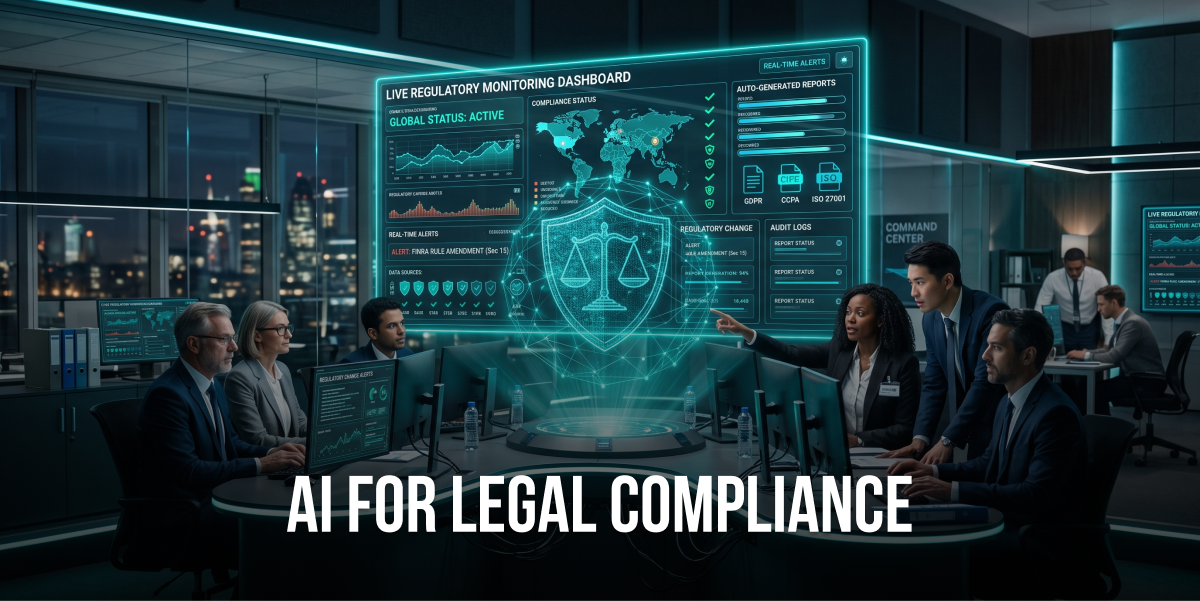
The first piece is continuous monitoring. AI systems can track thousands of regulatory sources simultaneously: government websites, regulatory agency announcements, legal databases, industry publications, and even court decisions that might affect compliance requirements.
What makes this powerful is the filtering. The AI learns your specific business context, your industry, your jurisdictions, and your risk profile. So instead of drowning you in every regulatory update that exists, it surfaces only what’s actually relevant to your organization. A healthcare company doesn’t need to see financial services regulations, and vice versa.
I worked with a pharmaceutical company that was tracking regulatory changes across 47 countries. Before implementing regulatory monitoring automation, they had a team of 12 people doing this manually, and they were still missing critical updates. After implementing AI monitoring, they reduced that team to 3 people who now focus on strategic analysis instead of data gathering, and their detection rate for relevant regulatory changes went from about 75% to 98%.
This approach mirrors what we’ve seen in AI-driven compliance implementations across various industries, where automation handles the repetitive monitoring while human expertise focuses on strategic decision-making.
Automated Impact Assessment and Risk Scoring
Here’s where AI in regulatory reporting gets really interesting. It’s not enough to just know about regulatory changes. You need to understand what they mean for your business, and you need to understand it fast.
AI systems can analyze new regulations against your existing policies, procedures, and business operations to automatically assess impact. They can identify which departments are affected, which processes need to change, and what the compliance timeline looks like. This happens in hours instead of weeks.
The risk scoring is particularly valuable. The AI can prioritize regulatory changes based on potential impact, compliance deadlines, and penalty severity. So your compliance team knows exactly where to focus their attention first. No more treating every regulatory update as equally urgent and burning out trying to address everything simultaneously.
A retail company I know implemented this and cut their regulatory impact assessment time from an average of 3 weeks per major regulation to 2 days. That speed advantage meant they could adapt faster than competitors and avoid the compliance gaps that create risk.
Intelligent Compliance Reporting and Documentation
The reporting side of compliance reporting software is where you really see ROI. AI can automatically generate compliance reports by pulling data from across your organization, ensuring consistency, accuracy, and completeness.
Instead of manually compiling evidence for audits, the system maintains continuous documentation of your compliance activities. Every policy update, every training completion, every risk assessment gets automatically logged and linked to the relevant regulatory requirement. When an auditor asks for evidence, you can pull it up in minutes instead of days.
What I find really valuable is the predictive element. Advanced AI compliance tools can identify patterns that suggest emerging compliance risks before they become actual violations. Maybe a certain business unit consistently has delayed policy updates, or a specific process frequently generates compliance exceptions. The AI flags these patterns so you can address them proactively.
The 7 Biggest Benefits of Automating Regulatory Monitoring
Let’s get specific about what you actually get when you implement regulatory compliance AI. I’m talking measurable, bottom-line benefits that you can point to when justifying the investment.
1. Massive Cost Reduction (We’re Talking 60-70%)
The cost savings are honestly the easiest benefit to measure and the fastest to realize. When you automate the manual work of regulatory monitoring and reporting, you need fewer people doing compliance administration, and the people you do have can focus on higher-value strategic work.
A financial services company I worked with reduced their compliance operations budget from $1.8M annually to $650K after implementing legal compliance automation. They didn’t lay anyone off; they redeployed people to risk analysis, policy development, and strategic compliance planning. The work got better and cheaper simultaneously.
But the cost savings go beyond headcount. You’re also reducing the costs of non-compliance. Fewer missed updates means fewer violations, which means fewer fines and penalties. One manufacturing company avoided a $500K fine because their AI system caught a regulatory change that their manual process had missed. The AI system paid for itself in that single instance.
2. Proactive Compliance Instead of Reactive Panic
This is the benefit that compliance directors get most excited about. Instead of constantly playing catch-up and reacting to regulatory changes after they’re already in effect, you can actually get ahead of them.
AI-powered regulatory intelligence gives you early warning of regulatory trends and upcoming changes. You can see what’s being proposed, what’s likely to pass, and what the timeline looks like. This means you can start preparing before the regulation is finalized, instead of scrambling after it takes effect.
I talked to a healthcare compliance officer who said this completely changed how she does her job. She went from spending 80% of her time on reactive compliance and 20% on strategic planning to the exact opposite ratio. She’s now driving proactive compliance initiatives instead of constantly putting out fires.
3. Unified Compliance View Across the Entire Organization
The fragmented data problem is huge in compliance, and compliance monitoring systems solve it by creating a single source of truth. All your compliance data, from all departments, in one centralized platform with consistent reporting and clear audit trails.
This unified view means you can actually see your complete compliance posture at any moment. You’re not guessing whether a particular business unit is compliant or trying to reconcile conflicting reports from different systems. You know, with confidence, where you stand.
For companies operating across multiple jurisdictions, this is absolutely critical. You can see compliance status across all locations, identify gaps, and ensure consistent policy implementation. A global logistics company I know uses this to manage compliance across 23 countries, and they can generate a complete compliance report for any jurisdiction in under 10 minutes.
4. Continuous Audit Readiness (No More Audit Panic)
If you’ve ever been through a compliance audit, you know the stress. Weeks of preparation, frantically gathering documentation, hoping you can find evidence for everything the auditor asks about. It’s exhausting and disruptive to normal operations.
Automated compliance tracking means you’re always audit-ready. The system maintains continuous documentation, clear audit trails, and instant access to compliance evidence. When an auditor requests documentation, you pull it up immediately instead of spending days searching for it.
A pharmaceutical company reduced their audit preparation time from 6 weeks to 3 days using this approach. The auditors were actually impressed by how quickly they could access detailed compliance documentation, which created a positive impression that carried through the entire audit process.
5. Predictive Risk Management and Early Warning
This is where AI compliance tools move from reactive to genuinely strategic. The predictive analytics can identify emerging risks before they become actual compliance violations.
The AI analyzes patterns in your compliance data, regulatory trends, and industry developments to forecast potential issues. Maybe there’s a pattern of delayed policy updates in a specific department. Maybe a certain type of transaction consistently generates compliance exceptions. Maybe regulatory activity in one jurisdiction suggests similar changes are coming in others.
These early warnings let you address problems proactively. You can fix process issues before they cause violations, prepare for regulatory changes before they’re finalized, and allocate resources to high-risk areas before problems emerge. It’s the difference between preventing fires and fighting them.
6. Faster, More Accurate Regulatory Impact Assessment
When a major new regulation drops, speed matters. The faster you can assess its impact and implement necessary changes, the less risk you face and the less disruption you experience.
Automated regulatory reporting systems can analyze new regulations against your existing operations in hours instead of weeks. They identify affected policies, processes, and systems. They highlight gaps between current state and required state. They even suggest remediation steps based on similar regulatory requirements you’ve addressed before.
A financial institution I worked with cut their regulatory impact assessment time by 85% using this approach. What used to take their team 4-6 weeks now takes 3-4 days, and the analysis is more thorough and accurate than the manual process ever was.
7. Scalability Without Proportional Cost Increase
Here’s something that doesn’t get talked about enough: legal compliance automation scales way better than manual processes. If your business expands into new jurisdictions, launches new products, or enters new markets, your compliance requirements grow significantly. With manual processes, that means hiring more people proportionally.
With AI systems, scaling is much more efficient. Adding new jurisdictions or regulatory domains doesn’t require proportional increases in headcount. The AI handles the additional monitoring and reporting workload, and your team focuses on strategic oversight and decision-making.
A technology company expanded from operating in 5 states to 50 states over two years. Their compliance team grew from 8 people to 11 people, instead of the 25-30 they would have needed with manual processes. The AI handled the scaling, and the humans handled the complexity.
What to Look for in AI Legal Compliance Solutions (Buyer’s Guide)
Okay, so you’re convinced that AI for legal compliance makes sense for your organization. Now comes the hard part: choosing the right solution. I’ve seen companies make expensive mistakes here, so let me walk you through what actually matters.
Production-Ready vs. Prototype Technology
This is the first and most important filter. A lot of vendors will show you impressive demos of AI capabilities that look amazing in controlled environments but fall apart when you try to use them with real-world data and complexity.
You need to ask specific questions: How many organizations are using this in production? What’s the implementation timeline? What does the support model look like? Can they show you real customer examples with measurable results?
I watched a company spend $200K on an AI compliance solution that turned out to be essentially a prototype. It worked great in demos but couldn’t handle their actual regulatory complexity. They ended up scrapping it after 8 months and starting over with a production-ready solution. Don’t be that company.
Integration Capabilities and Data Compatibility
Your compliance monitoring system needs to integrate with your existing technology stack. That means connecting to your document management systems, your policy management platforms, your training systems, and your business intelligence tools.
If the AI solution is a standalone island that doesn’t talk to your other systems, you’re going to end up with the same data fragmentation problem you’re trying to solve. Ask about APIs, integration options, and data compatibility. Get specific about how the system will connect to your existing infrastructure.
A healthcare organization I know almost bought a solution that looked perfect until they realized it couldn’t integrate with their existing policy management system. That would have meant maintaining two separate systems and manually syncing data between them, which defeats the entire purpose of automation.
Customization for Your Industry and Risk Profile
Generic AI legal compliance solutions don’t work well because compliance requirements are highly specific to industry, jurisdiction, and business model. You need a solution that can be customized to your specific regulatory landscape.
Look for systems that allow you to define your regulatory universe, set your risk parameters, and configure monitoring and reporting to match your specific needs. The AI should learn your business context and get better over time at identifying what’s relevant to you specifically.
Financial services compliance is completely different from healthcare compliance, which is completely different from manufacturing compliance. A solution that tries to be everything to everyone usually ends up being mediocre for everyone. This is why understanding AI’s role in compliance and risk management within your specific industry context is crucial.
Transparent Pricing and Clear ROI Metrics
Pricing in the AI space can be frustratingly opaque. You need vendors who are transparent about costs and can clearly articulate the ROI you should expect.
Ask about total cost of ownership, including implementation, training, ongoing support, and any usage-based fees. Get specific about what’s included and what costs extra. And push for concrete ROI projections based on your specific situation, not generic industry averages.
Typical pricing for enterprise-grade compliance reporting software ranges from $50K-$150K annually depending on organization size, regulatory complexity, and feature requirements. Implementation costs are usually 1-2x the annual license fee. If someone’s quoting you significantly outside this range, ask why.
Security, Compliance, and Data Governance
This should be obvious, but your compliance solution needs to be compliant itself. That means robust data security, clear data governance policies, and compliance with relevant regulations like GDPR, CCPA, and industry-specific requirements.
Ask about data encryption, access controls, audit logging, and data residency options. If you’re in a regulated industry, you may need the solution to meet specific security standards or certifications. Don’t assume; verify.
A financial services company I worked with almost implemented a solution before realizing it stored data in a way that violated their data residency requirements. Catching that before implementation saved them from a massive compliance headache.
How to Implement AI Compliance Automation (Step-by-Step)
Let’s talk about actually implementing regulatory monitoring automation in your organization. I’m going to give you a realistic roadmap based on what actually works, not the idealized timelines vendors show you in sales presentations.
Phase 1: Assessment and Planning (Weeks 1-4)
Start by mapping your current compliance landscape. What regulations do you need to track? What jurisdictions do you operate in? What are your biggest compliance pain points and risks? What systems and processes do you currently use?
This assessment phase is critical because it defines your requirements and success criteria. You need to know what you’re trying to solve before you can evaluate solutions effectively. I’ve seen companies skip this step and end up implementing solutions that don’t actually address their core problems.
Document your current compliance costs, both direct (staff, technology, consultants) and indirect (time spent, opportunity costs, non-compliance incidents). This becomes your baseline for measuring ROI later.
Get stakeholders involved early. You need buy-in from legal, compliance, IT, and affected business units. If you try to implement this as a compliance-only initiative, you’ll struggle with adoption and integration.
Phase 2: Solution Selection and Vendor Evaluation (Weeks 5-10)
Now you’re ready to evaluate AI legal compliance solutions. Create a shortlist of 3-5 vendors that meet your basic requirements, then dig deep into each one.
Request detailed demos using your actual use cases, not generic scenarios. Ask to speak with current customers in similar industries. Review case studies and ask for references you can contact directly. Push vendors on the hard questions about integration, customization, and support.
Create a scoring matrix based on your requirements: functionality, integration capabilities, ease of use, vendor stability, pricing, support quality, and implementation timeline. This keeps the evaluation objective and helps you compare apples to apples.
Don’t rush this phase. A bad vendor selection will cost you way more in the long run than taking an extra month to evaluate properly. I’ve seen companies make hasty decisions and regret them for years.
Phase 3: Pilot Implementation (Weeks 11-18)
Start with a pilot before rolling out enterprise-wide. Choose a specific regulatory domain or business unit where you can test the solution in a controlled environment and measure results.
The pilot should be large enough to be meaningful but small enough to manage if things go wrong. Maybe you start with one jurisdiction or one regulatory category. You want to prove the concept and work out implementation issues before committing fully.
Define clear success metrics for the pilot: time savings, cost reduction, accuracy improvements, user satisfaction. Measure these metrics rigorously so you have data to support the full rollout decision.
Use the pilot to refine your implementation approach, identify integration challenges, and train your core team. The lessons you learn here will make the full rollout much smoother.
Phase 4: Full Rollout and Change Management (Weeks 19-30)
Once the pilot proves successful, plan your full rollout carefully. This isn’t just a technology implementation; it’s a significant change to how your organization does compliance.
Develop a comprehensive change management plan that includes training, communication, and support. People need to understand not just how to use the new system, but why it’s better than the old way and what’s in it for them.
Roll out in phases if you’re a large organization. Maybe you go jurisdiction by jurisdiction or department by department. This lets you manage the complexity and provide adequate support during the transition.
Expect resistance. Some people will be comfortable with the old way and skeptical of AI. Address concerns directly, provide plenty of training and support, and celebrate early wins to build momentum.
Phase 5: Optimization and Continuous Improvement (Ongoing)
Implementation isn’t the end; it’s the beginning. AI compliance tools get better over time as they learn your business and as you optimize your processes around them.
Establish regular review cycles to assess performance, gather user feedback, and identify optimization opportunities. The AI should be continuously learning and improving its accuracy and relevance.
Track your ROI metrics over time. You should see continuous improvement in efficiency, cost savings, and compliance effectiveness. If you’re not seeing the expected benefits, dig into why and make adjustments.
Stay engaged with your vendor. Good vendors will release regular updates and new features. Make sure you’re taking advantage of improvements and that the solution continues to meet your evolving needs.
Real-World Success Stories: AI Compliance in Action
Let me share some real examples of organizations that have successfully implemented AI for legal compliance and the results they’ve achieved. These aren’t theoretical; these are actual outcomes from companies I’ve worked with or studied closely.
Global Financial Services Firm Cuts Compliance Costs by 65%
A multinational bank operating in 34 countries was spending $3.2M annually on regulatory monitoring and compliance reporting. They had teams in each region manually tracking local regulations, and coordination between regions was a constant challenge.
After implementing regulatory compliance AI, they consolidated their regional monitoring into a centralized system that automatically tracked regulations across all jurisdictions. The AI filtered updates based on relevance to specific business units and automatically routed them to the appropriate teams.
Within 18 months, they reduced their compliance operations costs to $1.1M while actually improving their compliance posture. They caught 40% more relevant regulatory changes than their manual process had, and their average response time to new regulations dropped from 6 weeks to 8 days. The system paid for itself in 14 months.
Healthcare System Achieves Continuous Audit Readiness
A large healthcare system with 47 facilities across 8 states was struggling with compliance documentation and audit preparation. Each facility maintained its own compliance records, and preparing for system-wide audits was a months-long ordeal.
They implemented automated compliance tracking that centralized all compliance documentation and maintained continuous audit trails. Every policy update, training completion, and compliance activity was automatically logged and linked to relevant regulations.
The impact was dramatic. Their next system-wide audit preparation took 5 days instead of 12 weeks. The auditors specifically commented on the quality and accessibility of their compliance documentation. And they identified and fixed 23 compliance gaps that their manual process had missed, avoiding potential violations.
Manufacturing Company Avoids $2M in Penalties
A manufacturing company operating in the chemical industry was hit with a $400K fine for environmental compliance violations. The violations occurred because they missed regulatory updates that affected their waste disposal procedures.
They implemented AI-powered regulatory intelligence specifically focused on environmental and safety regulations. The system monitored federal, state, and local regulations across all their operating locations and automatically assessed impact on their operations.
Over the next two years, the AI system identified 17 regulatory changes that required operational modifications. Their manual process would have likely missed 8-10 of these based on their historical detection rate. By catching and addressing these changes proactively, they avoided an estimated $2M in potential fines and remediation costs.
These success stories reflect patterns we’ve seen across AI implementations in the legal industry, where automation delivers measurable ROI while improving operational effectiveness.
Common Implementation Challenges (And How to Overcome Them)
Let’s be real about the challenges you’ll face implementing legal compliance automation. I’m not going to pretend this is always smooth sailing. But if you know what to expect, you can prepare and overcome these obstacles.
Data Quality and Integration Issues
The biggest technical challenge is usually data. Your AI system is only as good as the data it has access to, and many organizations have messy, inconsistent, or siloed compliance data.
You’ll need to invest time in data cleanup and integration before or during implementation. This isn’t glamorous work, but it’s essential. Map out where your compliance data lives, assess its quality, and develop a plan to consolidate and clean it.
Don’t try to boil the ocean. Start with your most critical data sources and expand over time. You can get value from the AI even with imperfect data, and the system will help you identify and fix data quality issues as you go.
User Adoption and Change Resistance
Some people will resist the change, especially if they’ve been doing compliance manually for years. They might be skeptical of AI, worried about job security, or just comfortable with the old way.
Address this through clear communication about why you’re making the change and what’s in it for them. Emphasize that the AI is handling the tedious work so they can focus on more interesting and valuable strategic work. Involve users in the implementation process and listen to their concerns.
Provide comprehensive training and ongoing support. Make sure people feel confident using the new system before you turn off the old one. Celebrate early wins and share success stories to build momentum.
Customization and Configuration Complexity
AI legal compliance solutions require significant configuration to match your specific regulatory landscape and business context. This takes time and expertise, and it’s easy to underestimate the effort required.
Plan for this in your timeline and budget. You’ll need people who understand both your compliance requirements and the technical capabilities of the system. This might mean hiring external consultants for the initial setup or dedicating internal resources full-time during implementation.
Start with a core set of regulations and expand over time. You don’t need to configure everything on day one. Get the highest-priority regulatory domains working well, then add more over time.
Keeping Pace with AI Evolution
AI technology is evolving rapidly, and what’s cutting-edge today might be standard tomorrow. You need to choose vendors who are actively developing and improving their solutions, not just maintaining legacy systems.
Ask about the vendor’s product roadmap and development investment. How often do they release updates? What new capabilities are they working on? How do they incorporate customer feedback into product development?
Build flexibility into your contracts so you can take advantage of new capabilities as they become available. And stay engaged with the vendor community to learn about new features and best practices.
Struggling to Keep Up With Regulatory Changes?
Build AI-powered workflows to track regulatory updates, analyze policy changes, and flag potential compliance gaps for review. Our team can develop a custom solution that fits your compliance processes and existing systems.
✅ HIPAA compliant. NDA ready.
✅ 100% confidential.
✅ 30 minutes. No obligation
The Future of AI in Legal Compliance
Let’s talk about where AI for legal compliance is heading. Understanding the trajectory helps you make better decisions about what to implement now and what to prepare for in the future.
Predictive Compliance and Risk Forecasting
The next generation of AI compliance tools will move beyond reactive monitoring to genuinely predictive compliance. We’re talking about systems that can forecast regulatory changes before they happen based on political trends, industry developments, and regulatory patterns.
Imagine knowing six months in advance that a new data privacy regulation is likely to pass in a specific jurisdiction, with AI-generated predictions about what it will require and how it will affect your operations. You could prepare proactively instead of scrambling after the fact.
Some of this capability exists today in early forms, but it’s going to get dramatically better. The AI will analyze regulatory proposals, legislative activity, court decisions, and industry trends to predict what’s coming and help you prepare.
Automated Policy Generation and Updates
We’re moving toward AI systems that don’t just monitor regulations but actually draft policy updates for you. The AI analyzes new regulatory requirements, compares them to your existing policies, and generates updated policy language that incorporates the new requirements.
This doesn’t mean the AI writes your policies without human oversight. But it dramatically accelerates the policy update process by doing the heavy lifting of drafting, leaving humans to review, refine, and approve.
A few organizations are already testing this capability in limited domains, and the results are promising. Policy update cycles that used to take weeks are happening in days, with higher consistency and accuracy. This aligns with broader trends in legal workflow automation that are transforming how legal teams operate.
Integration with Business Operations
Regulatory monitoring automation is going to become more tightly integrated with actual business operations, not just compliance functions. The AI will monitor your business activities in real-time and flag potential compliance issues before they become violations.
Think of it as continuous compliance monitoring embedded directly into your operational systems. If someone tries to execute a transaction that might violate a regulation, the system flags it immediately. If a process change might create compliance risk, the system alerts you before implementation.
This shifts compliance from a periodic review function to a continuous, real-time capability that’s built into how you operate. The integration of AI in legal operations will make compliance a seamless part of daily business activities rather than a separate function.
How Tezeract Builds AI-Powered Compliance Solutions
When you’re ready to implement AI for legal compliance, choosing the right development partner is critical. You need a team that understands both the technical complexity of AI and the specific challenges of legal and regulatory compliance.
Tezeract stands out for their production-first approach to AI development. Unlike agencies that deliver prototypes or proof-of-concepts, Tezeract focuses exclusively on AI solutions that work in production environments and deliver measurable ROI. Their problem-first methodology means they start by understanding your specific compliance challenges, not pushing specific technologies.
With 300+ projects across legal, healthcare, finance, and other regulated industries, Tezeract brings deep expertise in building AI legal compliance solutions that handle real-world complexity. They understand regulatory requirements, data security needs, and the integration challenges that come with enterprise compliance systems. Their work spans everything from AI solutions for law firms to comprehensive compliance automation for enterprises.
Their transparent pricing model ($50K-$100K typical range for compliance automation projects) and rapid prototyping process help you validate AI feasibility before major investment. You’re not committing to a massive project without proof that the approach will work for your specific situation.
What sets Tezeract apart is their thinking partner approach. They don’t just build what you ask for; they help you figure out what you actually need. They’ll challenge assumptions, suggest alternatives, and ensure you’re investing in solutions that deliver real business value, not just impressive technology.
Best for mid-market companies and enterprises seeking a strategic AI partner who acts as a thinking partner, not just developers. Ideal for organizations that need compliance monitoring systems that actually ship, scale, and deliver ROI in production environments.
Ready to transform your compliance operations with AI? Contact Tezeract for a consultation on how automated regulatory reporting can reduce your compliance costs while improving effectiveness. They’ll assess your specific situation, identify high-impact opportunities, and develop a roadmap for implementation that delivers results.
Conclusion: The Compliance Advantage Is Now
Look, I get it. Implementing AI for legal compliance feels like a big leap, especially if you’ve been doing compliance manually for years. But here’s the reality: the organizations that move now are going to have a massive advantage over those that wait.
The cost savings alone justify the investment. Cutting compliance operations costs by 60-70% while improving effectiveness isn’t a nice-to-have; it’s a competitive necessity. Your competitors are already doing this, and the gap is going to widen.
But beyond the cost savings, there’s the strategic advantage of proactive compliance. When you’re not constantly playing catch-up with regulatory changes, when you’re not living in fear of missed updates and potential violations, you can actually use compliance as a competitive advantage. You can move faster, enter new markets more confidently, and innovate without the constant anxiety of compliance risk.
The technology is ready. AI legal compliance solutions have moved from experimental to proven. The implementation challenges are well-understood and manageable. The ROI is clear and measurable. The question isn’t whether to do this; it’s when and how.
Start with a clear assessment of your current compliance landscape and pain points. Evaluate solutions based on production readiness, integration capabilities, and proven results. Implement in phases, starting with a pilot that proves value before full rollout. And choose partners who understand both AI technology and compliance complexity.
The organizations that get this right are transforming compliance from a cost center and risk management function into a strategic capability that enables faster growth and better decision-making. That’s the opportunity in front of you right now.
So what are you waiting for?
Ready to Build AI-Powered Compliance Monitoring Software?
Create a solution that connects regulatory monitoring, document analysis, alerts, and compliance reporting in one workflow. Tezeract can design, develop, and integrate custom AI software around your organization’s regulatory and operational requirements.
✅ HIPAA compliant. NDA ready.
✅ 100% confidential.
✅ 30 minutes. No obligation
FAQs
How does AI improve GRC (Governance, Risk, and Compliance) processes?
AI improves GRC by automating regulatory monitoring across thousands of sources, providing real-time risk scoring and impact assessment, and creating unified compliance views across departments. It transforms reactive compliance into proactive risk management by identifying patterns and predicting potential issues before they become violations. Organizations typically see 60-70% cost reduction while improving compliance accuracy and audit readiness. Advanced AI systems can integrate with existing business operations to provide continuous compliance monitoring embedded directly into operational workflows.
What are the main benefits of AI in legal operations for compliance teams?
The main benefits include massive time savings (reducing regulatory monitoring from weeks to hours), significant cost reduction (typically 60-70% of compliance operations costs), proactive risk identification through predictive analytics, continuous audit readiness with automated documentation, and unified compliance visibility across the entire organization. AI also enables faster regulatory impact assessment and more strategic resource allocation. By automating administrative tasks, compliance professionals can focus on strategic analysis and decision-making rather than data gathering and manual reporting.
What risk management AI solutions work best for regulatory compliance?
The most effective risk management AI solutions combine natural language processing for regulatory monitoring, machine learning for impact assessment and risk scoring, and predictive analytics for forecasting emerging risks. Look for production-ready systems with strong integration capabilities, industry-specific customization, and proven ROI in similar organizations. Solutions should provide real-time monitoring, automated reporting, and clear audit trails. It’s essential to choose vendors who deliver production-ready solutions rather than prototypes, with transparent pricing and measurable outcomes.
How does machine learning improve compliance audits?
Machine learning improves compliance audits by maintaining continuous documentation and audit trails automatically, identifying compliance gaps and inconsistencies across departments, and enabling instant retrieval of compliance evidence. It reduces audit preparation time from weeks to days by organizing and linking all compliance activities to relevant regulations. ML also learns from past audits to improve future compliance processes and documentation. The system creates a single source of truth for compliance data, eliminating the fragmentation that typically makes audit preparation so time-consuming and stressful.
What is AI compliance automation and how does it work?
AI compliance automation uses natural language processing and machine learning to continuously monitor regulatory sources, identify relevant changes, assess their impact on your business, and automate compliance reporting. The system learns your specific business context, filters out irrelevant updates, and provides risk-scored alerts with recommended actions. It integrates with existing systems to create unified compliance documentation and audit trails. The AI can track thousands of regulatory sources simultaneously across multiple jurisdictions, surfacing only what’s relevant to your organization while maintaining continuous documentation of all compliance activities.
How can AI enable real-time regulatory tracking across multiple jurisdictions?
AI enables real-time regulatory tracking by simultaneously monitoring thousands of regulatory sources across jurisdictions 24/7, using natural language processing to identify relevant changes, and filtering updates based on your specific business context and risk profile. The system provides instant alerts when relevant regulations change, automatically assesses impact across affected business units, and maintains a centralized view of compliance status across all jurisdictions. This approach scales efficiently as your business expands into new markets or jurisdictions, handling increased monitoring workload without proportional increases in headcount or costs.