TL;DR
AI contract management uses artificial intelligence to automate and optimize the entire contract lifecycle, from drafting to renewal, saving legal teams hundreds of hours monthly.
Legal teams should care because AI-powered CLM reduces contract review time by 80%, eliminates compliance gaps, and enables scaling operations without adding headcount.
This guide covers what AI contract management is, how it works, the benefits of AI in legal contracts, implementation strategies, and real-world ROI examples.
Key takeaways include understanding intelligent contract management capabilities, choosing the right AI contract software for lawyers, and avoiding common pitfalls during adoption.
Future-ready legal teams are leveraging AI contract review to gain competitive advantage, reduce risk, and transform from cost centers into strategic business partners.
Last month, I watched a senior legal counsel at a mid-sized tech company spend 14 hours reviewing a single vendor agreement. Fourteen hours. For one contract.
She was hunting for non-standard liability clauses, checking compliance with new data privacy regulations, and cross-referencing terms against their master template. By hour twelve, her eyes were glazed over. By hour fourteen, she admitted she probably missed something.
This isn’t an isolated incident. Legal teams everywhere are drowning in contracts while businesses demand faster turnaround times. The volume keeps growing, but headcount doesn’t. Something has to give.
That’s where AI contract management comes in. Not as some futuristic concept, but as a practical solution that’s transforming how legal teams work right now.
What Is AI Contract Management?
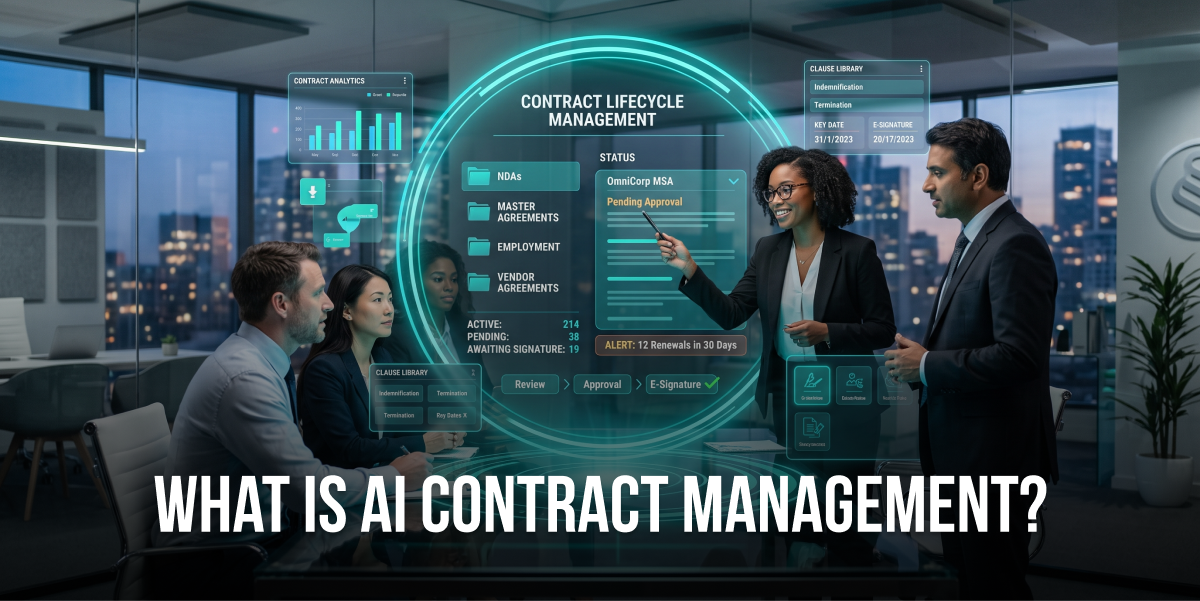
AI contract management is the use of artificial intelligence technologies to automate, optimize, and enhance every stage of the contract lifecycle. Instead of manually reading through hundreds of pages, AI systems can analyze contracts in seconds, extract critical data, flag risks, and even suggest improvements based on your company’s historical agreements.
Think of it as having a tireless legal assistant who never gets fatigued, never misses a clause, and learns from every contract they review. Except this assistant can process 50 contracts simultaneously while you’re grabbing coffee.
At its core, what is AI contract management really about? It’s about applying machine learning, natural language processing, and intelligent automation to transform contract management from a manual, error-prone process into a streamlined, data-driven operation.
The Core Components of AI Contract Management
When we talk about AI contract management for legal teams, we’re really talking about several interconnected capabilities working together:
Intelligent Document Analysis: AI systems use natural language processing to read and understand contract language just like a human would, but exponentially faster. They can identify contract types, extract key terms, and understand context across different document formats.
Automated Data Extraction: Instead of manually copying dates, parties, payment terms, and obligations into spreadsheets, AI extracts this information automatically with 95%+ accuracy. I’ve seen legal teams cut data entry time from days to minutes.
Risk and Compliance Monitoring: AI continuously scans contracts against your compliance requirements, regulatory standards, and company policies. It flags deviations, missing clauses, and potential risks before they become problems.
Workflow Automation: From routing contracts for approval to triggering renewals 90 days before expiration, AI handles the repetitive tasks that eat up your calendar. One legal ops manager told me she got back 15 hours per week just from automating approval workflows.
Predictive Analytics: Advanced AI systems analyze historical contract data to predict outcomes, suggest optimal terms, and identify patterns that humans might miss across thousands of agreements.
What Is CLM and How Does AI Enhance It?
Before we go further, let’s clarify what is CLM. Contract Lifecycle Management (CLM) refers to the systematic management of contracts from initial request through execution, compliance, and renewal or termination. Traditional CLM systems are basically sophisticated filing cabinets with some workflow capabilities.
AI-powered CLM is fundamentally different. It doesn’t just store contracts and route them for signatures. It actively reads, understands, and learns from every agreement that passes through the system.
A traditional CLM might remind you that a contract expires in 30 days. An AI-powered CLM analyzes that contract’s performance, compares terms against similar agreements, identifies unfavorable clauses, and suggests specific improvements for the renewal negotiation. That’s the difference between a reminder app and a strategic advisor.
Why Legal Teams Are Turning to AI for Contract Management
I recently spoke with a General Counsel at a healthcare company managing 8,000+ active contracts with a legal team of five people. Five. When I asked how they were managing, she laughed and said, “We’re not. We’re surviving.”
That conversation stuck with me because it captures the reality for so many legal teams. The traditional approach to contract management isn’t just inefficient anymore. It’s unsustainable.
The Breaking Point for Manual Contract Management
Here’s what actually happens in most legal departments without AI contract management:
Contracts arrive via email, Slack, shared drives, and sometimes even physical mail. There’s no central repository, so finding a specific agreement means asking around, checking multiple folders, and hoping someone remembers where it was saved.
Review processes are bottlenecked. A simple NDA might take three days to approve because it’s sitting in someone’s inbox. Complex agreements take weeks. Business teams get frustrated. Deals slow down. Revenue gets delayed.
Compliance becomes a guessing game. When a new regulation drops, legal teams face the nightmare of manually reviewing hundreds or thousands of contracts to identify which ones need amendments. One privacy lawyer told me it took her team six months to audit their contracts after GDPR went into effect.
Renewal dates get missed. Contracts auto-renew with unfavorable terms because nobody noticed the 60-day cancellation window. Or worse, critical vendor agreements lapse, disrupting business operations.
Knowledge walks out the door. When that senior attorney who negotiated all your supplier contracts leaves, their institutional knowledge goes with them. There’s no system capturing what worked, what didn’t, and why certain terms were agreed to.
The Real Cost of Manual Contract Processes
But the costs go beyond just money. There’s the opportunity cost of legal talent spending 60% of their time on administrative tasks instead of strategic work. There’s the risk cost of compliance gaps and missed obligations. There’s the relationship cost when slow contract processes frustrate partners and customers.
One VP of Legal Operations calculated that her team spent 2,400 hours annually just searching for contracts and extracting basic data. At an average loaded cost of $150 per hour, that’s $360,000 spent on activities that AI could handle for a fraction of the cost.
Benefits of AI in Legal Contracts: Beyond Time Savings
When people ask about the benefits of AI in legal contracts, most expect to hear about speed and efficiency. And yes, those benefits are massive. But the real transformation goes much deeper.
Dramatic Reduction in Contract Review Time
Let’s start with the obvious one because it’s genuinely shocking. AI contract review can analyze a 50-page agreement in under two minutes, identifying all key terms, risks, and deviations from your standard template.
A colleague at a financial services firm implemented AI contract management last year. Their average contract review time dropped from 4.5 hours to 35 minutes. That’s an 87% reduction. For their team of eight attorneys, that freed up roughly 1,200 hours per quarter.
But here’s what really matters: those 1,200 hours didn’t just disappear. They got reallocated to strategic initiatives like improving contract templates, negotiating better master agreements, and advising business units on risk management. The legal team transformed from a bottleneck into a strategic partner.
Proactive Compliance and Risk Management
Traditional contract management is reactive. You discover compliance issues during audits or when something goes wrong. AI contract management is proactive.
AI systems continuously monitor your contract portfolio against regulatory requirements, company policies, and industry standards. When regulations change, you can instantly identify every affected contract and prioritize remediation efforts.
One healthcare company I know used AI to audit their vendor contracts for HIPAA compliance. The system flagged 127 agreements with inadequate data protection clauses in less than an hour. Manually, that audit would have taken months and cost over $200,000 in legal fees.
The AI also caught something their legal team had missed: a pattern of vendors pushing liability caps that were below their company’s risk tolerance. Armed with this insight, they revised their negotiation playbook and saved an estimated $1.2 million in potential liability exposure over the next year.
Centralized Visibility and Data-Driven Insights
What is AI contract management’s most underrated benefit? Visibility.
For the first time, legal teams can actually see their entire contract portfolio in one place, with every agreement analyzed, categorized, and searchable. Need to find all contracts with a specific vendor? Done in seconds. Want to know which agreements have auto-renewal clauses expiring in Q3? Here’s the list.
But it goes beyond search. AI-powered CLM provides analytics that were previously impossible. You can see average negotiation cycle times by contract type, identify which clauses get redlined most frequently, and benchmark your terms against industry standards.
One legal ops director used these insights to discover that their sales team was agreeing to custom payment terms in 73% of deals, creating massive administrative overhead for finance. With data in hand, they implemented standardized payment terms and reduced payment processing time by 40%.
Scaling Operations Without Adding Headcount
This is the miracle that CFOs care about most. As contract volume grows, AI contract management for legal teams enables you to handle the increased workload without proportionally increasing headcount.
A SaaS company I advise grew from 200 to 800 customers in 18 months. Their contract volume increased 4x. Their legal team grew from 3 to 4 people. How? They implemented intelligent contract management that automated 70% of their routine contract work.
The math is compelling. Hiring a mid-level contract attorney costs $150K-$200K annually plus benefits and overhead. An AI contract management platform might cost $50K-$100K per year but can handle the workload of 2-3 full-time employees for routine contract tasks.
Now, AI isn’t replacing lawyers. It’s amplifying them. That same legal team of four is now handling work that would have required seven or eight people using traditional methods. And they’re doing it with better quality and lower risk.
How AI Transforms the Contract Lifecycle
Let’s walk through how AI transforms legal contract processes at each stage. Because understanding what happens at each phase helps you see where the biggest wins are for your team.
Contract Creation and Drafting
AI contract drafting assistance starts with intelligent templates that adapt based on deal parameters. Instead of starting from a static template and manually customizing it, you answer a few questions and AI generates a first draft tailored to your specific situation.
But it’s smarter than mail merge. AI analyzes your historical contracts to learn which clauses work best in different scenarios. It can suggest alternative language based on what’s been successfully negotiated before, reducing back-and-forth during negotiations.
One enterprise software company reduced their initial contract drafting time from 2 hours to 15 minutes using AI-assisted drafting. More importantly, the quality improved because AI caught inconsistencies and missing clauses that humans often overlooked when working from templates.
Contract Review and Analysis
This is where AI contract review really shines. Upload a contract and within minutes you get a comprehensive analysis highlighting:
Key terms extracted and organized (parties, dates, payment terms, obligations, termination clauses). Deviations from your standard template with risk ratings. Missing clauses that should be included based on contract type. Unfavorable terms compared to your negotiation guidelines. Compliance issues flagged against your regulatory requirements.
A legal team at a manufacturing company told me they used to spend 6-8 hours reviewing complex supplier agreements. With AI, the initial review takes 20 minutes. The attorney still makes the final decisions, but they’re starting from a comprehensive analysis instead of a blank page.
The AI also learns from attorney feedback. When a lawyer overrides a risk rating or approves a flagged clause, the system learns that context and adjusts future recommendations. It gets smarter with every contract.
Negotiation and Redlining
During negotiations, AI provides real-time guidance based on your historical data. When a counterparty proposes a change, AI can instantly show you how often you’ve accepted similar language, what alternatives you’ve successfully negotiated, and what the risk implications are.
This is huge for less experienced attorneys or business users who negotiate contracts. Instead of escalating every redline to senior counsel, they have AI-powered guidance helping them make informed decisions within approved parameters.
One legal team reduced their average negotiation cycles from 23 days to 11 days by empowering their business development team with AI-guided negotiation playbooks. Senior attorneys only got involved on truly complex issues, freeing up their time for strategic work.
Approval and Execution
AI streamlines approvals by automatically routing contracts based on risk scores, contract value, and clause analysis. Low-risk, standard agreements can be auto-approved or fast-tracked. High-risk contracts get routed to appropriate stakeholders with AI-generated summaries highlighting what needs attention.
The system also prevents bottlenecks. If a contract is sitting in someone’s queue for too long, AI can escalate or reroute based on your business rules. One company reduced their average approval time from 8 days to 2 days just by implementing intelligent routing.
Compliance Management and Obligation Tracking
After execution, AI continuously monitors contracts for upcoming obligations, renewal dates, and compliance requirements. It doesn’t just set reminders. It understands the context.
For example, if a contract requires quarterly reporting, AI tracks whether reports were submitted, flags missed deadlines, and can even analyze the reports for completeness. If a vendor is required to maintain certain insurance coverage, AI monitors expiration dates and requests updated certificates automatically.
Compliance management with AI contracts means you’re not just reacting to problems. You’re preventing them. One legal ops manager told me they went from missing 15-20 renewal deadlines per year to missing zero after implementing AI-powered obligation tracking.
Renewal and Amendment Management
AI analyzes contract performance data to inform renewal decisions. It can show you which vendors consistently deliver value, which contracts have unfavorable terms compared to market rates, and which relationships should be renegotiated or terminated.
For renewals, AI generates comparison reports showing how terms have changed over time, flags clauses that should be renegotiated, and suggests improvements based on your latest templates and negotiation guidelines.
A procurement team used AI analytics to identify that they were paying 23% above market rates for certain software licenses because contracts had auto-renewed without renegotiation for years. They renegotiated those agreements and saved $340,000 annually.
Choosing the Right AI Contract Software for Lawyers
Not all AI contract management platforms are created equal. Some are glorified document repositories with basic search. Others are genuinely intelligent systems that transform how legal teams work.
Here’s what to look for when evaluating the best AI contract software for lawyers:
Core Capabilities That Actually Matter
Natural Language Processing Quality: The AI needs to actually understand legal language, not just match keywords. Test it with your real contracts. Can it distinguish between different types of indemnification clauses? Does it understand context and nuance?
Extraction Accuracy: Data extraction should be 95%+ accurate out of the box. Anything less means you’re still doing manual verification, which defeats the purpose. Ask vendors for accuracy metrics on contracts similar to yours.
Learning Capabilities: The system should learn from your feedback and improve over time. If it flags the same false positives repeatedly without learning, that’s a problem.
Integration Ecosystem: Your AI contract management platform needs to integrate with your existing tools: CRM, ERP, e-signature platforms, document management systems. Standalone systems create more silos, not fewer.
Customization and Configuration: Every legal team has unique requirements, templates, and risk tolerances. The platform should be configurable to match your specific needs without requiring custom development.
Implementation and Adoption Considerations
The best technology is worthless if your team won’t use it. When evaluating AI contract management solutions, consider:
User Experience: Is the interface intuitive? Can attorneys find what they need without training? Complex interfaces lead to low adoption and wasted investment.
Training and Change Management: What support does the vendor provide for onboarding and training? Do they offer change management resources to help drive adoption?
Migration Path: How do you get your existing contracts into the system? Bulk upload with AI-powered analysis? Manual migration? This is often underestimated and can make or break implementation.
Scalability: Will the platform grow with you? Can it handle 10x your current contract volume without performance degradation?
Security and Compliance Requirements
Contracts contain sensitive business information. Your AI contract management platform must meet enterprise security standards:
SOC 2 Type II certification. Data encryption at rest and in transit. Role-based access controls and audit trails. Compliance with relevant regulations (GDPR, HIPAA, etc.). Clear data ownership and usage policies. Disaster recovery and business continuity plans.
One legal team I know almost selected a platform based on features alone, then discovered during security review that the vendor stored data in unsecured cloud storage. They dodged a bullet by doing thorough due diligence.
Pricing Models and Total Cost of Ownership
AI contract management pricing varies widely. Some vendors charge per user, others per contract, some have flat annual fees. Look beyond the sticker price to understand total cost of ownership:
Implementation and setup fees. Training and change management costs. Integration development if needed. Ongoing support and maintenance. Cost per additional user or contract as you scale.
A platform that costs $50K annually but requires $100K in implementation and custom integration might be more expensive than a $80K platform that’s ready to use out of the box.
Implementing AI Contract Management: A Practical Roadmap
I’ve seen AI contract management implementations go spectacularly well and spectacularly wrong. The difference usually comes down to approach, not technology.
Phase 1: Assessment and Planning (Weeks 1-4)
Start by understanding your current state. Map your existing contract processes from request to renewal. Identify bottlenecks, pain points, and manual workarounds. Quantify the time spent on different contract activities.
Define clear success metrics. What does success look like? Faster review times? Reduced compliance incidents? Better contract terms? Higher legal team satisfaction? Pick 3-5 metrics you’ll track.
Get stakeholder buy-in early. Legal, procurement, sales, finance, everyone who touches contracts needs to understand the why and the what’s-in-it-for-me. One implementation failed because sales saw the new system as more work, not less. They actively resisted until leadership clarified how it would speed up deal closures.
Phase 2: Platform Selection and Pilot (Weeks 5-12)
Evaluate 3-4 platforms using real contracts from your organization. Don’t rely on vendor demos with their cherry-picked examples. Upload your messiest, most complex contracts and see how the AI handles them.
Run a pilot with a subset of contracts and users. Start with a specific use case where you’ll see quick wins, maybe NDA review or vendor contract analysis. Prove value before rolling out enterprise-wide.
During the pilot, gather feedback obsessively. What’s working? What’s confusing? What features are missing? Use this input to configure the platform and refine your rollout plan.
Phase 3: Migration and Configuration (Weeks 13-20)
Migrate your existing contracts in phases. Start with active agreements and recent contracts. Historical archives can come later. Use AI to analyze and categorize contracts during migration, this is a huge opportunity to finally organize your contract chaos.
Configure the platform to match your processes, templates, and risk criteria. Set up approval workflows, risk scoring rules, and compliance checks. This customization is critical for adoption.
Integrate with your existing systems. Connect to your CRM so sales can initiate contracts directly. Link to your e-signature platform for seamless execution. Integrate with your document management system for centralized storage.
Phase 4: Training and Rollout (Weeks 21-28)
Develop role-specific training. Attorneys need different training than procurement specialists or sales reps. Focus on workflows relevant to each group.
Create champions in each department. These are your early adopters who get it and can help their colleagues. Empower them with extra training and make them your go-to resources.
Roll out in waves, not all at once. Start with one department or contract type. Stabilize, learn, adjust, then expand. One company rolled out to their entire organization on day one and created chaos. Support tickets overwhelmed their team and adoption suffered.
Phase 5: Optimization and Scaling (Ongoing)
Monitor your success metrics weekly. Are you hitting your targets? Where are the gaps? Use data to drive continuous improvement.
Refine AI models based on feedback. As attorneys override AI recommendations or approve flagged clauses, feed that back into the system to improve accuracy.
Expand use cases gradually. Once core contract review is working well, add obligation tracking. Then renewal management. Then advanced analytics. Build momentum with successive wins.
Common Implementation Pitfalls to Avoid
Underestimating change management. Technology is 30% of the challenge. People and process are 70%. Budget time and resources for training, communication, and adoption support.
Trying to boil the ocean. Don’t try to automate everything on day one. Start with high-volume, low-complexity contracts where you’ll see quick wins.
Neglecting data quality. AI is only as good as the data it learns from. If your contract templates are inconsistent or your historical data is messy, clean it up before or during migration.
Ignoring integration requirements. Standalone systems that don’t integrate with existing workflows create friction and reduce adoption. Plan integrations from the start.
Setting unrealistic expectations. AI contract management is transformative, but it’s not magic. It won’t fix broken processes or eliminate the need for legal judgment. Set realistic expectations about what it can and can’t do.
Measuring ROI: How AI Contract Management Pays for Itself
CFOs want numbers. Here’s how to calculate and demonstrate the ROI of AI contract management.
Direct Cost Savings
Reduced Legal Hours: Calculate hours saved on contract review, data extraction, and administrative tasks. Multiply by your loaded hourly cost. A team saving 1,000 hours annually at $150/hour saves $150,000.
Avoided Headcount: If AI enables you to handle growth without adding legal staff, that’s $150K-$200K saved per avoided hire, plus benefits and overhead.
Lower External Legal Spend: Many companies reduce outside counsel usage by 30-50% when they can handle more work in-house efficiently. For a company spending $500K annually on outside counsel, that’s $150K-$250K in savings.
Risk Reduction and Compliance
Avoided Penalties: Compliance violations can cost millions. If AI prevents even one major compliance incident, it pays for itself many times over.
Better Contract Terms: Data-driven negotiation leads to more favorable terms. One company calculated they saved $1.2M annually through better liability caps and payment terms identified through AI analysis.
Reduced Litigation: Clearer contracts with fewer errors mean fewer disputes. The average commercial litigation costs $100K-$500K. Avoiding one lawsuit covers years of AI contract management costs.
Revenue Acceleration
Faster Deal Cycles: Reducing contract cycle time from 23 days to 11 days means deals close faster and revenue is recognized sooner. For a company with $50M in annual sales, accelerating revenue recognition by even a week can improve cash flow by $1M+.
Higher Win Rates: Sales teams that can respond faster to RFPs and contract requests win more deals. One sales leader attributed a 15% increase in win rate partially to faster contract turnaround enabled by AI.
Productivity and Strategic Value
Reallocation to High-Value Work: When legal teams spend less time on administrative tasks, they can focus on strategic initiatives that drive business value. This is harder to quantify but often the most significant benefit.
Improved Decision-Making: Contract analytics provide insights that inform better business decisions. One company used contract data to identify underperforming vendors and renegotiate $2M in annual spend.
Real-World ROI Examples
A mid-market software company invested $75K in AI contract management. Within 12 months they documented: $180K in saved legal hours, $120K in avoided headcount (handled 40% growth without adding staff), $200K in better contract terms through data-driven negotiation, $150K in reduced outside counsel spend. Total quantified benefit: $650K. ROI: 767%.
A healthcare organization spent $120K on implementation and annual fees. Their benefits included: $240K in saved legal and compliance hours, $500K in avoided HIPAA penalties (caught compliance gaps proactively), $180K in better vendor terms, $300K in faster revenue recognition. Total benefit: $1.22M. ROI: 917%.
Spending Too Much Time on Manual Contract Work?
Automate contract review, clause extraction, obligation tracking, and document workflows with custom AI capabilities. Our team can develop a solution that fits your existing legal systems and business processes.
✅ HIPAA compliant. NDA ready.
✅ 100% confidential.
✅ 30 minutes. No obligation
The Future of Legal Contracts AI
Where is this all heading? Based on what I’m seeing in the market and conversations with AI researchers, here’s what’s coming.
Predictive Contract Analytics
AI will move beyond analyzing what’s in contracts to predicting outcomes. Which vendors are likely to breach? Which contract terms correlate with better performance? What’s the probability this negotiation will succeed with these terms?
Imagine uploading a proposed contract and getting an AI-generated risk score that says “Based on 500 similar agreements, contracts with these terms have a 23% higher breach rate and 15% lower vendor satisfaction scores.” That’s the future of legal contracts AI.
Autonomous Contract Negotiation
AI agents will negotiate routine contracts autonomously within defined parameters. For standard agreements like NDAs or simple vendor contracts, AI will handle the entire negotiation, only escalating to humans when issues fall outside approved guidelines.
This isn’t science fiction. Early versions are already being tested. One legal tech company has an AI that successfully negotiates 70% of NDAs to completion without human intervention.
Real-Time Compliance Monitoring
AI will continuously monitor not just contract terms but actual performance against those terms. Did the vendor deliver on time? Are SLAs being met? Are payment terms being followed?
When deviations occur, AI will automatically trigger remediation workflows, notify stakeholders, and even draft amendment language to address issues.
Cross-Contract Intelligence
AI will analyze relationships and dependencies across your entire contract portfolio. It’ll identify conflicting terms, overlapping obligations, and optimization opportunities that span multiple agreements.
For example, AI might discover that you have three different contracts with the same vendor, each with different payment terms and liability caps. It’ll recommend consolidating into a master agreement with better overall terms.
Natural Language Contract Interaction
Instead of searching for contracts or running reports, you’ll just ask questions in plain English. “Show me all vendor contracts expiring in Q3 with auto-renewal clauses and payment terms over $50K.” AI will understand the query, find the contracts, and present the results.
You’ll be able to have conversations with your contract database. “Why did we agree to these liability caps in the Acme contract?” AI will pull up the negotiation history, similar contracts for comparison, and the business context that drove the decision.
These emerging capabilities represent just the beginning of what’s possible with AI in the legal industry. As natural language processing and machine learning models continue to advance, the gap between AI-enabled legal teams and traditional operations will only widen.
How Tezeract Builds AI-Powered Contract Management Solutions
When legal teams come to us looking to implement AI contract management, they’re usually frustrated with vendors who promise the moon but deliver prototypes that don’t work in production. Or they’ve been burned by agencies that push specific technologies without understanding their actual business problems.
Tezeract takes a different approach. We start with your problem, not our technology.
Our Production-First Methodology
We don’t build demos or proofs of concept. We build AI solutions that work in production from day one. That means understanding your real contracts, your actual workflows, and your specific compliance requirements before writing a single line of code.
For a legal team at a healthcare company, we spent two weeks analyzing their contract processes, reviewing sample agreements, and understanding their compliance challenges before proposing a solution. The result? An AI contract management system that achieved 96% extraction accuracy on their specific contract types and reduced review time by 82%.
This approach aligns with our broader expertise in AI automation in the legal industry, where we’ve helped firms streamline everything from document review to compliance monitoring.
Industry-Specific Expertise That Matters
With 300+ projects across legal, healthcare, finance, retail, and other industries, we bring deep expertise in how different sectors handle contracts. Healthcare contracts have unique HIPAA requirements. Financial services contracts need specific regulatory compliance. SaaS agreements have different risk profiles than manufacturing supply agreements.
We’ve built AI contract solutions for companies managing everything from 500 to 50,000 contracts. We know what works at different scales and complexities. Our experience spans the full spectrum of legal tech AI applications, from contract analysis to predictive analytics.
Transparent Pricing and Rapid Validation
Our typical AI contract management projects range from $50K-$100K, with clear deliverables and timelines. No hidden fees, no scope creep, no surprises.
We start with rapid prototyping to validate AI feasibility before major investment. Within 2-3 weeks, you’ll see your actual contracts analyzed by our AI, with real accuracy metrics and performance data. This lets you make informed decisions about moving forward.
End-to-End Ownership
We don’t just build and disappear. We own the entire journey from design through deployment to optimization. That includes integration with your existing systems, training your team, and ongoing support to ensure you achieve your ROI targets.
One legal ops director told us, “Other vendors delivered technology and walked away. Tezeract acted as our thinking partner, helping us refine processes and maximize value long after go-live.”
Our commitment to partnership is reflected in our proven track record of successful AI implementations across diverse legal environments, from boutique law firms to enterprise legal departments.
Measurable ROI Focus
We define success metrics upfront and track them religiously. For AI contract management, that typically means: percentage reduction in review time, extraction accuracy rates, compliance incident reduction, cost savings from avoided headcount or external counsel, user adoption and satisfaction scores.
We don’t consider a project successful unless you’re achieving measurable business outcomes, not just implementing technology. This philosophy extends to how we approach choosing AI partners and driving collaboration success, we believe the right partnership is built on shared accountability for results.
Ready to transform your contract management? Schedule a 30-minute strategy session with Tezeract to discuss your specific challenges and see how AI can deliver ROI for your legal team. We’ll analyze your current contract processes and provide concrete recommendations tailored to your organization’s needs.
Conclusion: The Strategic Imperative of AI Contract Management
Here’s what I’ve learned after watching dozens of legal teams implement AI contract management: The question isn’t whether to adopt AI for contract management. It’s when and how.
Legal teams that embrace intelligent contract management now are gaining competitive advantages that compound over time. They’re closing deals faster, reducing risk more effectively, and transforming from cost centers into strategic business partners.
Teams that wait are falling further behind. As contract volumes grow and business demands accelerate, the manual approach becomes increasingly unsustainable. The gap between AI-enabled teams and traditional teams widens every quarter.
But success requires more than just buying software. It requires thoughtful implementation, strong change management, and a commitment to continuous improvement. It requires choosing the right partner who understands your business, not just the technology.
The legal teams winning with AI contract management share common traits: They start with clear problems, not technology solutions. They measure success with business metrics, not just technical capabilities. They invest in change management as much as technology. They choose partners who act as thinking partners, not just vendors.
If you’re still manually reviewing contracts, searching through email for agreements, or missing renewal deadlines, you’re not just inefficient. You’re at risk. The good news? The technology exists today to transform your contract management from a bottleneck into a competitive advantage.
The question is: Will you be among the legal teams leading this transformation, or playing catch-up in three years?
Ready to Build Custom AI Contract Management Software?
Create a centralized solution to help your teams manage contracts, identify risks, track obligations, and streamline contract lifecycle workflows. Tezeract can design, develop, and integrate custom AI-powered contract management software around your business requirements.
✅ HIPAA compliant. NDA ready.
✅ 100% confidential.
✅ 30 minutes. No obligation
FAQs
How does AI transform legal contract processes?
AI transforms legal contract processes by automating manual review, extracting data with 95%+ accuracy, continuously monitoring compliance, and providing predictive analytics. Legal teams see 80% reduction in review time, proactive risk identification, and the ability to scale operations without adding headcount. AI handles repetitive tasks while attorneys focus on strategic work. Companies like Tezeract specialize in building custom AI solutions that integrate seamlessly with existing legal workflows, ensuring production-ready systems that deliver measurable ROI from day one.
What are the benefits of reducing contract risk with AI?
AI reduces contract risk by continuously scanning agreements for compliance gaps, flagging unfavorable terms, and monitoring obligations in real-time. It catches issues before they become problems, ensures regulatory adherence, and provides data-driven insights for better negotiation outcomes. Organizations report avoiding millions in potential penalties and litigation costs. With AI-powered contract management, legal teams can proactively identify patterns across thousands of contracts that would be impossible to detect manually, transforming risk management from reactive to predictive.
How can AI improve contract efficiency for legal teams?
AI improves contract efficiency by reducing review time from hours to minutes, automating approval workflows, and eliminating manual data entry. Legal teams report saving 1,000+ hours annually, accelerating deal cycles by 50%, and reallocating time to high-value strategic work instead of administrative tasks. AI automation in the legal industry enables teams to handle exponentially more contracts without proportional increases in headcount, fundamentally changing the economics of legal operations.
What is the best AI contract software for lawyers?
The best AI contract software for lawyers offers high extraction accuracy (95%+), natural language processing that understands legal context, seamless integration with existing systems, and strong security compliance. Top solutions include customizable risk scoring, learning capabilities that improve over time, and intuitive interfaces that drive adoption. Tezeract builds production-ready AI contract solutions with transparent pricing ($50K-$100K range) and measurable ROI, focusing on end-to-end ownership from design through deployment and ongoing optimization.
How does AI contract drafting assistance work?
AI contract drafting assistance uses intelligent templates that adapt based on deal parameters and historical data. It suggests optimal clauses based on past negotiations, catches inconsistencies, and ensures compliance with company standards. Legal teams reduce drafting time from hours to minutes while improving quality and consistency across all agreements. The AI learns from your organization’s contract history to recommend language that has proven successful in similar situations, reducing negotiation cycles and improving outcomes.
What is compliance management with AI contracts?
Compliance management with AI contracts involves continuous monitoring of agreements against regulatory requirements, automatic flagging of non-compliant clauses, and proactive alerts for upcoming obligations. AI tracks changes in regulations and instantly identifies affected contracts, enabling legal teams to address compliance gaps before audits or incidents occur. This proactive approach has helped organizations avoid millions in penalties by catching HIPAA, GDPR, and other regulatory violations before they become costly problems.
What does the future of legal contracts AI look like?
The future of legal contracts AI includes predictive analytics that forecast contract outcomes, autonomous negotiation of routine agreements, real-time performance monitoring against contract terms, and natural language interaction with contract databases. AI will provide cross-contract intelligence, identifying optimization opportunities across entire portfolios and acting as a strategic advisor for legal teams. Emerging capabilities in AI and legal technology will enable legal departments to move from reactive contract management to predictive, strategic partnership with the business.
How long does it take to implement AI contract management?
AI contract management implementation typically takes 20-28 weeks from assessment to full rollout, though pilot programs can show value within 8-12 weeks. The timeline includes platform selection, migration, configuration, training, and phased rollout. Organizations that start with focused use cases and invest in change management see faster adoption and earlier ROI. Tezeract’s rapid prototyping approach validates AI feasibility within 2-3 weeks, allowing legal teams to see their actual contracts analyzed with real accuracy metrics before committing to full implementation.