TL;DR
NDA automation transforms how businesses handle non-disclosure agreements by replacing manual, error-prone processes with intelligent software that generates, routes, and manages NDAs in minutes instead of hours.
Decision-makers should care because automated NDA processes deliver measurable ROI through 75% faster contract cycles, 90% fewer errors, and up to 60% reduction in legal costs while eliminating bottlenecks that delay critical business deals.
Our comprehensive guide explains what NDA automation is, explores how NDA automation helps businesses across seven key pain points, and reveals the benefits of NDA automation software including AI-powered generation, centralized tracking, and seamless e-signature integration.
Choosing the right solution means evaluating NDA workflow automation platforms for template customization, compliance features, integration capabilities, and scalability to support your growth.
Future-ready organizations are adopting AI NDA automation with predictive analytics, intelligent clause recommendations, and automated compliance monitoring to stay competitive in 2025 and beyond.
I remember the first time I watched our legal team spend three full days just getting a single NDA signed for a partnership deal. Three days. The agreement itself was pretty standard, but the back-and-forth emails, the version control nightmare, the waiting for signatures… it made me want to throw my laptop out the window.
That’s when I started digging into what NDA automation actually is and whether it could solve this mess. Turns out, I wasn’t alone in this frustration.
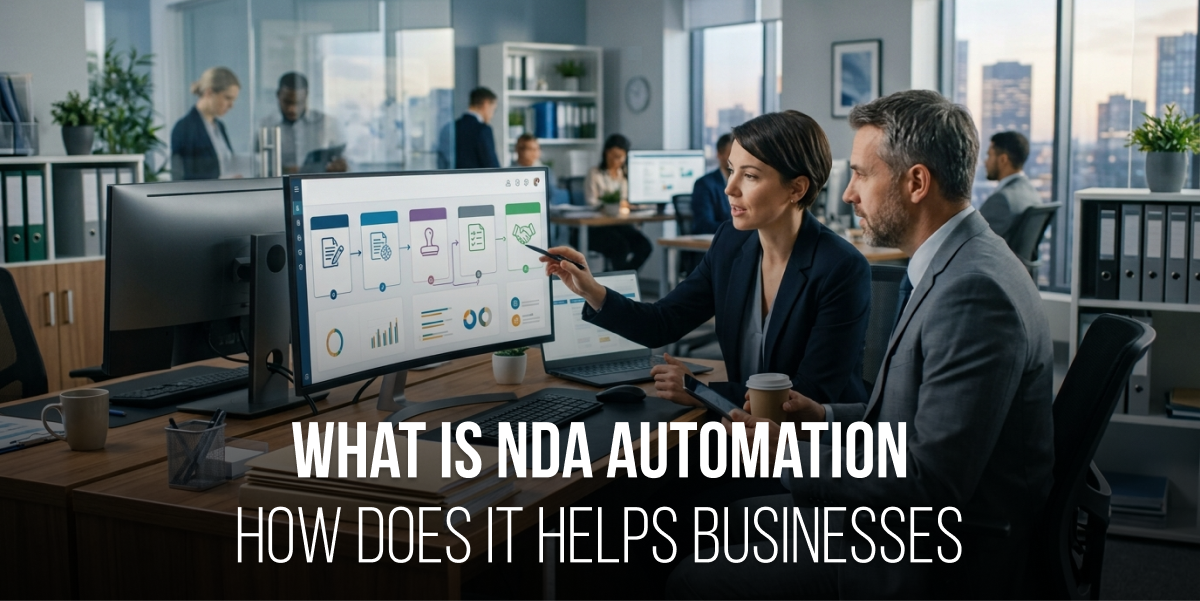
So what is NDA automation, really? At its core, it’s the use of specialized software to handle the entire lifecycle of non-disclosure agreements without the manual grunt work. We’re talking about automated NDA generation, intelligent routing for approvals, integrated e-signatures, and centralized storage, all working together to turn what used to take days into something that happens in minutes.
The shift from traditional NDA workflows to automated NDA processes isn’t just about speed. It’s about eliminating the errors that keep legal teams up at night, cutting costs that drain budgets, and creating an experience that doesn’t make external partners question whether they want to work with you at all.
Understanding What NDA Automation Really Means
When I first heard about NDA automation software, I pictured some clunky tool that just filled in names and dates. Boy, was I wrong. Modern NDA management automation is way more sophisticated than that.
What is NDA automation in practical terms? It’s a complete system that handles every step of the NDA lifecycle. You start with intelligent template libraries that contain pre-approved legal language. The software then uses conditional logic to customize agreements based on specific scenarios like whether you’re dealing with a vendor, employee, or potential investor.
The automated NDA process doesn’t stop at generation. The system routes drafts to the right stakeholders for review, tracks changes, manages approval workflows, sends agreements for e-signature, stores executed documents in a searchable repository, and monitors key dates like expiration or renewal deadlines. All of this happens with minimal human intervention.
What makes NDA workflow automation different from just using document templates? The intelligence. These systems learn from your organization’s patterns, suggest relevant clauses based on context, flag potential risks or missing elements, and integrate with your existing tech stack like CRM, contract management, and legal ops platforms.
The Technology Behind Automated NDA Generation
The tech powering AI NDA automation has gotten seriously impressive. Modern platforms use natural language processing to understand context and intent, machine learning algorithms to improve clause recommendations over time, and optical character recognition to digitize and analyze existing NDA libraries.
I’ve seen systems that can analyze thousands of your historical NDAs, identify the most common clause variations, and automatically create optimized templates that reflect your organization’s actual needs. That’s not just automation, that’s intelligent automation that gets smarter the more you use it.
The best NDA software for businesses also includes validation engines that check for conflicting terms, missing required clauses, and compliance with industry regulations. One client told me their automated system caught a jurisdiction error that would have made their NDA unenforceable in three states. That’s the kind of catch that pays for the software ten times over.
How NDA Approval Automation Streamlines Workflows
The approval bottleneck used to drive me absolutely crazy. You’d send an NDA to legal, wait two days, get feedback, make changes, send to the business owner, wait another day, make more changes, and by the time everyone signed off, the external party had moved on to another vendor.
NDA approval automation fixes this by creating parallel review workflows where multiple stakeholders can review simultaneously, setting automatic escalation rules when approvals stall, providing real-time visibility into where documents are stuck, and using AI to route only non-standard terms for legal review.
What I find really cool is how these systems learn your organization’s risk tolerance. After analyzing enough approvals, the software can auto-approve low-risk standard NDAs while flagging unusual terms for human review. This means your legal team only sees the 10-15% of NDAs that actually need their expertise, not the 85% that are completely standard.
How Does NDA Automation Help Businesses Solve Critical Pain Points
Okay, so we know what NDA automation is. But how does NDA automation help businesses in the real world? I’m talking about actual, measurable impact on the problems that make people want to put their heads through their desks.
Eliminating Time-Consuming Manual Drafting and Review
Last year, I talked to a VP of Legal at a mid-sized tech company who told me her team was spending 40% of their time on NDAs. Forty percent. That’s two full days every week just drafting, reviewing, and chasing signatures for agreements that are 90% identical to each other.
Automated NDA generation changes this completely. Instead of starting from scratch or hunting through folders for the right template, users answer a few simple questions in a guided workflow. The system then assembles the perfect NDA using pre-approved clauses, automatically populates party information from your CRM, and applies the correct legal language based on jurisdiction and agreement type.
But it’s not just about speed. The quality improves too. When your team isn’t rushing through their 15th NDA of the day, they can focus on the genuinely complex agreements that need careful attention. One legal ops manager told me that after implementing NDA management automation, her team finally had time to update their entire contract playbook, something they’d been trying to do for two years.
Eliminating Errors and Ensuring Consistency
I once saw an NDA that had the wrong company name in three different places. Not typos, actual different company names because someone had copied an old agreement and missed a few find-and-replace instances. That NDA was completely unenforceable, and the company didn’t discover the error until they tried to use it in a dispute six months later.
Human error in legal documents isn’t just embarrassing, it’s expensive and risky. Manual NDA creation leads to inconsistent terminology across agreements, missing or outdated clauses, incorrect party details or addresses, conflicting terms within the same document, and non-compliant language for specific jurisdictions.
The benefits of NDA automation software really shine here. Automated systems use validated templates that legal has approved once, apply consistent formatting and clause numbering, cross-check party information against authoritative sources, and flag potential conflicts or missing elements before generation.
According to International Association for Contract and Commercial Management data, contract errors cost businesses an average of 9% of annual revenue. For a $50 million company, that’s $4.5 million potentially at risk. Automated NDA processes can reduce error rates by over 90%, protecting both your legal position and your bottom line.
What I love about modern NDA workflow automation is the validation layer. Before an NDA even reaches the signature stage, the system runs dozens of checks. Does the confidentiality period match company policy? Are all required clauses present? Is the governing law appropriate for the parties involved? These aren’t things humans catch consistently when they’re tired or rushed, but software never gets tired.
Centralized Management and Instant Tracking
Picture this scenario that happened to a client of mine. During an audit, they needed to prove they had valid NDAs with all their vendors. Sounds simple, right? Except their NDAs were scattered across email inboxes, shared drives, filing cabinets, and individual laptops. It took three people two full weeks to compile the list, and they still weren’t sure they’d found everything.
The lack of centralized NDA management creates absolute chaos. You can’t quickly find specific agreements when you need them, have no visibility into which NDAs are expiring soon, struggle to report on NDA status for audits or compliance, and risk using outdated or expired agreements.
NDA automation software solves this with a centralized repository where every agreement lives in one searchable database. You get powerful search by party name, date range, agreement type, or custom fields, automated alerts for upcoming expirations or key milestones, real-time dashboards showing NDA status across your organization, and complete audit trails of every action taken on each document.
I’ve seen legal teams go from spending hours hunting for documents to finding any NDA in under 30 seconds. The productivity gain is massive, but the risk reduction is even bigger. When you can instantly prove you have proper NDAs in place, you’re protecting your intellectual property, satisfying compliance requirements, and demonstrating professional contract governance.
Accelerating Signature and Approval Workflows
The signature bottleneck is where deals go to die. I’ve watched promising partnerships fall apart because the NDA process took so long that momentum evaporated. By the time all the signatures were collected, the external party had moved on or circumstances had changed.
Traditional NDA workflows create massive bottlenecks through sequential routing where each person waits for the previous one, email-based tracking that gets lost in overflowing inboxes, printing, scanning, and mailing physical documents, and unclear ownership when things get stuck.
Automated NDA process platforms integrate e-signature capabilities directly into the workflow. This means parallel routing to multiple internal reviewers, automatic escalation when approvals are delayed, mobile-friendly signing for on-the-go executives, and real-time status visibility for all stakeholders.
The speed improvement is dramatic. Forrester research shows that e-signature integration reduces contract cycle time by 80% on average. For NDAs, which are often time-sensitive, this can mean the difference between a 5-day process and a 4-hour process.
One sales director told me that before NDA approval automation, she’d lose about 20% of potential deals just because prospects got frustrated with the slow NDA process. After automation, that dropped to nearly zero. The professional, streamlined experience actually became a competitive advantage because it signaled that the company was modern and easy to work with.
Slashing Legal Costs and Resource Drain
Legal costs are brutal, especially for growing companies. External counsel charges $300-$500 per hour, and even routine NDAs can rack up significant bills when you’re doing hundreds per year. For businesses without in-house legal, the costs can be absolutely prohibitive.
The traditional approach drains resources through high hourly rates for routine document review, legal team time spent on repetitive, low-value work, external counsel fees for standard agreements, and opportunity costs from delayed deals and partnerships.
Benefits of NDA automation include empowering business users to generate standard NDAs without legal involvement, reserving legal expertise for genuinely complex or high-risk agreements, reducing external counsel dependency for routine matters, and accelerating deal velocity to capture more opportunities.
The ROI is pretty straightforward. If your legal team spends 40 hours per month on routine NDAs at a fully loaded cost of $150/hour, that’s $6,000 monthly or $72,000 annually. NDA automation software typically costs $10,000-$30,000 per year depending on volume and features. The payback period is often under six months.
But the real value goes beyond direct cost savings. When your legal team isn’t buried in NDA administration, they can focus on strategic initiatives like contract playbook development, risk assessment and mitigation, complex negotiation support, and proactive legal strategy. That’s where legal really adds value to the business.
Ensuring Compliance and Audit Readiness
Compliance failures can be catastrophically expensive. I know a company that faced a $2.3 million fine because they couldn’t demonstrate proper NDA coverage during a regulatory audit. They had the agreements, they just couldn’t find them or prove they were executed before confidential information was shared.
Manual NDA management creates compliance nightmares through incomplete or inaccessible audit trails, difficulty proving when agreements were executed, inability to demonstrate consistent policy application, and risk of using non-compliant or outdated language.
NDA management automation provides complete audit trails showing who did what and when, automated compliance checks against company policies and regulations, version control that tracks every change to every document, and reporting capabilities that generate compliance documentation instantly.
The peace of mind this creates is huge. During audits, instead of scrambling to compile evidence, you can generate comprehensive reports in minutes. You can prove that every NDA was reviewed by appropriate stakeholders, executed before confidential disclosure, and compliant with relevant regulations.
Creating Seamless External Party Experiences
First impressions matter, and for many business relationships, the NDA is the first legal interaction. A clunky, slow, confusing NDA process sends a terrible message about how you operate. I’ve heard prospects say things like, “If their NDA process is this painful, imagine working with them on actual projects.”
Traditional NDA workflows create friction for external parties through confusing email chains with multiple versions, printing and scanning requirements in a digital world, unclear instructions on what to sign and where, and long wait times with no visibility into status.
NDA software for businesses transforms this experience with branded, professional digital portals for NDA review and signing, clear, guided workflows that make signing intuitive, mobile-optimized experiences for signing anywhere, and automated status updates so parties know exactly where things stand.
The competitive advantage here is real. When your NDA process is smooth and professional, you signal operational excellence, respect for partners’ time, modern, digital-first approach, and confidence in your legal processes.
One business development executive told me that after implementing automated NDA generation, prospects started commenting on how easy the process was. Several specifically mentioned it as a factor in choosing to move forward with the partnership. That’s the kind of intangible benefit that’s hard to quantify but incredibly valuable.
Key Benefits of NDA Automation Software
We’ve covered how NDA automation helps businesses solve specific pain points, but let’s zoom out and look at the broader benefits of NDA automation that transform how organizations operate.
Speed and Efficiency Gains
The speed improvement from automated NDA processes is honestly the most immediately noticeable benefit. We’re talking about 75-85% reduction in NDA cycle time, same-day execution instead of multi-week processes, and instant access to agreement status and history.
But speed isn’t just about convenience. In business, speed is competitive advantage. Faster NDA execution means you can move quickly on time-sensitive opportunities, respond to RFPs with shorter turnaround times, and onboard vendors and partners without delays.
I’ve seen companies close deals that would have gone to competitors simply because they could get an NDA signed in hours instead of days. In fast-moving industries, that responsiveness can be worth millions in captured opportunities.
Cost Reduction Across Multiple Dimensions
The financial benefits of NDA automation extend way beyond just legal cost savings. You’re looking at reduced legal department overhead, lower external counsel expenses, decreased administrative costs, and fewer costs from errors and non-compliance.
One CFO told me that after implementing NDA workflow automation, their legal operations costs dropped by 40% in the first year. That included both direct costs like external counsel fees and indirect costs like administrative time and error remediation.
The ROI calculation is pretty compelling. Most organizations see payback within 6-12 months, with ongoing annual savings of 3-5x the software cost. For a mid-sized company executing 500+ NDAs annually, that can translate to $100,000+ in annual savings.
Risk Mitigation and Legal Protection
The risk reduction from NDA management automation is probably the most underappreciated benefit. Consistent, error-free NDAs mean better legal protection for confidential information, reduced risk of unenforceable agreements, and stronger position in disputes or litigation.
Automated validation catches issues that humans miss, especially when they’re tired or rushing. Missing clauses, conflicting terms, incorrect jurisdictions, these are the kinds of errors that can make an NDA worthless when you actually need to enforce it.
The compliance benefits are equally important. Automated audit trails, policy enforcement, and reporting capabilities mean you can demonstrate robust contract governance to regulators, auditors, and stakeholders. In regulated industries, this can be the difference between passing an audit and facing significant penalties.
Scalability for Growing Organizations
What I love about NDA automation software is how it scales with your business. When you’re doing 50 NDAs per year, manual processes are annoying but manageable. When you hit 500 or 5,000, manual processes become completely unsustainable.
Automated systems scale effortlessly. Whether you’re processing 10 NDAs per month or 1,000, the software handles it with the same efficiency. There’s no need to hire additional legal staff, no degradation in quality or speed, and no increased error rates as volume grows.
This scalability is crucial for growing companies. You can expand into new markets, onboard more partners and vendors, and increase deal velocity without your NDA process becoming a bottleneck. The system grows with you instead of holding you back.
Implementing NDA Workflow Automation: What to Consider
So you’re convinced that NDA automation is worth exploring. Now comes the practical question: how do you actually implement it successfully? I’ve seen both smooth implementations and absolute disasters, and the difference usually comes down to a few key factors.
Before diving into vendor selection, it’s worth understanding what custom software development entails versus off-the-shelf solutions. While many businesses start with packaged NDA automation tools, organizations with unique legal workflows or complex compliance requirements often benefit from bespoke solutions designed specifically for their processes.
Choosing the Right NDA Automation Software
Not all NDA software for businesses is created equal. The market ranges from simple template tools to sophisticated AI-powered platforms, and choosing the wrong solution can be worse than not automating at all.
Key capabilities to evaluate include template flexibility and customization options, workflow automation and routing capabilities, e-signature integration (native or third-party), repository and search functionality, reporting and analytics features, integration with existing systems (CRM, contract management, etc.), security and compliance certifications, and user experience for both internal users and external parties.
I always recommend starting with your specific use cases. What types of NDAs do you execute most frequently? What are your biggest pain points? What integrations are non-negotiable? The answers will help you prioritize features and avoid paying for capabilities you don’t need.
If you’re considering automation more broadly across your legal operations, reviewing business process automation tools for enterprises can provide valuable context on how NDA automation fits within your larger digital transformation strategy.
Pricing models vary widely. Some vendors charge per user, others per document or transaction, and some offer flat annual fees. Make sure you understand the total cost of ownership including implementation, training, and ongoing support.
Integration with Existing Systems
The best NDA automation software doesn’t exist in isolation. It needs to connect with your existing tech stack to deliver maximum value. Key integrations to consider include CRM systems for party information and deal tracking, contract lifecycle management platforms, document management systems, e-signature platforms if not natively included, and legal ops and matter management tools.
API availability and quality matter a lot here. You want a platform with robust, well-documented APIs that make integration straightforward. I’ve seen implementations fail because the chosen software couldn’t integrate with critical systems, creating data silos and manual workarounds that defeated the purpose of automation.
Understanding how AI in business process automation works can help you evaluate whether vendors are using genuine intelligent automation or just marketing buzzwords. True AI-powered NDA automation learns from your data and improves over time, rather than simply following static rules.
Change Management and User Adoption
Here’s something that catches a lot of organizations off guard: the technology is usually the easy part. The hard part is getting people to actually use it. I’ve seen expensive NDA automation platforms sit unused because the change management was botched.
Successful implementation requires executive sponsorship and clear communication of benefits, comprehensive training for all user groups (legal, business users, admins), gradual rollout starting with pilot groups, ongoing support and feedback mechanisms, and clear policies on when to use automation versus manual processes.
The user experience matters enormously. If the system is clunky or confusing, people will find workarounds. The best platforms are intuitive enough that users can generate NDAs with minimal training, which drives adoption and ensures you actually realize the benefits.
Before launching any automation initiative, consulting an AI automation checklist can help you avoid common pitfalls and ensure you’ve addressed critical success factors like stakeholder buy-in, data readiness, and change management planning.
Still Managing NDAs Manually?
Automate NDA creation, template selection, approval routing, and document tracking with custom software. Our team can develop a solution that fits your business processes and integrates with your existing systems.
✅ HIPAA compliant. NDA ready.
✅ 100% confidential.
✅ 30 minutes. No obligation
The Future of AI NDA Automation
The NDA automation space is evolving rapidly, and the next generation of capabilities is pretty exciting. We’re moving beyond simple template automation into genuinely intelligent systems that learn and improve over time.
Predictive Analytics and Risk Scoring
AI-powered platforms are starting to analyze historical NDA data to predict outcomes and assess risk. Imagine a system that can review a proposed NDA and say, “Based on 500 similar agreements, this clause has a 73% chance of being rejected by the counterparty” or “This combination of terms has historically led to disputes in 12% of cases.”
This kind of predictive capability helps legal teams make better decisions about what terms to propose, where to be flexible in negotiations, and which agreements warrant extra scrutiny. It’s like having a data scientist embedded in your contract process.
Intelligent Clause Recommendations
Modern AI NDA automation is getting scary good at understanding context and recommending appropriate clauses. The system analyzes the parties involved, the nature of the relationship, the industry and jurisdiction, and historical precedents to suggest optimal language.
I’ve tested platforms that can generate NDAs that are 95% ready to execute with zero human input, just by answering a few questions about the business context. The AI understands nuances like “this is a vendor relationship in a regulated industry” and automatically includes appropriate compliance clauses.
Automated Compliance Monitoring
The next frontier is proactive compliance monitoring. Instead of just storing NDAs, future systems will continuously monitor for compliance issues like upcoming expirations that need renewal, regulatory changes that affect existing agreements, and potential conflicts with new company policies.
Imagine getting an alert that says, “You have 47 NDAs that expire in the next 90 days” or “New data privacy regulations affect 23 of your existing NDAs.” That’s the kind of proactive risk management that transforms legal from reactive to strategic.
Building Custom NDA Automation Solutions with Tezeract
When it comes to implementing NDA automation and broader legal AI solutions, choosing the right development partner can make or break your success. This is where Tezeract stands out from typical software vendors.
Tezeract builds custom end-to-end AI solutions and automates business processes for companies across the world. They help businesses improve efficiency, support decision-making, and create more control in daily operations. For legal teams and law firms specifically, Tezeract has extensive experience developing intelligent document automation, contract analysis systems, and compliance monitoring platforms.
What makes Tezeract different is their problem-first methodology. They don’t start by pushing specific technologies or platforms. Instead, they begin by deeply understanding your business challenge, whether that’s NDA bottlenecks, contract review inefficiencies, or compliance monitoring gaps. Only after understanding the problem do they design the right AI solution.
Tezeract takes a production-first approach to AI development and AI automation. Unlike agencies that deliver prototypes or proof-of-concepts that never make it to production, Tezeract focuses exclusively on AI solutions that work in real-world conditions and deliver measurable ROI from day one. This is particularly critical for legal automation, where reliability and accuracy aren’t optional.
With 300+ projects delivered across legal, fashion, retail, healthcare, and finance, Tezeract brings deep cross-industry expertise. They’ve built automated contract analysis systems, AI-powered legal research tools, compliance monitoring platforms, and intelligent document generation solutions. This breadth of experience means they’ve likely solved problems similar to yours.
For organizations dealing with high-volume document processing beyond just NDAs, Tezeract’s expertise in automated invoice processing demonstrates their ability to handle complex document workflows with AI-powered extraction, validation, and routing capabilities that can be adapted to legal documents.
Their transparent pricing model ($50,000-$100,000 typical range) and rapid prototyping process help businesses validate AI feasibility before major investment. You’re not committing to a six-month, million-dollar project before knowing if the approach will work. Tezeract’s iterative methodology delivers working prototypes in weeks, allowing you to test, learn, and refine before scaling.
What clients consistently highlight is Tezeract’s thinking partner approach. They don’t just execute requirements, they challenge assumptions, suggest alternatives, and bring strategic perspective. For organizations implementing NDA automation as part of broader legal transformation, this strategic partnership is invaluable.
Tezeract is best for mid-market companies and enterprises seeking a strategic AI partner who acts as a thinking partner, not just developers. They’re ideal for organizations that need AI solutions that actually ship, scale, and deliver ROI, not just impressive demos. Their services span agentic AI, AI agent development, custom AI development, AI automation, machine learning, NLP, and chatbots, all of which can be applied to legal document automation challenges.
Ready to transform your NDA process with AI-powered automation?
Schedule a free 30-minute strategy session with Tezeract to explore how intelligent automation can eliminate bottlenecks, reduce costs, and accelerate your contract workflows. Their team will assess your specific needs and provide actionable recommendations for implementing NDA automation that delivers measurable results.
Conclusion: Transform Your NDA Process Today
Look, I get it. Changing established processes is hard, especially in legal where risk aversion is built into the culture. But the gap between organizations using NDA automation and those still doing everything manually is growing wider every day.
The businesses that embrace automated NDA generation, workflow automation, and intelligent management aren’t just saving time and money. They’re creating competitive advantages through faster deal cycles, better partner experiences, and legal teams focused on strategy instead of administration.
What is NDA automation? It’s the difference between legal being a bottleneck and legal being an enabler. It’s the difference between drowning in administrative work and having time for the strategic initiatives that actually move your business forward.
How does NDA automation help businesses? By eliminating the seven critical pain points we’ve covered, from time-consuming manual processes to poor external experiences, while delivering measurable ROI through cost savings, risk reduction, and operational efficiency.
The benefits of NDA automation software are clear and quantifiable. The technology is mature and proven. The only question is whether you’ll implement it before your competitors do, or after they’ve already captured the advantages.
Start small if you need to. Pilot with one type of NDA or one business unit. Measure the results. Then scale. But start. Because every day you wait is another day of wasted time, unnecessary costs, and missed opportunities.
Whether you choose an off-the-shelf platform or work with a development partner like Tezeract to build a custom solution tailored to your unique workflows, the important thing is taking that first step toward intelligent automation.
Your legal team will thank you. Your business partners will thank you. And your bottom line will definitely thank you.
Ready to Build Custom NDA Automation Software?
Streamline NDA management with software designed around your templates, approval rules, access controls, and document workflows. Tezeract can design, develop, and integrate a custom solution to help your business manage NDAs more efficiently.
✅ HIPAA compliant. NDA ready.
✅ 100% confidential.
✅ 30 minutes. No obligation
FAQs
What is NDA automation and how does it work?
NDA automation is the use of specialized software to handle the complete lifecycle of non-disclosure agreements without manual intervention. It works by using intelligent templates, conditional logic for customization, automated routing for approvals, integrated e-signatures, and centralized storage with tracking capabilities. Modern AI-powered NDA automation platforms can learn from your organization’s patterns and continuously improve recommendations based on historical data.
How does NDA automation help businesses reduce costs?
NDA automation helps businesses cut costs by reducing legal team time spent on routine agreements by 75-85%, decreasing external counsel dependency for standard NDAs, eliminating errors that lead to expensive remediation, and accelerating deal cycles to capture more revenue opportunities. Most organizations see 40-60% cost reduction in NDA-related expenses. The typical payback period for NDA automation software is under six months, with ongoing annual savings of 3-5x the software cost.
What are the main benefits of NDA automation software?
The primary benefits include 75-85% faster NDA cycle times, 90% reduction in errors and inconsistencies, centralized management with instant document retrieval, automated compliance monitoring and audit trails, significant cost savings through reduced legal overhead, and improved external party experiences that strengthen business relationships. Additionally, NDA automation provides scalability that allows organizations to handle growing volumes without adding headcount or sacrificing quality.
How to implement NDA automation successfully?
Successful implementation requires choosing software with the right features for your use cases, ensuring integration with existing systems like CRM and contract management, providing comprehensive training for all users, starting with pilot groups before full rollout, and maintaining executive sponsorship to drive adoption across the organization. It’s also helpful to consult an AI automation checklist to avoid common pitfalls and ensure you’ve addressed critical success factors like stakeholder buy-in, data readiness, and change management planning.
What is the difference between NDA automation and contract automation?
NDA automation is a specialized subset of contract automation focused specifically on non-disclosure agreements. While contract automation handles various agreement types with complex negotiations, NDA automation typically deals with more standardized agreements that follow consistent patterns, allowing for higher degrees of automation and faster processing. NDA automation platforms are optimized for the high-volume, repetitive nature of NDAs, whereas broader contract automation systems handle more diverse document types with greater variation.
Can NDA workflow automation integrate with existing legal systems?
Yes, modern NDA automation platforms offer robust API integrations with CRM systems, contract lifecycle management tools, document management platforms, e-signature solutions, and legal operations software. Integration capabilities are essential for eliminating data silos and ensuring seamless workflows across your tech stack. When evaluating solutions, prioritize platforms with well-documented APIs and proven integration track records to avoid implementation challenges.
What are the security considerations for automated NDA processes?
Secure NDA automation requires end-to-end encryption for documents in transit and at rest, role-based access controls to limit who can view or edit agreements, complete audit trails of all actions, compliance with regulations like GDPR and SOC 2, and secure e-signature capabilities that meet legal enforceability standards. Organizations should verify that any NDA automation platform meets their industry-specific security and compliance requirements before implementation.
How does AI NDA automation improve over traditional methods?
AI NDA automation uses machine learning to recommend optimal clauses based on context, natural language processing to understand agreement intent and flag risks, predictive analytics to assess potential issues before they occur, and continuous learning that improves recommendations over time based on your organization’s historical data and outcomes. Unlike static template systems, AI-powered platforms become smarter with use, adapting to your organization’s specific needs and risk tolerance.