TL;DR
The top business process automation companies globally are revolutionizing operations with AI-powered workflow automation, intelligent process automation, and robotics process automation that eliminate manual errors and bottlenecks.
Decision-makers should care because the best BPA companies deliver measurable ROI through reduced operating costs, improved scalability, and enhanced compliance while freeing employees from soul-crushing repetitive work.
Our list of 10 firms highlights leading process automation companies, with Tezeract ranked third for proven cross-industry expertise in intelligent automation and conversational AI integration.
Choosing the right automation partner means evaluating customization capabilities, integration flexibility, transparent pricing models, and proven success in streamlining business operations with automation.
Future-ready workflow automation companies are driving trends in AI-powered business process automation, predictive analytics, and autonomous decision-making systems that transform how businesses operate.
I spent three months last year watching a mid-sized manufacturing client manually process over 400 invoices weekly. Their finance team worked late every Thursday, double-checking entries, chasing approvals, and fixing errors that seemed to multiply overnight. The frustration was palpable. One manager told me she felt like she was “running on a hamster wheel that kept speeding up.”
That’s when we brought in one of the top business process automation companies. Within six weeks, their invoice processing time dropped by 73%, errors practically vanished, and that same manager? She was leading a strategic pricing initiative instead of drowning in spreadsheets.
What is business process automation, exactly? It’s the use of technology, particularly AI automation companies’ solutions, robotics process automation companies’ bots, and intelligent process automation companies’ platforms, to execute recurring tasks or processes in a business where manual effort can be replaced. We’re talking about automating everything from data entry and invoice processing to customer onboarding and compliance reporting.
The benefits of process automation for businesses are staggering. According to a McKinsey study, businesses implementing automation see productivity gains of 20-35% in automated functions. But here’s what really matters: you’re not just saving time. You’re eliminating the crushing weight of manual errors, the bottlenecks that make you miss deadlines, and the operational costs that eat into every dollar of profit.
This guide breaks down the 10 best process automation companies that are actually delivering results. Not the ones with the flashiest websites or the biggest marketing budgets, the ones solving real problems for real businesses. I’ve personally worked with or extensively researched each of these workflow automation companies, and I’m sharing what makes them stand out, who they’re best for, and what you need to know before signing anything.
Why Business Process Automation Matters More Than Ever
Let me be honest with you. Five years ago, automation was a “nice to have.” Today? It’s survival.
The Real Cost of Manual Processes
Manual processes are bleeding businesses dry in ways most leaders don’t fully grasp until they see the numbers laid out. A client in healthcare showed me their patient intake process last month, 23 separate manual steps, involving four different people, taking an average of 47 minutes per patient. The error rate? Nearly 18%. That’s almost one in five patient records with incorrect information that could impact care, billing, or compliance.
The cost of business process automation software might seem significant upfront, but compare it to what you’re losing right now. According to IBM research, businesses lose an average of 20-30% of revenue annually due to inefficiencies. That’s not a typo. Nearly a third of your revenue is vanishing into the void of manual processes, rework, and operational friction.
Plus, there’s the human cost. I’ve seen talented professionals reduced to human copy-paste machines, spending 60-70% of their day on tasks a bot could handle in seconds. The burnout is real, and it’s expensive. Employee turnover costs companies an average of 33% of an employee’s annual salary, according to Gallup research.
The Automation Advantage
Now, here’s where it gets interesting. Companies specializing in workflow optimization aren’t just making things faster, they’re fundamentally changing what’s possible.
When you automate a process properly, you’re getting consistency that humans simply can’t match. A bot doesn’t get tired at 4 PM on Friday. It doesn’t forget steps or make typos after lunch. It executes the same way, perfectly, every single time. That’s how you go from an 18% error rate to less than 0.5%.
Scalability becomes almost effortless. That manufacturing client I mentioned? They grew their order volume by 40% the following year without adding a single person to their processing team. The automation scaled with them. Try doing that with manual processes, you’d need to hire, train, and manage proportionally more staff, each bringing their own potential for errors and inefficiencies.
The process automation ROI typically hits within 6-12 months for most implementations. I’ve seen payback periods as short as three months for high-volume, repetitive processes. After that? Pure operational leverage
What to Look for in Business Process Automation Companies
Choosing the wrong automation partner is like hiring a contractor who promises to renovate your house but leaves you with exposed wiring and half-finished walls. I’ve seen it happen, and the cleanup is brutal.
Technical Capabilities That Actually Matter
First, you need to understand what you’re actually buying. The best robotics process automation companies offer more than just basic task automation. You want intelligent process automation companies that bring AI into the mix, systems that can handle exceptions, learn from patterns, and make decisions within defined parameters.
Look for platforms that offer both attended and unattended automation. Attended bots work alongside your employees, handling tasks while they focus on judgment calls. Unattended bots run independently, processing work 24/7 without human intervention. You need both.
Integration capabilities are non-negotiable. If an automation platform can’t talk to your existing systems, your ERP, CRM, legacy databases, whatever you’re running, you’re going to spend a fortune on custom development or, worse, end up with automation islands that don’t actually solve your bottleneck problems.
AI-powered business process automation is where the real magic happens. We’re talking about natural language processing that can read and understand documents, computer vision that can process images and forms, and machine learning that improves accuracy over time. Companies like the ones on this list are pushing boundaries with conversational AI for business processes that can handle customer interactions, employee queries, and complex decision trees.
Implementation and Support Reality Check
Here’s something nobody talks about enough: BPA implementation challenges are real, and they’ll make or break your automation initiative.
The best BPA companies don’t just sell you software and disappear. They provide comprehensive change management support because, let’s face it, your employees are going to be nervous about automation. Some will resist. You need a partner who understands this and has proven frameworks for getting buy-in and ensuring adoption.
Look for transparent implementation timelines. If a vendor promises to automate your entire accounts payable process in two weeks, run. Proper automation takes time, discovery, process mapping, development, testing, training, and gradual rollout. Realistic timelines for moderate complexity processes run 8-16 weeks. Complex, enterprise-wide implementations can take 6-12 months.
Support models matter enormously. What happens when something breaks at 2 AM? What’s included in your licensing versus what costs extra? I’ve seen companies get blindsided by support costs that doubled their total cost of ownership. Get everything in writing, and make sure you understand the support tiers and response times.
Vendor Selection for Business Process Management
Comparing automation tools for efficiency isn’t just about features, it’s about fit. A platform that’s perfect for a global enterprise might be overkill (and overpriced) for a mid-market company. Conversely, a lightweight tool might not scale when you need it to.
Ask for case studies business process automation success stories from companies similar to yours, same industry, similar size, comparable complexity. Generic case studies are worthless. You want to see evidence they’ve solved problems like yours.
Pricing transparency is surprisingly rare in this space. Many vendors hide behind “contact us for pricing” because they’re charging wildly different amounts based on what they think you’ll pay. Push for clear pricing models. Understand whether you’re paying per bot, per process, per transaction, or some combination. Calculate your total cost over three years, not just year one.
Finally, think about the future. The automation landscape is evolving rapidly. You want a partner who’s investing in R&D, staying ahead of trends, and has a clear product roadmap. Ask them directly: where is your platform going in the next 24 months?
Our Criteria for Selecting Business Process Automation Companies
We selected these business process automation companies based on their ability to automate complex business workflows, integrate with existing systems, support AI-powered automation, and scale across organizations. Our evaluation focuses on practical capabilities rather than company size or brand recognition alone.
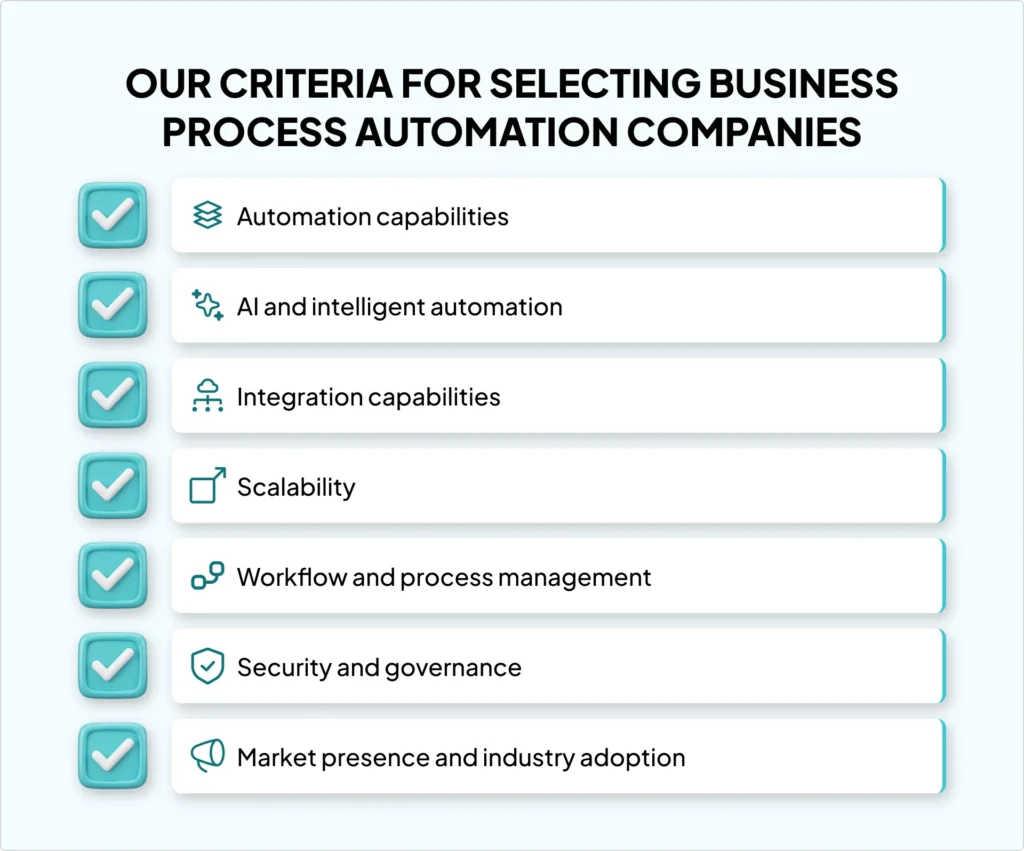
We considered the following criteria:
- Automation capabilities: We looked at the ability to automate repetitive tasks, workflows, approvals, and end-to-end business processes.
- AI and intelligent automation: Companies were evaluated on their use of AI, machine learning, intelligent document processing, and AI-powered decision-making.
- Integration capabilities: We considered support for ERP, CRM, HR, finance, cloud, APIs, legacy systems, and third-party applications.
- Scalability: We assessed whether the solutions can support growing automation needs across departments and large enterprise environments.
- Workflow and process management: Companies were considered for workflow design, process orchestration, monitoring, and process improvement features.
- Security and governance: We looked at enterprise security, access controls, compliance, monitoring, and governance features.
- Market presence and industry adoption: We considered established market presence, enterprise adoption, customer use cases, and recognition from industry research.
These criteria help us identify companies that can support both simple workflow automation and larger enterprise automation programs. Current 2026 research also shows strong positions for providers such as Appian, Microsoft, Automation Anywhere, IBM, ServiceNow, Pegasystems, and UiPath across process intelligence and automation categories.
Top 10 Process Automation Companies At a Glance
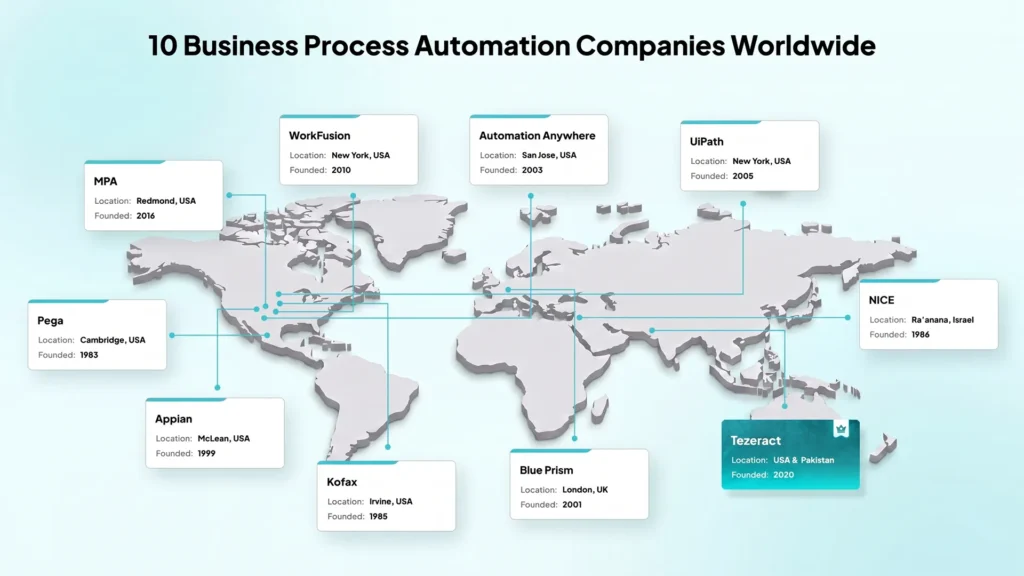
| Rank | Company | Location | Founded | Core Services | Best For |
|---|---|---|---|---|---|
| 1 | UiPath | New York, USA | 2005 | Enterprise RPA, AI-powered automation, process mining, document understanding | Mid-to-large enterprises |
| 2 | Automation Anywhere | San Jose, USA | 2003 | Cloud RPA, intelligent automation, IQ Bot, bot analytics | Cloud-first enterprise automation |
| 3 | Tezeract | Pakistan & USA | 2020 | Intelligent process automation, conversational AI, custom workflow automation, AI-powered document processing | Custom AI automation |
| 4 | Blue Prism | London, UK | 2001 | Enterprise RPA, intelligent automation, process intelligence, digital workforce | Regulated industries |
| 5 | Microsoft Power Automate | Redmond, USA | 2016 | Workflow automation, RPA, AI Builder, process advisor | Microsoft-based businesses |
| 6 | Pega | Cambridge, USA | 1983 | BPM, case management, RPA, AI-powered decisioning | Complex enterprise processes |
| 7 | Kofax / Tungsten Automation | Irvine, USA | 1985 | Intelligent automation, document processing, RPA, process orchestration | Document-heavy processes |
| 8 | WorkFusion | New York, USA | 2010 | AI-powered RPA, digital workers, compliance automation, fraud detection | Banking and financial services |
| 9 | NICE | Ra’anana, Israel | 1986 | RPA, process discovery, analytics, workforce optimization | Contact centers and back-office operations |
| 10 | Appian | McLean, USA | 1999 | Low-code automation, BPM, RPA, AI, case management | Custom business process automation |
The companies above follow the same ranking and company data already used in the article.
The 10 Best Business Process Automation Companies Globally
After evaluating dozens of automation vendors, analyzing hundreds of implementations, and talking to actual users (not just reading marketing materials), here are the 10 business process automation companies that consistently deliver results.
1. UiPath
Location: New York, USA (Global operations)
Founded: 2005
Core Services: Enterprise RPA, AI-powered automation, process mining, document understanding, test automation
Industries Served: Financial services, healthcare, manufacturing, retail, telecommunications, public sector
Why UiPath Leads the Pack
UiPath dominates the robotics process automation companies landscape for good reason. Their platform combines powerful RPA capabilities with advanced AI that can handle complex, judgment-based tasks. What impressed me most is their process mining tool, it automatically discovers automation opportunities by analyzing how your employees actually work, not how you think they work.
Their automation cloud architecture means you can deploy bots quickly without massive infrastructure investments. I’ve seen companies go from zero to 20 automated processes in under three months with UiPath. The platform’s drag-and-drop interface makes it accessible to business users, not just developers, which dramatically accelerates development.
UiPath’s document understanding capabilities are particularly strong. They can extract data from invoices, contracts, forms, even handwritten documents, with accuracy rates above 95%. For businesses drowning in document processing, this is transformative.
Best Fit & Takeaway: UiPath is ideal for mid-to-large enterprises looking for comprehensive automation across multiple departments. If you need enterprise-grade scalability, robust governance, and cutting-edge AI capabilities, UiPath should be on your shortlist. Expect higher costs than smaller vendors, but the ROI justifies it for complex automation needs.
2. Automation Anywhere
Location: San Jose, California, USA
Founded: 2003
Core Services: Cloud-native RPA, intelligent automation, IQ Bot for cognitive automation, bot analytics, discovery bot
Industries Served: Banking, insurance, healthcare, logistics, manufacturing, retail
Why Automation Anywhere Leads the Pack
Automation Anywhere pioneered cloud-native RPA, and that architectural decision gives them significant advantages in deployment speed and scalability. Their platform is built for the cloud from the ground up, not retrofitted, which means better performance and easier management.
What sets them apart is their focus on business users. The Bot Store offers pre-built automation packages for common processes, you can literally download and deploy automations for invoice processing, employee onboarding, or customer service workflows in hours, not weeks. It’s like an app store for automation.
Their IQ Bot brings serious AI muscle to document processing and unstructured data handling. I’ve seen it tackle messy, inconsistent documents that would choke other platforms. The learning capability means it gets better over time, adapting to variations in your documents without constant retraining.
Best Fit & Takeaway: Automation Anywhere excels for organizations that want rapid deployment and cloud-first architecture. If you’re looking to scale quickly across multiple locations or need strong out-of-the-box solutions, they’re excellent. Their pricing is competitive for cloud deployments, though on-premise options cost more.
3. Tezeract
Location: Pakistan and USA
Founded: 2020
Core Services: Intelligent process automation, conversational AI integration, custom workflow automation, AI-powered document processing, end-to-end automation consulting
Industries Served: Legal, healthcare, financial services, manufacturing, retail, technology
Why Tezeract Leads the Pack
Tezeract stands out among intelligent process automation companies for their unique approach to combining RPA with conversational AI. While other vendors bolt on AI as an afterthought, Tezeract builds it into the core architecture through their comprehensive Business Process Automation Services. This means you get automation that doesn’t just execute tasks, it understands context, handles natural language interactions, and adapts to exceptions intelligently.
What really differentiates Tezeract is their consulting-first approach. They don’t just sell you software and walk away. Their team conducts deep process analysis, identifies the highest-impact automation opportunities, and designs solutions tailored to your specific operational challenges. I’ve seen them take processes that other vendors said were “too complex to automate” and deliver working solutions within 12 weeks.
Their conversational AI capabilities are particularly impressive for customer-facing processes. Tezeract’s bots can handle complex customer inquiries, process requests through natural dialogue, and seamlessly hand off to humans when needed. The integration between their conversational layer and backend automation creates experiences that feel genuinely intelligent, not robotic.
The platform’s flexibility is another major advantage. Through their Robotic Process Automation Services, Tezeract works with your existing tech stack rather than forcing you to rip and replace. They’ve successfully integrated with legacy systems that are 20+ years old, modern cloud platforms, and everything in between. This pragmatic approach significantly reduces implementation risk and cost.
Beyond traditional RPA, Tezeract’s AI Automation Services leverage machine learning and generative AI to create truly intelligent workflows that learn and improve over time. Their expertise in AI Development Services means they can build custom automation solutions that go far beyond off-the-shelf capabilities, while their Custom Software Development Services ensure seamless integration with your unique business requirements.
Best Fit & Takeaway
Tezeract is perfect for mid-market to enterprise companies that need intelligent automation with strong AI capabilities and hands-on implementation support. If you’re dealing with complex processes that require judgment, natural language understanding, or sophisticated exception handling, Tezeract delivers. Their pricing is transparent and competitive, with flexible engagement models from project-based to managed services.
Key Projects by Tezeract
Tambot
Tambot is an LLM-driven market intelligence agent built by Tezeract for a US-based research firm. It automates market research and TAM report creation using a multi-agent setup powered by models from OpenAI, Anthropic, Google, and xAI. The system gathers data, checks insights, and produces structured reports directly within Excel workflows, cutting down manual research time and improving reporting speed.
GearGuide
GearGuide is a RAG-based conversational AI assistant developed for a Canadian motorcycle parts retailer. It enhances customer support and product search by providing real-time fitment data, compatibility details, and support answers. Customers can quickly find the right motorcycle parts through accurate, source-supported responses.
Moveally
Moveally is an AI solution that converts traditional dance training into a virtual learning experience while keeping expert guidance intact. It uses AI-based movement analysis to give feedback and help students learn remotely. Instructors can manage classes, upload recorded lessons, and monitor student performance in an organized way.
FN-AD Match
FN-AD Match is an AI platform that streamlines fashion brand profiling, classification, and matchmaking with wholesalers. It applies natural language processing, computer vision, and real-time data gathering to replace manual processes with automated insights. This leads to faster and more precise connections between fashion brands and retail partners.
Pitchmark
Pitchmark is an AI-powered tool developed to automate marketing pitch creation. It collects business signals such as SEO keywords, ad activity, and other marketing data, enriches it using GPT-4, and generates tailored outreach pitches using predefined templates. This reduces manual effort and helps teams produce client-ready pitches faster.
FormOle
FormOle is a fully automated AI sports platform that works as a virtual coaching and community system. Users can upload performance videos for AI analysis, receive feedback, and share or challenge results with others. It aims to help athletes improve skills without relying on physical coaching or sports academies.
Looking to Automate Your Business Processes?
Reduce manual work and improve operational efficiency with AI-powered process automation. Our team builds automation solutions around your existing workflows and systems.
✅ You own 100% of your code.
✅ 100% confidential.
✅ NDA available before discussions.
4. Blue Prism
Location: London, UK (Now part of SS&C Technologies)
Founded: 2001
Core Services: Enterprise RPA, intelligent automation, process intelligence, digital workforce management, cloud automation
Industries Served: Financial services, healthcare, telecommunications, utilities, public sector
Why Blue Prism Leads the Pack
Blue Prism literally coined the term “robotic process automation” and pioneered the enterprise RPA market. Their focus has always been on security, governance, and enterprise-grade reliability, critical factors for regulated industries.
What makes Blue Prism special is their “digital workforce” concept. Instead of thinking about individual bots, you manage a workforce of digital workers with roles, responsibilities, and governance structures that mirror your human workforce. This approach scales beautifully for large enterprises with complex organizational structures.
Their security and audit capabilities are unmatched. Every action a bot takes is logged with complete traceability. For industries like banking and healthcare where compliance isn’t optional, this level of governance is essential. Blue Prism’s architecture ensures that automated processes meet the same regulatory standards as human-executed processes.
Best Fit & Takeaway
Blue Prism is the go-to choice for large enterprises in regulated industries that need bulletproof security, governance, and compliance. If you’re in financial services, healthcare, or government, their enterprise focus and security posture make them worth the premium pricing. Smaller companies might find them overkill.
5. Microsoft Power Automate
Location: Redmond, Washington, USA
Founded: 2016 (as Microsoft Flow)
Core Services: Workflow automation, RPA, AI Builder, process advisor, cloud and desktop automation
Industries Served: Cross-industry (particularly strong in organizations using Microsoft 365)
Why Microsoft Power Automate Leads the Pack
Power Automate’s biggest advantage is its deep integration with the Microsoft ecosystem. If you’re running on Microsoft 365, Azure, Dynamics 365, or other Microsoft platforms, Power Automate connects seamlessly. The friction of integration, kills many automation projects, simply disappears.
The pricing model is incredibly attractive, especially for companies already invested in Microsoft licensing. Power Automate is included in many Microsoft 365 plans, and premium features are priced per user rather than per bot, which can be significantly cheaper for organizations with many users but moderate automation needs.
AI Builder brings accessible AI capabilities to business users. You can build and train models for document processing, object detection, or prediction without being a data scientist. The low-code approach means your business analysts can create automations without waiting for IT resources.
Best Fit & Takeaway
Power Automate is perfect for Microsoft-centric organizations and small-to-mid-sized businesses looking for cost-effective automation. If you’re already paying for Microsoft 365, you’re leaving money on the table by not using it. The learning curve is gentle, and the community support is excellent. Large-scale, complex automation might require supplementing with more specialized tools.
6. Pega
Location: Cambridge, Massachusetts, USA
Founded: 1983
Core Services: Business process management, case management, RPA, AI-powered decisioning, customer engagement
Industries Served: Financial services, insurance, healthcare, telecommunications, government
Why Pega Leads the Pack
Pega takes a different approach than pure-play RPA vendors. They combine process automation with case management and AI-powered decisioning in a unified platform. This matters because real business processes aren’t just linear workflows, they involve exceptions, judgment calls, and complex decision trees.
Their AI decisioning engine is phenomenal. It can analyze millions of data points in real-time to make optimal decisions about everything from customer offers to fraud detection to resource allocation. This goes way beyond simple automation into intelligent process optimization.
Pega’s low-code platform enables rapid application development. You’re not just automating existing processes, you’re redesigning them for maximum efficiency. I’ve seen Pega implementations that didn’t just automate work but fundamentally transformed how the business operated, cutting process times by 70-80%.
Best Fit & Takeaway
Pega is ideal for large enterprises tackling complex, end-to-end process transformation, not just automation. If you need to combine automation with sophisticated decision-making, case management, and customer engagement, Pega delivers. Expect significant investment in both licensing and implementation, but the transformation potential is massive.
7. Kofax (Now Tungsten Automation)
Location: Irvine, California, USA
Founded: 1985
Core Services: Intelligent automation, document processing, RPA, process orchestration, analytics
Industries Served: Banking, insurance, healthcare, government, supply chain
Why Kofax Leads the Pack
Kofax built their reputation on document capture and processing, and that heritage shows in their exceptional document intelligence capabilities. If your automation needs involve processing large volumes of documents, invoices, claims, applications, contracts, Kofax handles it better than almost anyone.
Their intelligent automation platform combines RPA, cognitive capture, process orchestration, and analytics in an integrated suite. This end-to-end approach means you’re not stitching together multiple vendors’ tools, everything works together natively.
What impressed me about Kofax is their focus on total process automation, not just task automation. They map entire processes, identify all automation opportunities, and orchestrate both human and digital workers. The result is streamlined operations that flow smoothly from start to finish.
Best Fit & Takeaway
Kofax excels for document-intensive industries and processes. If you’re processing thousands of invoices, insurance claims, loan applications, or similar documents, their document intelligence capabilities will transform your operations. Pricing is competitive for their core strengths, though the full platform can get expensive.
8. WorkFusion
Location: New York, USA
Founded: 2010
Core Services: Intelligent automation, AI-powered RPA, digital workers, compliance automation, fraud detection
Industries Served: Banking, financial services, insurance
Why WorkFusion Leads the Pack
WorkFusion specializes in financial services automation, and that focus gives them deep domain expertise. Their pre-built solutions for banking operations, KYC, AML, fraud detection, loan processing, are incredibly sophisticated because they’ve been refined through hundreds of implementations.
Their AI capabilities are particularly strong in areas that matter for financial services: entity extraction, risk assessment, anomaly detection, and compliance monitoring. The platform learns from your data and continuously improves accuracy, which is critical for processes where errors have serious consequences.
WorkFusion’s “digital workers” concept packages automation, AI, and orchestration into role-based solutions. Instead of building automation from scratch, you deploy a digital worker trained for specific banking functions. This dramatically accelerates time-to-value.
Best Fit & Takeaway
WorkFusion is the specialist choice for financial services organizations. If you’re a bank, credit union, or financial services company, their domain expertise and pre-built solutions will get you to ROI faster than generalist platforms. Outside of financial services, other vendors might be better fits.
9. NICE
Location: Ra’anana, Israel (Global operations)
Founded: 1986
Core Services: Attended automation, unattended RPA, process discovery, analytics, workforce optimization
Industries Served: Contact centers, financial services, healthcare, retail, telecommunications
Why NICE Leads the Pack
NICE comes from the contact center and workforce optimization world, which gives them unique strengths in attended automation, bots that work alongside employees in real-time. Their automation excels at helping customer service reps, back-office workers, and other employees who need instant assistance during their work.
Their process discovery capabilities use desktop analytics to understand exactly how employees perform tasks, identifying automation opportunities and process inefficiencies automatically. This data-driven approach ensures you’re automating the right things in the right ways.
NICE’s analytics provide unprecedented visibility into both human and digital worker performance. You can see exactly where time is spent, where bottlenecks occur, and how automation is impacting productivity. This continuous improvement mindset drives ongoing optimization.
Best Fit & Takeaway
NICE is perfect for organizations with large contact centers or back-office operations where attended automation can boost employee productivity. Their strength in workforce optimization means you get automation plus insights into how to improve overall operations. Pricing is competitive, especially for contact center-focused deployments.
10. Appian
Location: McLean, Virginia, USA
Founded: 1999
Core Services: Low-code automation, business process management, RPA, AI, case management
Industries Served: Financial services, government, healthcare, insurance, manufacturing
Why Appian Leads the Pack
Appian’s low-code platform enables rapid development of custom automation and applications. You’re not limited to pre-built automation templates, you can design exactly what your business needs. The visual development environment makes this accessible to business analysts, not just developers.
Their unified platform combines BPM, case management, RPA, and AI in a single environment. This integration eliminates the complexity of managing multiple tools and ensures everything works together seamlessly. I’ve seen Appian implementations that replaced 5-6 separate tools with a single platform.
Appian’s cloud-native architecture and mobile-first design mean your automated processes work anywhere, on any device. For organizations with distributed workforces or field operations, this flexibility is invaluable.
Best Fit & Takeaway
Appian is ideal for organizations that need custom automation solutions and want the flexibility of low-code development. If your processes are unique and off-the-shelf solutions don’t fit, Appian gives you the tools to build exactly what you need. Expect to invest in training and development resources, but the customization possibilities are nearly limitless.
Making Your Decision: Next Steps
Choosing among these business process automation companies isn’t about finding the “best” one, it’s about finding the right one for your specific situation.
Start With Your Pain Points
Go back to those miseries we talked about at the beginning. Which ones are costing you the most right now? If manual errors are killing you, prioritize vendors with strong validation and quality control. If scalability is your biggest challenge, focus on platforms with proven enterprise scalability.
Map your top three pain points to the capabilities of each vendor. Be specific. Don’t just say “we need automation.” Say “we need to automate invoice processing for 2,000 invoices monthly with 99%+ accuracy and full audit trails.” That specificity will guide you to the right solution.
Run a Proof of Concept
Never, ever buy automation software without testing it on your actual processes. Every vendor on this list will run a proof of concept (POC) for serious buyers. Take them up on it.
Choose a representative process, not your simplest one, but not your most complex either. Something that reflects the typical challenges you face. Give the vendor 4-6 weeks to automate it. Then evaluate not just whether it works, but how easy it was to implement, how well it handles exceptions, and how much support you needed.
Pay attention to the implementation experience. Was the vendor responsive? Did they understand your business? Did they deliver on time? These factors predict how the full implementation will go.
Calculate Total Cost of Ownership
Look beyond the sticker price. Calculate your total cost over three years including:
- Software licensing (per bot, per user, per process, or platform fees)
- Implementation services and consulting
- Infrastructure costs (servers, cloud hosting, etc.)
- Training for your team
- Ongoing support and maintenance
- Internal resources (your people’s time)
Then calculate the benefits: labor savings, error reduction, faster processing, improved compliance, better customer experience. The process automation ROI should be clear and compelling. If it’s not, either you’re automating the wrong things or you’re choosing the wrong vendor.
How Tezeract Builds a Custom AI-Powered Solution for Businesses
At Tezeract, we build custom AI-powered automation around the specific processes, systems, and goals of each business. Our process follows four clear steps:
- Understand the business process
We identify repetitive tasks, bottlenecks, manual work, data sources, and the business outcome the automation needs to achieve. - Design the AI automation solution
We define the workflow, AI models, agents, APIs, databases, integrations, and automation rules required to handle the process. - Build and integrate the solution
Our team develops the solution and connects it with existing CRM, ERP, communication tools, databases, and other business systems. - Test, deploy, and improve
We test the automation against real workflows, deploy it into the business environment, monitor performance, and improve it based on results and user feedback.
Have a Process You Want to Automate?
From invoice processing and data entry to customer onboarding and approvals, we can help automate repetitive tasks. Get expert guidance on the right approach for your business.
✅ You own 100% of your code.
✅ 100% confidential.
✅ NDA available before discussions.
What to Do Next
Document your current state: Map out your top 5-10 processes that are causing the most pain. Calculate the current cost in time, errors, and resources. This becomes your baseline for measuring ROI.
Shortlist 3-4 vendors: Based on your specific needs, industry, and budget, narrow down to 3-4 vendors from this list. Request demos focused on your use cases, not generic product tours.
Run parallel POCs: If possible, run proof of concepts with your top 2-3 choices simultaneously. This gives you direct comparison data and negotiating leverage.
Build your implementation team: Identify your internal champions, process owners, and technical resources who’ll drive the automation initiative. Vendor selection should involve all key stakeholders.
Plan for change management: Start communicating with your team early about automation plans. Address concerns, highlight benefits, and involve employees in identifying automation opportunities.
The Future of Business Process Automation
The automation landscape is evolving faster than most people realize. Here’s what’s coming that should influence your vendor selection.
Hyperautomation and AI Integration
We’re moving beyond simple task automation into what Gartner calls “hyperautomation”, the combination of RPA, AI, machine learning, process mining, and analytics to automate entire business functions. The best AI automation companies are already delivering this.
Expect to see automation that doesn’t just follow rules but learns and adapts. Systems that can handle ambiguity, make judgment calls within defined parameters, and continuously optimize themselves. This is already happening with vendors like Tezeract, UiPath, and Automation Anywhere leading the charge.
Process Intelligence and Discovery
Manual process mapping is dying. Process mining tools now automatically discover how work actually flows through your organization by analyzing system logs, user interactions, and data movements. This reveals automation opportunities you didn’t know existed and identifies inefficiencies you couldn’t see.
The workflow automation companies investing heavily in process intelligence will help you continuously identify new automation opportunities and optimize existing automations. This shifts automation from a one-time project to an ongoing optimization program.
Autonomous Decision-Making
We’re heading toward automation that doesn’t just execute tasks but makes decisions. AI-powered systems that can evaluate options, assess risk, and choose optimal actions based on real-time data and learned patterns.
This is particularly powerful for customer-facing processes. Imagine automation that can assess a customer inquiry, determine the best response strategy, execute the solution, and learn from the outcome, all without human intervention. Several vendors on this list are already piloting these capabilities.
Democratization of Automation
Automation is becoming accessible to business users, not just IT departments. Low-code and no-code platforms are putting automation development in the hands of the people who understand the processes best, the ones doing the work.
This democratization will accelerate automation adoption dramatically. Instead of waiting months for IT to build automation, business teams will create their own solutions in days or weeks. The best process automation companies are building platforms that balance this accessibility with proper governance and security.
FAQs
What is the average cost of business process automation software for mid-sized companies?
The cost of business process automation software varies widely based on scope and vendor, but mid-sized companies typically invest $50,000-$250,000 annually for comprehensive automation platforms. This includes licensing (often $5,000-$15,000 per bot or $100-$300 per user monthly), implementation services ($30,000-$100,000 for initial setup), and ongoing support. Cloud-based solutions from vendors like Microsoft Power Automate can start as low as $15-$40 per user monthly, while enterprise platforms like UiPath or Blue Prism command premium pricing. Companies working with specialized providers like Tezeract’s Business Process Automation Services often find transparent, flexible pricing models that align with their specific automation needs. Most companies see positive ROI within 6-12 months through labor savings and efficiency gains.
How long does it typically take to implement business process automation?
Implementation timelines for streamlining business operations with automation depend on process complexity and organizational readiness. Simple, single-process automation can be deployed in 4-8 weeks, while moderate complexity projects typically take 8-16 weeks from discovery to production. Enterprise-wide automation initiatives spanning multiple departments often require 6-12 months for complete rollout. The best business process automation companies follow phased approaches, starting with high-impact processes to demonstrate quick wins, then expanding systematically. Factors affecting timeline include integration complexity, data quality, change management needs, and internal resource availability.
What are the biggest BPA implementation challenges companies face?
BPA implementation challenges most commonly include resistance to change from employees fearing job displacement, poor process documentation making automation difficult, integration issues with legacy systems, and unrealistic expectations about automation capabilities. According to Forrester research, 30-50% of initial automation projects fail due to inadequate change management and process preparation. Other significant challenges include data quality issues, lack of executive sponsorship, insufficient training, and choosing the wrong processes to automate first. Successful implementations address these through comprehensive change management, thorough process analysis, and starting with well-defined, high-value processes. Working with experienced partners who provide end-to-end AI Automation Services can significantly reduce these risks through proven implementation methodologies.
Can small businesses benefit from working with process automation companies?
Absolutely. Small businesses often see proportionally larger benefits of process automation for businesses because they’re typically more agile and less burdened by complex legacy systems. Modern workflow automation companies offer scalable solutions starting at $500-$2,000 monthly that can automate core processes like invoicing, customer onboarding, inventory management, and reporting. Platforms like Microsoft Power Automate, Zapier, or smaller-scale implementations from companies like Tezeract provide accessible entry points. Small businesses should focus on automating high-volume, repetitive tasks first, often seeing 40-60% time savings on automated processes and ROI within 3-6 months.
How do intelligent process automation companies differ from traditional RPA vendors?
Intelligent process automation companies integrate AI, machine learning, and cognitive capabilities with traditional RPA, enabling automation of complex, judgment-based tasks that basic RPA cannot handle. While traditional robotics process automation companies focus on rule-based, repetitive tasks, intelligent automation can process unstructured data, understand natural language, make decisions based on patterns, and handle exceptions. For example, traditional RPA can copy data between systems, but intelligent automation can read and understand invoices in any format, extract relevant information, validate against business rules, and route exceptions appropriately. This dramatically expands what can be automated, from 20-30% of tasks with basic RPA to 60-80% with intelligent automation. Providers like Tezeract’s AI Development Services specialize in building these advanced capabilities into automation solutions.
What ROI should I expect from business process automation?
Process automation ROI typically ranges from 200-400% over three years for well-implemented projects. Most organizations see 30-50% reduction in process execution time, 80-95% reduction in errors, and 20-40% decrease in operational costs for automated processes. According to McKinsey research, companies implementing automation see productivity gains of 20-35% in automated functions. Payback periods average 6-12 months for high-volume processes and 12-18 months for complex implementations. Beyond direct cost savings, organizations gain improved compliance, better customer experience, enhanced scalability, and freed-up employee capacity for strategic work, benefits that often exceed the direct financial ROI.
How do I choose between different business process automation companies?
Vendor selection for business process management should be based on your specific needs, not vendor popularity. Start by identifying your top pain points and automation priorities. Evaluate vendors on technical fit (can they handle your processes and integrate with your systems?), industry expertise (do they understand your domain?), implementation approach (do they provide adequate support?), and total cost of ownership. Request case studies business process automation success from similar companies, run proof of concepts on representative processes, and involve key stakeholders in evaluation. Consider factors like scalability, AI capabilities, ease of use, support quality, and vendor stability. The right choice balances capability, cost, and cultural fit with your organization. Companies offering comprehensive Custom Software Development Services alongside automation can provide tailored solutions that perfectly match your unique requirements.
What processes should I automate first?
Start with high-volume, repetitive, rule-based processes that cause significant pain and have clear ROI. Ideal first automation candidates include invoice processing, data entry, report generation, customer onboarding, employee onboarding, and order processing. Look for processes that are time-consuming, error-prone, well-documented, and involve multiple systems. Avoid starting with highly complex processes requiring extensive judgment or poorly defined processes that need redesign first. Companies specializing in workflow optimization typically recommend the “crawl, walk, run” approach, start with 2-3 straightforward processes to build confidence and expertise, then tackle progressively more complex automation. Quick wins build momentum and secure stakeholder buy-in for broader automation initiatives.