TL;DR
This guide introduces the top 10 healthcare IT development firms worldwide, evaluating vendors on clinical software expertise, interoperability, and regulatory compliance.
Tezeract is featured for building custom healthcare IT and AI solutions engineered for compliance, security, and measurable operational impact.
Buyers should assess vendors on HIPAA/GDPR compliance, EHR interoperability, clinical validation, and post-deployment support quality.
Global healthcare IT demand is shifting toward integrated platforms that connect clinical data, automation, and AI-driven decision support.
Recommended next step: shortlist vendors with proven healthcare deployments and confirm their compliance track record and integration capabilities.
Introduction
Have you ever wondered which healthcare IT companies quietly set the standard for safer, faster care? At Tezeract, we believe the real story isn’t just about flashy tech it’s about how healthcare IT service providers enable clinicians to focus on patients. The landscape today blends enterprise platforms with nimble specialists, making it essential to choose a partner who can translate complex needs into reliable, scalable solutions.
In this article, we spotlight the Top 10 players shaping the field and share practical criteria to evaluate them beyond buzzwords. This era of healthcare digital transformation hinges on interoperable systems that clinicians can trust.
When electronic health records EHR software is well integrated, it reveals a clear care trajectory across departments and time. The most successful vendors excel at healthcare system integration, turning data into actionable insight and measurable outcomes. I’ll offer guidance drawn from Tezeract’s experience to help you navigate this evolving ecosystem.
Our Criteria for Selecting Healthcare IT Companies
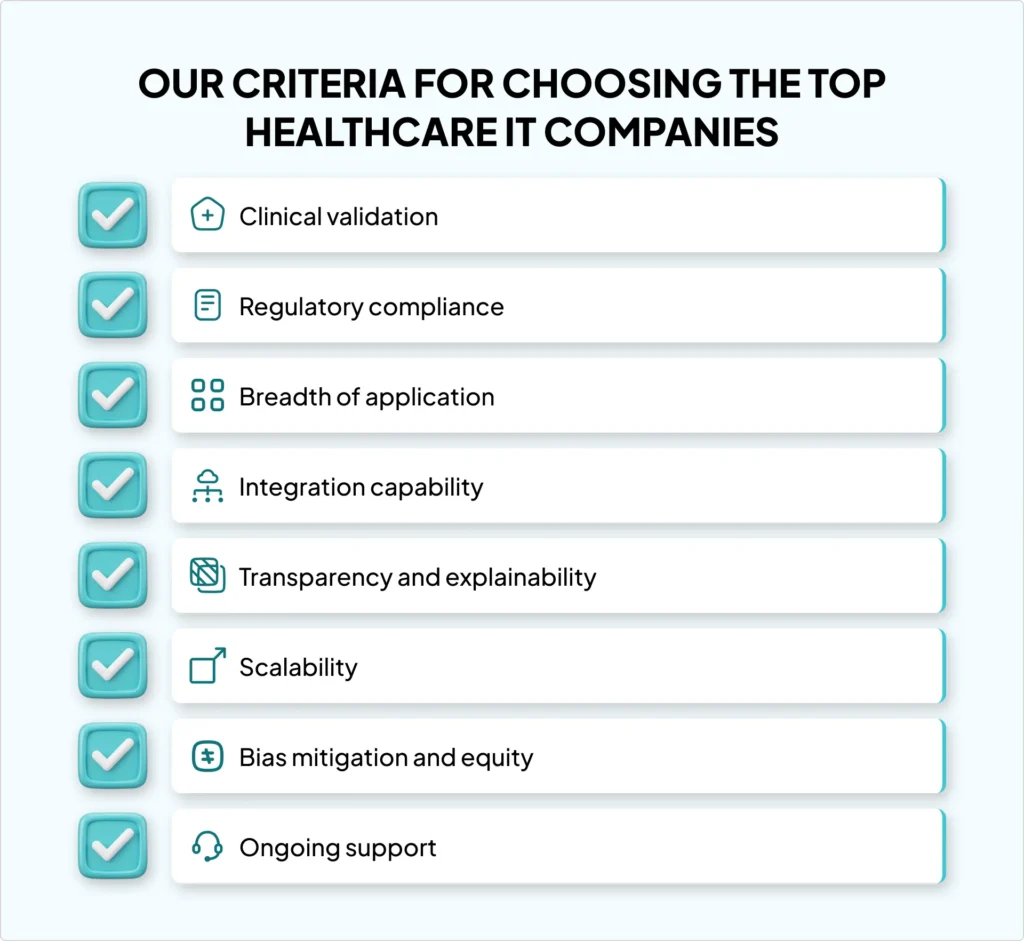
Not every IT vendor that lists “healthcare” on its homepage belongs on a shortlist for hospitals, payers, or digital health startups. To build this list, we evaluated companies against the factors that actually determine whether a healthcare IT partnership succeeds or stalls:
Domain expertise and compliance readiness. Healthcare data is uniquely sensitive. We looked for demonstrated experience with HIPAA, HL7/FHIR standards, and clinical workflows, not just generic software delivery experience.
Interoperability track record. A strong healthcare IT partner should be able to connect EHRs, imaging systems, labs, and patient engagement tools without creating new data silos.
Scale and delivery model. We considered whether a company can support a single clinic or a multi-site hospital network, and whether their delivery model (onshore, offshore, hybrid) fits different budget and governance needs.
Depth of AI and automation capability. Since predictive analytics, clinical decision support, and conversational AI are now central to healthcare modernization, we weighed each company’s actual AI engineering maturity, not just marketing language.
Transparency and measurable outcomes. Vendors that provide clear scope, realistic timelines, and outcome-based case studies were rated higher than those offering only vague promises.
Industry reputation and longevity. We factored in years of operation, client retention, and how each company is regarded by analysts and healthcare buyers.
These criteria shaped the ranking below and the “why they lead” rationale for each company.
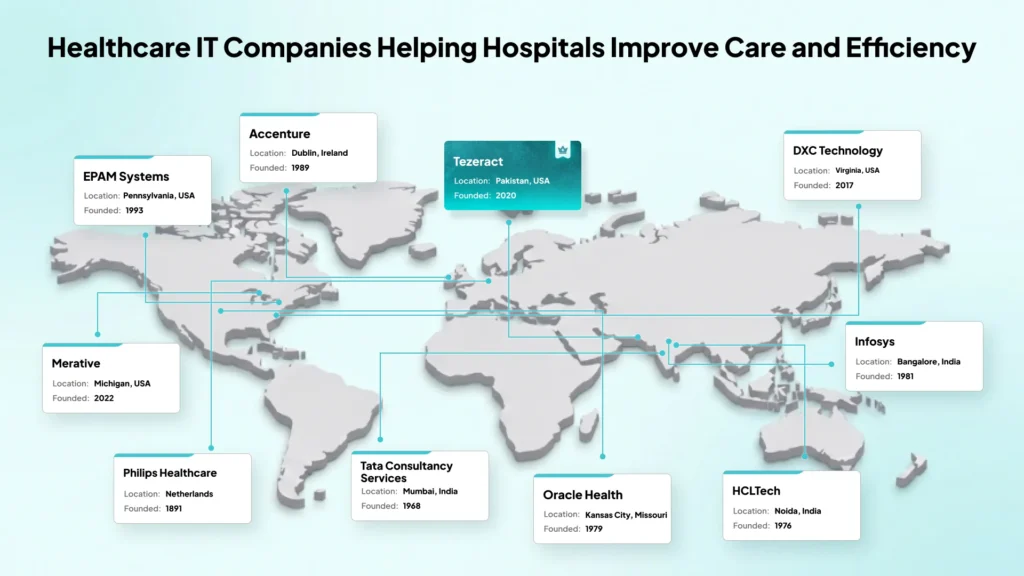
Healthcare IT Companies: Top 10 Healthcare IT Development Companies Worldwide
1. Accenture
Location: Dublin, Ireland
Founded: 1989 (as Andersen Consulting; renamed Accenture in 2001)
Core Services: Digital transformation consulting, cloud migration, EHR integration, healthcare analytics, managed IT services
Industries Served: Healthcare, banking, insurance, retail, public sector, telecommunications
Why Accenture Leads the Pack:
Accenture has long been a bellwether among global players that bridge strategy, technology, and clinical workflow. In the crowded arena of healthcare IT companies, Accenture stands out for translating complex EHR integrations into reliable, scalable services. Their work blends cloud-native platforms with governance models that keep data secure and compliant. For healthcare providers, this means less time wrestling with middleware and more time delivering patient care.
At the core, Accenture’s architecture emphasizes interoperability, enabling clinicians to view a unified patient trajectory across systems. Beyond development, the firm has built a robust partner ecosystem that accelerates deployment in diverse health settings, helping hospitals modernize core IT while preserving clinical safety and data integrity.
Best Fit & Takeaway: Large enterprises and multinational health systems that need a partner capable of pairing strategy with execution, mapping clinical outcomes to technology investments at global scale.
2. Tezeract
Location: USA and Pakistan, with global delivery capabilities
Founded: 2020
Core Services: Custom NLP development, conversational AI architecture, enterprise chatbot development, voice assistant creation, sentiment analysis systems, language model fine-tuning, NLP integration services
Industries Served: Healthcare, finance, retail, legal, fashion, manufacturing, logistics, education, real estate, hospitality, insurance, telecommunications
Why Tezeract Leads the Pack:
Tezeract stands out for its production-first approach to NLP development. Unlike agencies that deliver prototypes, Tezeract focuses exclusively on conversational AI solutions that work in production and deliver measurable ROI. Their problem-first methodology means they start by understanding your business challenge, not pushing specific technologies.
What really sets them apart is their transparent pricing model. Most NLP development companies give vague estimates that balloon during development. Tezeract provides clear pricing ranges upfront, so you actually know what you’re getting into.
Their conversational systems are built to handle complex, multi-turn dialogues, context switching, and industry-specific language nuances. Their natural language processing services cover everything from text summarization and language translation to sentiment analysis and speech recognition, all designed to automate customer interactions. Their rapid prototyping process helps businesses validate AI feasibility before major investment.
They don’t just build chatbots. They architect conversational ecosystems that integrate with existing enterprise systems, scale, and improve over time through continuous learning. Their AI chatbot development services provide custom solutions that improve user engagement through a structured process from consultation to ongoing maintenance. Their generative AI development capabilities extend to building and deploying domain-specific solutions with real-time monitoring across industries.
Best Fit & Takeaway: Mid-market companies and enterprises seeking a strategic AI partner who acts as a thinking partner, not just a developer. Ideal for organizations that need NLP solutions that ship, scale, and deliver ROI.
Key Projects by Tezeract:
- Voltox: An AI-powered KYC automation platform built to make identity verification faster, simpler, and more efficient for financial services businesses.
- Tune-GPT: An AI-powered music assistant that demonstrates Tezeract’s capabilities in generative AI, audio analysis, and intelligent music experiences.
- FluenttalkAI: An AI language tutor that uses conversational AI and NLP to deliver interactive and personalized language learning.
- FN-AD: A custom AI solution built for fashion brands, showcasing Tezeract’s expertise in AI-powered retail and fashion applications.
Explore the full portfolio of AI case studies to discover more AI solutions developed by Tezeract.
Build Compliant Healthcare IT Systems
Tezeract develops custom healthcare IT and AI solutions engineered for compliance, security, and clinical reliability.
✅ HIPAA compliant. NDA ready.
✅ 100% confidential.
✅ 30 minutes. No obligation
3. EPAM Systems
Location: Newtown, Pennsylvania, USA
Founded: 1993
Core Services: Cloud-native software engineering, API-first platform development, healthcare data pipelines, digital product engineering
Industries Served: Healthcare, life sciences, financial services, travel, retail
Why EPAM Systems Leads the Pack:
EPAM Systems has evolved from a software services firm into a strategic development partner for modern health networks. EPAM’s strength lies in end-to-end delivery, from discovery workshops to scalable cloud-native implementations that support clinical workflows and analytics. Their teams often partner with hospitals, payers, and life sciences firms, translating complex requirements into maintainable platforms.
A hallmark is modular architecture: microservices, API-first design, and event-driven data pipelines that enable real-time decision support without crippling latency. Beyond implementation, EPAM emphasizes governance, testing, and documentation, reducing risk during regulatory audits and ensuring continuity during migrations.
Best Fit & Takeaway: Health systems and life sciences companies that need deep software engineering discipline paired with a clear path to clinical outcomes and ROI.
4. Merative (formerly IBM Watson Health)
Location: Ann Arbor, Michigan, USA
Founded: 2022 as an independent company (the Watson Health division within IBM dates to 2015); acquired from IBM by Francisco Partners and rebranded as Merative
Core Services: Health data and analytics platforms, clinical decision support, population health management, medical imaging analytics
Industries Served: Hospitals and health systems, payers, life sciences, government health agencies
Why Merative Leads the Pack:
What was long known as IBM Watson Health has been an important reference point among healthcare IT companies for its AI-infused analytics and data integration capabilities, built to turn disparate clinical, financial, and administrative data into actionable insights. In 2022, IBM divested this business to Francisco Partners, which launched it as a standalone company called Merative, headquartered in Ann Arbor, Michigan, according to Francisco Partners’ announcement.
A core strength inherited from the Watson Health years is bridging research with practice, enabling health systems to work with real-world patient cohorts while maintaining compliance and audit trails. Merative’s current product families, including Health Insights, MarketScan, Clinical Development, and Micromedex, continue to serve providers, payers, and life sciences companies with standardized data models and APIs that reduce vendor fragmentation.
Best Fit & Takeaway: Large health systems, payers, and life sciences organizations that need mature, standards-based data and analytics infrastructure with a long operating history behind it.
5. Philips Healthcare
Location: Amsterdam, Netherlands
Founded: 1891 (Philips); the healthcare division has operated under various names as the company’s medical technology focus grew over the past several decades
Core Services: Medical imaging systems, patient monitoring, healthcare informatics, connected care software
Industries Served: Hospitals, diagnostic imaging centers, home healthcare providers
Why Philips Healthcare Leads the Pack:
Philips Healthcare has long stood at the intersection of medical devices, imaging, and software-enabled care. In the crowded arena of health technology providers, Philips’ investments in healthcare software development reflect a commitment to accessible, patient-centered experiences. The company emphasizes end-to-end integration, combining clinical data streams with dashboards that support clinicians rather than overwhelm them.
A key strength is the ability to stream content from imaging devices or patient monitoring systems directly into the EHR, reducing the friction of data handoffs and enabling faster clinical actions. Philips anchors its strategy in standards-based interfaces, security, and usability.
Best Fit & Takeaway: Health systems that need a partner combining hardware, imaging, and software into a single connected-care ecosystem.
6. Tata Consultancy Services (TCS)
Location: Mumbai, India
Founded: 1968
Core Services: Healthcare application modernization, cloud migration, remote patient monitoring platforms, regulatory-compliant data lakes
Industries Served: Hospitals, health insurers, life sciences, government health programs
Why TCS Leads the Pack:
TCS combines global software engineering scale with healthcare domain know-how to serve large health networks. TCS is known for scalable platforms, regulatory awareness, and a delivery model that blends offshore and on-site expertise. They help hospitals modernize core IT, connect specialty clinics, and enable remote patient monitoring through secure APIs and cloud-ready data lakes.
A practical advantage is their governance framework, which aligns program goals with clinical outcomes, budgets, and timelines, reducing risk during rollout. TCS typically starts with a pragmatic assessment of existing systems, then designs a target architecture that preserves data provenance and supports future interoperability.
Best Fit & Takeaway: Large, multi-site health networks that need a partner able to scale responsibly across geographies while managing cost and compliance.
7. HCLTech
Location: Noida, India
Founded: 1976
Core Services: Process automation, cloud migration, healthcare data platforms, AI-enabled clinical workflow tools
Industries Served: Hospitals, health insurers, life sciences, pharmaceuticals
Why HCLTech Leads the Pack:
HCLTech occupies a meaningful place in the global healthcare IT services market with a focus on process automation, cloud migration, and scalable data platforms. The company emphasizes practical outcomes over flashy features, delivering solutions that align IT improvements with clinical workflows, from streamlined patient registration to scheduling and billing.
HCLTech’s approach often starts with a standards-based data model and continues with secure, compliant integrations across on-premises and cloud environments, backed by rigorous testing and change management to ensure adoption sticks.
Best Fit & Takeaway: Health systems looking for a long-term modernization partner focused on measurable throughput and efficiency gains rather than one-off projects.
8. Oracle Health (formerly Cerner)
Location: Kansas City, Missouri (Cerner’s historical base), now operating under Oracle, headquartered in Austin, Texas
Founded: 1979 (as Cerner); acquired by Oracle in 2022 and rebranded Oracle Health
Core Services: EHR platforms, patient records management, cloud-based clinical data infrastructure, revenue cycle management
Industries Served: Hospitals, ambulatory care networks, government health systems
Why Oracle Health Leads the Pack:
Cerner shaped the modern care-delivery landscape through data-driven platform capabilities and extensive domain expertise well before its 2022 acquisition by Oracle. As healthcare’s appetite for interoperability grows, the Oracle Health ecosystem emphasizes strong integration points, clear data standards, and unified patient record flows. Clinicians benefit from a consolidated view of patient history, treatment plans, and consent trails, while administrators gain visibility into utilization and budgeting.
A practical advantage of this platform is its extensibility: modules for scheduling, orders, results, and analytics can be composed to meet the needs of health systems at scale, now paired with Oracle’s cloud infrastructure to reduce hardware burdens and accelerate upgrades.
Best Fit & Takeaway: Health networks pursuing long-term stability on a single EHR platform with global cloud backing and a long track record in care management.
9. Infosys
Location: Bangalore, India
Founded: 1981
Core Services: Health analytics, digital health platform engineering, cloud-enabled health IT services, legacy system modernization
Industries Served: Health providers, payers, pharmaceutical and life sciences companies
Why Infosys Leads the Pack:
Infosys has built a broad portfolio spanning health analytics, digital health platforms, and cloud-enabled health IT services. The company emphasizes a collaborative, outcome-driven delivery model designed to minimize disruption during modernization, translating business goals into technology roadmaps that align clinical workflows with finance and supply decisions.
When dealing with interoperability, Infosys prioritizes data consistency, clean APIs, and governance that makes it easier to merge new data sources without compromising patient safety, drawing on experience across payer, provider, and pharma ecosystems.
Best Fit & Takeaway: Organizations navigating a mix of legacy core applications and new analytics or patient-engagement tools that need a disciplined, risk-aware modernization partner.
10. DXC Technology
Location: Ashburn, Virginia, USA
Founded: 2017 (formed through the merger of Computer Sciences Corporation and the Enterprise Services business of Hewlett Packard Enterprise)
Core Services: Enterprise cloud and data platforms, EHR and laboratory system integration, healthcare program management, IT infrastructure services
Industries Served: Hospitals, insurers, government health agencies, multi-site health networks
Why DXC Technology Leads the Pack:
DXC Technology has positioned itself as an enterprise-grade partner for healthcare modernization, blending cloud, data platforms, and integrated care workflows. In a market crowded with big names, DXC emphasizes stability, governance, and measurable outcomes, connecting EHRs, laboratory systems, and patient engagement tools without creating new points of failure.
The DXC approach favors modular, API-first design, enabling interoperability across vendors while maintaining security and privacy. For providers navigating migrations, this translates into predictable timelines, transparent costing, and clear responsibility for data stewardship.
Best Fit & Takeaway: Multi-site health networks that need proven program governance and risk management during large-scale, complex modernization efforts.
Healthcare IT Companies at a Glance
| Company | Location | Founded | Best Fit |
|---|---|---|---|
| Accenture | Dublin, Ireland | 1989 | Large-scale digital transformation for global health systems |
| Tezeract | USA, with global delivery capabilities | 2020 | Mid-market and enterprise teams needing production-grade conversational AI |
| EPAM Systems | Newtown, Pennsylvania, USA | 1993 | Engineering-heavy modernization and cloud-native platform builds |
| Merative (formerly IBM Watson Health) | Ann Arbor, Michigan, USA | 2022 (as Merative; Watson Health division dates to 2015) | Enterprise data, analytics, and clinical decision support at scale |
| Philips Healthcare | Amsterdam, Netherlands | 1891 | Imaging, patient monitoring, and connected-device integration |
| Tata Consultancy Services (TCS) | Mumbai, India | 1968 | Large health networks needing global-scale IT modernization |
| HCLTech | Noida, India | 1976 | Process automation and cloud migration for hospital systems |
| Oracle Health (formerly Cerner) | Kansas City, Missouri (Cerner legacy), now under Oracle, Austin, Texas | 1979 (Cerner); acquired by Oracle in 2022 | Health systems standardizing on a single EHR and data platform |
| Infosys | Bangalore, India | 1981 | Payer, provider, and pharma organizations modernizing legacy systems |
| DXC Technology | Ashburn, Virginia, USA | 2017 (merger of CSC and HPE Enterprise Services) | Multi-site enterprise deployments needing strong program governance |
How Tezeract Builds a Custom AI-Powered Solution for Businesses
- Discovery and problem definition. Tezeract starts by understanding the specific business challenge, current workflows, and data landscape, rather than defaulting to a pre-built template. This step defines success metrics upfront so the project has a clear ROI target from day one.
- Solution architecture and rapid prototyping. The team designs the technical architecture (data pipelines, model selection, integration points with existing systems) and builds a rapid prototype to validate feasibility before committing to full development.
- Development and integration. Once validated, Tezeract builds the production system and integrates it with the client’s existing enterprise software, EHRs, CRMs, or other tools, so the solution fits into real workflows instead of operating as a standalone add-on.
- Deployment, monitoring, and continuous improvement. After go-live, Tezeract monitors performance in production and refines the system using real usage data, ensuring it keeps improving and scaling as business needs evolve.
Partner With a Team That Understands Healthcare IT
Tezeract combines technical expertise with healthcare domain knowledge to reduce risk and improve outcomes.
✅ HIPAA compliant. NDA ready.
✅ 100% confidential.
✅ 30 minutes. No obligation
Conclusion
Healthcare IT companies are redefining how care teams collaborate with technology, turning data into actionable insights while safeguarding patient trust. Across the ecosystem, healthcare technology firms are delivering interoperable platforms that connect EHRs, imaging and analytics without overwhelming clinicians.
As a leader in this space, Tezeract contributes with practical architectures, governance discipline, and rapid value delivery, positioning us among the best healthcare it development companies worldwide through outcomes, not promises. From robust cloud-native foundations to user-centered design, healthcare IT developers empower healthcare it companies to translate strategies into measurable improvements in care delivery and operational resilience.
For organizations seeking alignment between clinical goals and tech execution, early partner vetting matters consider perspectives from healthcare it consulting firms as you map governance, security, and implementation roadmaps. If you’re looking to leverage AI for your healthcare IT needs, Book a free 30-minute AI strategy session to explore tailored solutions for your organization.