AI Summary
The latest AI trends 2026 are reshaping how businesses operate, compete, and grow, with generative AI, autonomous systems, and predictive analytics leading the charge.
Decision-makers should care because understanding AI trends 2026 for business means unlocking competitive advantage, cutting operational costs by up to 40%, and delivering customer experiences that drive loyalty and revenue.
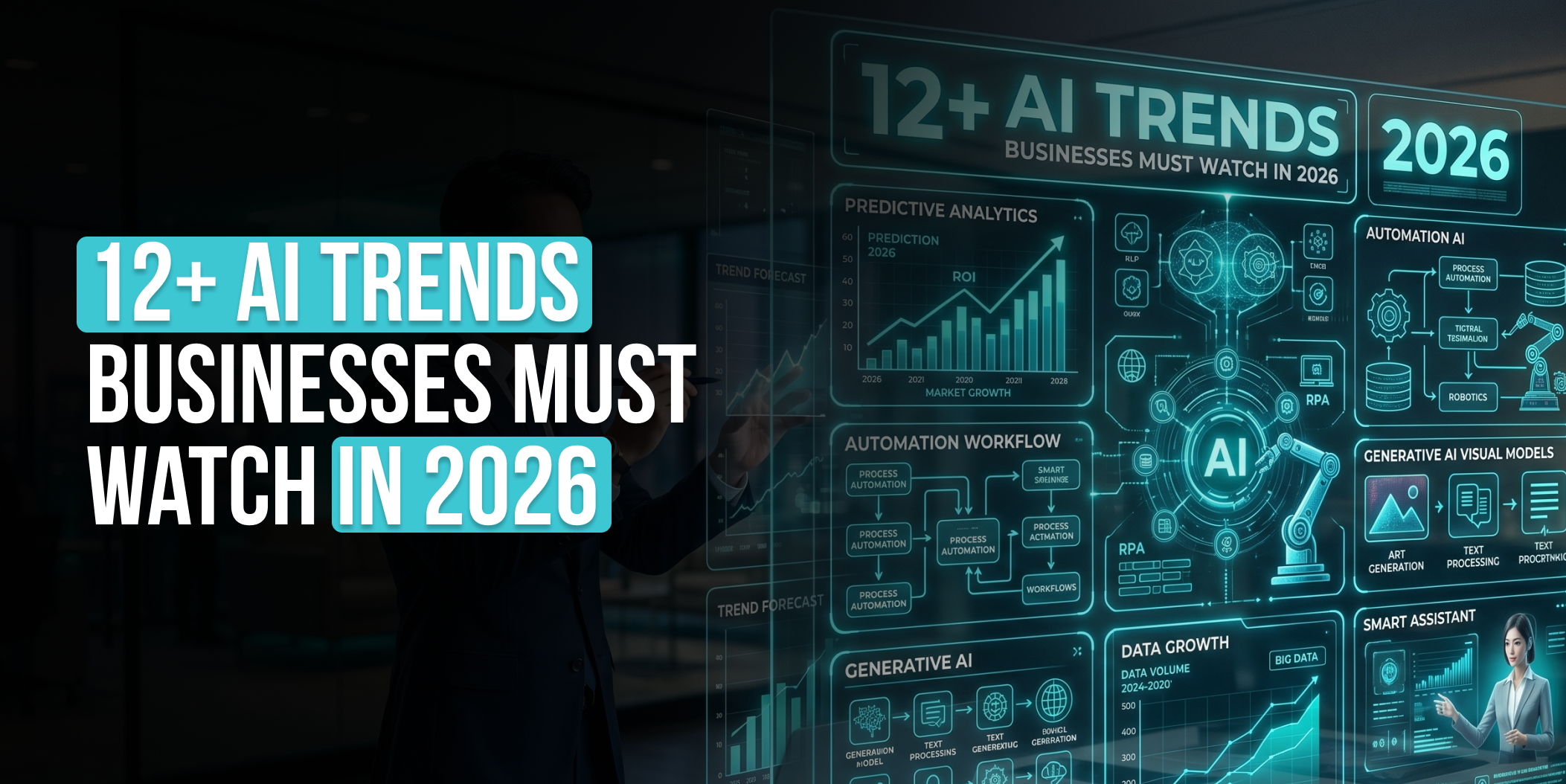
Our comprehensive guide covers 12+ top AI trends 2026 that companies must know, from AI agents and multimodal systems to ethical frameworks and quantum-AI integration.
Preparing for these emerging AI trends 2026 requires strategic planning, workforce upskilling, and choosing the right technology partners who understand both innovation and implementation.
Future-ready organizations leveraging AI transformation trends 2026 will dominate their markets through faster innovation cycles, smarter decision-making, and unmatched operational efficiency.
I was sitting in a boardroom last month when a CEO asked me something that made everyone uncomfortable: “If we don’t figure out AI in the next 18 months, are we basically done?”
The room went silent. Not because the question was dramatic, but because deep down, everyone knew the answer.
Look, I get it. Keeping up with AI trends 2026 for business feels like trying to drink from a fire hose while riding a roller coaster. Every week there’s a new breakthrough, a new tool, a new “game-changing” announcement that makes last month’s strategy feel ancient.
But here’s what I’ve learned after working with dozens of companies navigating this exact challenge: you don’t need to chase every shiny AI object. You need to understand which current AI trends will actually move the needle for your business, and which ones are just noise.
The businesses winning right now aren’t the ones with the biggest AI budgets. They’re the ones who saw these trends coming, made smart bets, and moved fast while their competitors were still forming committees to discuss forming committees.
So let’s cut through the hype and talk about the top AI trends 2026 that’ll separate the leaders from the followers. I’m talking about the stuff that’ll either put you miles ahead or leave you scrambling to catch up.
Why Current AI Trends Matter More Than Ever for Business Success
Last Tuesday, I watched a mid-sized manufacturing company lose a $2.3 million contract to a competitor half their size. The reason? The smaller company used AI-powered predictive maintenance and could guarantee 99.7% uptime. My client was still doing quarterly manual inspections.
That’s the reality of ignoring AI industry trends 2026. It’s not some distant future problem. It’s happening right now, in real dollars, in real market share.
The Competitive Gap Is Widening Fast
What worked in 2024 is already outdated. The business AI trends forecast shows that by mid-2026, AI adoption won’t be a competitive advantage anymore. It’ll be table stakes just to stay in the game.
I’ve seen this pattern before with cloud computing and mobile. The companies that moved early didn’t just win, they redefined their entire industries. The late adopters? Many of them aren’t around anymore.
Customer Expectations Have Permanently Shifted
Your customers don’t care that implementing AI is hard. They just know that Company X gives them instant, personalized responses at 2 AM, and you’re still asking them to “please hold for the next available representative.”
The emerging AI trends 2026 around hyper-personalization aren’t optional upgrades. They’re survival requirements. Customers who experience AI-powered personalization elsewhere won’t tolerate generic experiences from you.
Operational Costs Are Crushing Margins
I recently worked with a logistics company spending $4.7 million annually on route planning and scheduling. After implementing AI optimization, they cut that to $1.8 million while actually improving delivery times by 23%.
That’s not a small efficiency gain. That’s the difference between profitability and struggling to make payroll.
The AI technology trends for enterprises around automation and optimization aren’t just about doing things faster. They’re about fundamentally restructuring your cost base in ways that were literally impossible three years ago.
Data Is Drowning Decision-Making
Here’s something nobody talks about: most businesses are collecting more data than ever but making worse decisions than they did five years ago. Why? Because humans can’t process the volume and complexity anymore.
I watched a retail executive spend six weeks analyzing customer data to decide on a promotion strategy. By the time they launched, the market had shifted and the whole campaign flopped. Meanwhile, their AI-equipped competitor was running real-time experiments and optimizing daily.
The future AI trends 2026 around predictive analytics and real-time insights aren’t luxuries. They’re the only way to make informed decisions at the speed modern markets demand.
Plus, and this is huge, the talent you need to stay competitive is already expecting to work with modern AI tools. Top performers don’t want to join companies stuck in 2020. They want to work where they can leverage cutting-edge technology to do their best work.
12+ Top AI Trends Companies Must Know for 2026
Alright, let’s get into the specific top AI trends companies must know that are reshaping business right now. I’m not talking about theoretical possibilities. These are trends already gaining serious traction, and by 2026, they’ll be everywhere.
1. Generative AI Moves Beyond Content Creation
Everyone knows about ChatGPT and image generators by now. But the generative AI business applications 2026 are evolving way beyond writing blog posts and creating marketing images.
I’m seeing companies use generative AI to design entire product lines, create custom software code, generate synthetic training data for other AI models, and even develop new drug compounds. A pharmaceutical client recently used generative AI to identify three promising drug candidates in six months, a process that traditionally takes years.
The real shift here is from “AI as a tool” to “AI as a creative partner.” By 2026, generative AI will be embedded in design software, engineering platforms, and strategic planning tools. It won’t replace human creativity, but it’ll amplify it in ways that make non-AI competitors look slow and limited.
For businesses looking to harness this transformative technology, partnering with experts who understand domain-specific applications is crucial. Tezeract’s generative AI development services help organizations build and deploy tailored generative AI solutions that go beyond generic tools to address specific business challenges and innovation goals.
2. AI Agents Take Over Routine Business Processes
Forget simple chatbots. The next generation AI trends include autonomous AI agents that can handle complex, multi-step business processes without human intervention.
I recently saw an AI agent system that handles the entire customer onboarding process for a SaaS company, from initial inquiry through contract negotiation, payment setup, and first-week training. It handles about 80% of cases completely autonomously and only escalates the truly complex situations to humans.
These agents don’t just follow scripts. They learn from outcomes, adapt to exceptions, and improve over time. That’s a fundamental shift from automation to actual intelligence. Organizations seeking to implement intelligent automation across their operations can explore comprehensive business process automation services that leverage AI and machine learning to streamline workflows and reduce manual intervention.
3. Multimodal AI Systems Understand Context Like Never Before
One of the most exciting AI transformation trends 2026 is the rise of multimodal AI that can process text, images, audio, video, and sensor data simultaneously to understand context in human-like ways.
A manufacturing client is using multimodal AI that watches production lines through cameras, listens to machine sounds, monitors sensor data, and reads maintenance logs all at once. It can predict equipment failures with 94% accuracy up to two weeks in advance.
This isn’t just incremental improvement. It’s a completely different capability. Traditional AI systems were like specialists who only understood one language. Multimodal systems are like polyglots who can synthesize information across multiple channels to grasp the full picture.
For customer service, this means AI that can analyze a customer’s words, tone of voice, facial expressions in video calls, and past behavior to understand not just what they’re saying, but what they actually need. Businesses can leverage natural language processing services as a foundation for building these sophisticated multimodal systems that truly understand customer intent and context.
4. Predictive AI Moves from Reactive to Proactive Strategy
The predictive AI trends for leaders are shifting from “here’s what might happen” to “here’s what will happen, and here’s what you should do about it.”
I worked with a retail chain that implemented predictive AI for inventory management. It doesn’t just forecast demand anymore. It automatically adjusts orders, reallocates stock between locations, and even suggests pricing changes to optimize for both sales and margin, all before humans even see a problem developing.
By 2026, predictive AI won’t be a separate analytics tool. It’ll be embedded in every business system, constantly running scenarios and recommending actions. The companies that learn to trust and act on these predictions will move at speeds that leave traditional decision-making processes in the dust. Forward-thinking organizations are already implementing predictive analytics services that turn historical data into actionable forecasts, enabling proactive decision-making across operations, sales, and strategic planning.
5. Edge AI Brings Intelligence to Where Data Lives
Here’s something most people miss: not all AI needs to run in the cloud. The AI technology trends for enterprises increasingly include edge AI that processes data right where it’s generated, on devices, sensors, and local systems.
Why does this matter? Speed, privacy, and cost. A logistics company I know uses edge AI in their delivery trucks to optimize routes in real-time based on traffic, weather, and package priorities, all without sending data back to central servers. Decisions happen in milliseconds, not seconds.
For healthcare, edge AI means diagnostic tools that work in remote clinics without internet connectivity. For manufacturing, it means quality control systems that can shut down a production line instantly when they detect a defect, not 30 seconds later after cloud processing.
By 2026, edge AI will be everywhere, from retail stores analyzing customer behavior in real-time to agricultural equipment making split-second decisions in fields. The transportation sector is already seeing massive benefits from edge AI implementations, as detailed in insights about AI in transportation, where real-time route optimization and predictive maintenance are transforming fleet operations.
6. AI-Powered Cybersecurity Becomes Non-Negotiable
Cybersecurity threats are evolving faster than human security teams can keep up. That’s why AI industry trends 2026 show massive investment in AI-driven security systems that can detect, respond to, and neutralize threats in real-time.
I recently spoke with a financial services CISO who told me their AI security system now stops about 40 sophisticated attacks per day that would have completely bypassed their traditional security tools. Not suspicious activity. Actual, confirmed attacks.
But here’s the scary part: attackers are using AI too. By 2026, the cybersecurity landscape will be an AI-versus-AI battlefield. Companies without AI-powered defenses will be sitting ducks.
7. Explainable AI Addresses the Black Box Problem
For years, one of the biggest barriers to AI adoption has been the “black box” problem. AI makes decisions, but nobody can explain why. That’s changing fast with explainable AI (XAI) systems.
A healthcare provider I work with uses AI to recommend treatment plans, but the system now provides detailed explanations of its reasoning, citing specific patient factors, research studies, and clinical guidelines. Doctors can understand and trust the recommendations instead of just blindly following them.
This is critical for regulated industries like finance, healthcare, and legal services where you need to justify decisions to regulators, customers, and courts. The ethical AI considerations for businesses increasingly require transparency and explainability.
By 2026, explainable AI won’t be a nice-to-have feature. It’ll be a regulatory requirement in many industries and a competitive necessity in all of them.
8. AI-Human Collaboration Tools Redefine Productivity
The future isn’t AI replacing humans or humans working alone. It’s AI and humans working together in ways that amplify both. The latest AI trends 2026 include collaboration tools that understand context, anticipate needs, and seamlessly hand off between AI and human intelligence.
I’m seeing design teams where AI generates dozens of concept variations, humans select and refine the most promising ones, AI optimizes those selections, and humans make final creative decisions. The cycle happens in hours instead of weeks.
The key is designing workflows where AI handles what it does best (processing vast amounts of data, identifying patterns, generating options) and humans do what they do best (creative thinking, emotional intelligence, strategic judgment).
9. Vertical AI Solutions Dominate Industry-Specific Needs
Generic AI tools are useful, but the real power comes from AI built specifically for your industry. The emerging AI trends 2026 show explosive growth in vertical AI solutions designed for specific sectors like healthcare, finance, manufacturing, and retail.
A construction company I advised recently implemented AI specifically trained on construction data, building codes, safety regulations, and project management best practices. It’s not just smarter than generic AI for their needs, it’s transformatively better.
These vertical solutions understand industry jargon, regulatory requirements, and domain-specific challenges in ways that general-purpose AI never will. By 2026, every major industry will have mature, specialized AI platforms that become the standard tools of the trade. For instance, the education sector is experiencing transformation through AI-driven learning tools that personalize instruction and improve student engagement, while the insurance industry benefits from automated claims processing that dramatically reduces processing time and improves accuracy.
10. Quantum-AI Integration Begins to Emerge
Okay, this one’s still early, but it’s coming faster than most people think. Quantum computing combined with AI creates capabilities that sound like science fiction but are starting to appear in real applications.
The future AI trends 2026 include hybrid systems where quantum computers handle specific optimization problems that would take traditional computers years, while AI systems interpret and apply those results to business problems.
I know a pharmaceutical company experimenting with quantum-AI systems for drug discovery. They’re simulating molecular interactions at scales that were impossible before, potentially cutting drug development timelines from 10+ years to under 5.
While widespread quantum-AI adoption is still a few years out, forward-thinking companies are already experimenting and building expertise. By 2026, early commercial applications will start delivering real business value.
11. Sustainable AI Becomes a Business Imperative
Here’s something that doesn’t get enough attention: AI has a massive carbon footprint. Training large AI models can emit as much CO2 as five cars over their entire lifetimes. The business AI trends forecast shows growing pressure for sustainable AI practices.
Companies are now optimizing AI models for energy efficiency, using renewable energy for training, and choosing smaller, more efficient models when possible. A tech company I know reduced their AI infrastructure costs by 35% while also cutting carbon emissions by 40% through optimization.
By 2026, customers, investors, and regulators will demand transparency about AI’s environmental impact. Companies with sustainable AI strategies will have both cost advantages and reputational benefits.
12. AI Governance Frameworks Become Standard Practice
As AI becomes more powerful and pervasive, the risks of misuse, bias, and unintended consequences grow. That’s why ethical AI considerations for businesses are moving from optional guidelines to mandatory governance frameworks.
I’m seeing companies establish AI ethics boards, implement bias testing protocols, create transparency standards, and build accountability systems for AI decisions. It’s not just about avoiding lawsuits, it’s about building trust with customers and employees.
Companies that get ahead of this trend will move faster because they’ve built trust and established clear guidelines. Those that wait will face regulatory bottlenecks and public backlash.
How to Prepare Your Business for AI Trends in 2026
Knowing the trends is one thing. Actually preparing your business to capitalize on them is something else entirely. Let me walk you through what actually works, based on what I’ve seen successful companies do.
Start with Strategic Assessment, Not Technology
The biggest mistake I see is companies jumping straight to “which AI tool should we buy?” That’s backwards. You need to start by understanding how to prepare for AI in business 2026 strategically.
Sit down with your leadership team and honestly assess where AI could have the biggest impact on your business. Is it customer experience? Operational efficiency? Product innovation? Risk management? You can’t do everything at once, so prioritize ruthlessly.
I worked with a distribution company that identified three high-impact areas: demand forecasting, route optimization, and inventory management. They focused exclusively on those for the first 18 months and saw $3.2 million in cost savings. Then they expanded to other areas.
Map your current processes, identify pain points, and look for places where AI could deliver measurable results quickly. Those quick wins build momentum and justify further investment.
Build Your AI-Ready Infrastructure
You can’t run advanced AI on outdated infrastructure. Period. The AI opportunities for business growth 2026 require modern data systems, cloud capabilities, and integration platforms.
This doesn’t mean ripping out everything and starting over. But it does mean auditing your current tech stack and identifying gaps. Can your systems handle real-time data processing? Do you have APIs that allow different systems to communicate? Is your data clean, organized, and accessible?
A manufacturing client spent six months cleaning up their data before implementing any AI. Frustrating? Sure. But when they finally deployed AI systems, everything worked smoothly instead of the nightmare scenarios I’ve seen at companies that skipped this step.
Invest in Talent Development and Acquisition
The talent gap is real, and it’s getting worse. You need a two-pronged approach: upskill your existing team and bring in specialized AI expertise.
For your current employees, create learning paths that help them understand AI capabilities, limitations, and applications in their specific roles. You don’t need everyone to become data scientists, but everyone should understand how AI can augment their work.
At the same time, hire or contract with AI specialists who can architect solutions, train models, and integrate systems. A retail company I advised hired one senior AI engineer who then trained and mentored their existing IT team. Within a year, they had a capable internal AI team.
Don’t forget about leadership training. Your executives need to understand AI well enough to make informed strategic decisions and set realistic expectations.
Start Small, Learn Fast, Scale Quickly
The AI strategy for competitive advantage isn’t about betting the company on one massive AI transformation. It’s about running focused pilots, learning from them, and scaling what works.
Pick one high-value, relatively contained use case for your first AI project. Something that can deliver results in 3-6 months and doesn’t require integrating with every system you own. Learn from that experience, then tackle something bigger.
I watched a healthcare provider start with an AI chatbot for appointment scheduling. Simple, contained, measurable. It worked great, they learned a ton about implementation challenges, and then they confidently moved to more complex applications like diagnostic support and treatment recommendations.
The companies that succeed with AI are the ones that embrace experimentation and iteration. You won’t get everything right the first time, and that’s okay. The goal is to learn faster than your competitors.
Establish Clear Governance and Ethics Guidelines
Before you deploy AI systems that affect customers or make important decisions, establish clear governance frameworks. Who’s accountable when AI makes a mistake? How do you ensure fairness and avoid bias? What data privacy standards will you follow?
These aren’t just legal compliance issues. They’re trust issues. A financial services company I know implemented AI credit decisioning but didn’t have proper bias testing. They ended up with a system that discriminated against certain demographics. The regulatory fines were bad, but the reputational damage was worse.
Create an AI ethics committee with diverse perspectives. Implement regular audits of AI systems for bias and fairness. Build transparency into your AI applications so users understand when they’re interacting with AI and how decisions are made.
Choose the Right Technology Partners
Unless you’re a tech giant, you’ll need partners to help implement AI solutions. Choosing the right ones is critical to success with AI driven innovation for enterprises.
Look for partners who understand your industry, not just AI technology. Ask for case studies and references from similar companies. Make sure they can explain complex AI concepts in business terms and focus on outcomes, not just features.
I’ve seen too many companies get burned by vendors who overpromise and underdeliver. Do your due diligence. Start with smaller projects to test the relationship before committing to major implementations.
Also, avoid vendor lock-in when possible. Choose solutions built on open standards that give you flexibility to switch providers or bring capabilities in-house as you mature. Organizations looking for comprehensive AI implementation support can explore partners like Tezeract, which offers end-to-end machine learning services and specialized capabilities across multiple AI domains, from computer vision to predictive analytics, helping businesses navigate the complex AI landscape with tailored solutions.
Measure What Matters and Iterate Constantly
You can’t improve what you don’t measure. Define clear KPIs for your AI initiatives before you start, and track them religiously.
But here’s the thing: don’t just measure AI performance metrics like accuracy or processing speed. Measure business outcomes. Did customer satisfaction improve? Did costs decrease? Did revenue grow? Did employee productivity increase?
A logistics company I worked with initially measured their AI route optimization by algorithm accuracy. Great, 95% accurate. But when they started measuring actual business impact, they found it was only saving 8% on fuel costs instead of the projected 20%. They dug in, found the problem, fixed it, and got to 18% savings.
Use those measurements to continuously refine and improve your AI systems. AI isn’t a “set it and forget it” technology. It requires ongoing monitoring, tuning, and enhancement.
Common Pitfalls to Avoid When Adopting AI Trends
Let me save you some pain by sharing the mistakes I see companies make over and over again when trying to capitalize on current AI trends.
Chasing Hype Instead of Value
Just because something is trending doesn’t mean it’s right for your business. I watched a B2B manufacturing company spend $400,000 implementing a generative AI content system because “everyone’s doing it.” Problem was, they barely did any content marketing. The tool sat unused.
Focus on AI opportunities for business growth 2026 that align with your actual business model and strategy. Not what’s cool or what your competitors are doing.
Underestimating Change Management
Technology is the easy part. Getting people to actually use it is hard. I’ve seen brilliant AI systems fail because companies didn’t invest in change management, training, and communication.
Your employees need to understand not just how to use AI tools, but why they’re beneficial and how they’ll make their jobs better, not eliminate them. Address fears head-on and involve people in the implementation process.
Ignoring Data Quality and Governance
AI is only as good as the data you feed it. Garbage in, garbage out. Companies that skip the boring work of data cleaning, organization, and governance end up with AI systems that produce unreliable results.
One retail client implemented AI demand forecasting using data that included a bunch of one-time promotional events and discontinued products. The forecasts were wildly inaccurate until they cleaned up the data and established proper governance.
Expecting Immediate ROI
AI delivers tremendous value, but it’s not usually instant. Companies that expect immediate returns often pull the plug on projects before they have a chance to succeed.
Set realistic timelines. Most AI projects take 6-12 months to show meaningful results, and another 6-12 months to reach full potential. Plan for that timeline and secure executive commitment for the long haul.
Going It Alone Without Expert Help
I get it, you want to build internal capabilities. But trying to implement complex AI systems without any external expertise is like trying to build a house when you’ve never held a hammer.
Bring in consultants, contractors, or technology partners for your first few projects. Learn from them, build internal knowledge, and then gradually take more ownership. The companies that succeed with staying ahead with AI trends know when to ask for help.
The Future of AI in Business Beyond 2026
So what comes after 2026? While predicting the future is always risky, some trends are clear enough that we can make educated guesses about where future AI trends 2026 and beyond are heading.
AI Becomes Invisible and Ubiquitous
In the same way you don’t think about “using the internet” anymore (it’s just part of everything), AI will become invisible infrastructure. Every business application, every device, every process will have AI embedded in it.
You won’t have separate “AI projects.” You’ll just have business processes that happen to be powered by AI. The technology will fade into the background while the capabilities it enables become the focus.
Human-AI Collaboration Reaches New Heights
The relationship between humans and AI will continue evolving from “AI as tool” to “AI as colleague.” We’ll see AI systems that understand context, learn individual working styles, and adapt to each person’s needs and preferences.
Imagine an AI assistant that knows your communication style, understands your strategic priorities, and can represent you in meetings or negotiations when you can’t be there. That’s not science fiction, it’s the logical extension of current trends.
Industry Boundaries Blur Through AI
AI will enable companies to expand into adjacent industries in ways that weren’t possible before. A logistics company becomes a data analytics provider. A retailer becomes a financial services company. A manufacturer becomes a software company.
The business implications of AI trends include fundamental restructuring of industry boundaries and competitive landscapes. The question won’t be “what industry are you in?” but “what problems do you solve and what capabilities do you have?”
Regulation and Ethics Take Center Stage
As AI becomes more powerful, regulation will intensify. We’ll see comprehensive AI governance frameworks, strict liability standards, and mandatory transparency requirements.
Companies that build ethical AI practices and robust governance now will have huge advantages. Those that cut corners will face regulatory nightmares and public backlash.
The AI Divide Widens
Here’s the uncomfortable truth: the gap between AI leaders and laggards will continue widening. Companies that invest now and build capabilities will pull further ahead. Those that wait will find it increasingly difficult to catch up.
The leveraging AI for future growth isn’t just about adopting technology. It’s about building organizational capabilities, cultural mindsets, and strategic positions that compound over time.
By 2030, I believe we’ll look back at 2026 as the year when the AI winners and losers were definitively determined. The companies that moved decisively in 2025-2026 will dominate their industries. The rest will be struggling to survive.
What to Do Next: Your AI Action Plan
Alright, you’ve made it this far. You understand the top AI trends companies must know and why they matter. Now what?
Here’s your practical action plan to start staying ahead with AI trends right now:
What to Do Next:
Conduct an AI readiness assessment this month. Gather your leadership team and honestly evaluate where you stand on data infrastructure, talent capabilities, and strategic priorities. Identify your top 3 high-impact AI opportunities and your biggest gaps. This isn’t a six-month consulting project, it’s a focused two-week exercise that gives you clarity on where to start.
Launch one pilot project in the next 90 days. Pick a contained, high-value use case where AI can deliver measurable results quickly. Maybe it’s automating customer service inquiries, optimizing inventory levels, or improving lead scoring. Set clear success metrics, allocate resources, and get started. Learning by doing beats endless planning every time.
Invest in your team’s AI literacy immediately. Enroll key employees in AI training programs, bring in experts for workshops, or create internal learning initiatives. Your people need to understand AI capabilities and limitations to identify opportunities and implement solutions effectively. This isn’t optional anymore, it’s a core business competency.
The companies that’ll dominate in 2026 and beyond aren’t waiting for perfect conditions or complete certainty. They’re moving now, learning fast, and building capabilities while their competitors are still debating whether AI is real or hype.
Which side of that divide will you be on?
Ready to get started? Book a call with our team and explore how we can build a tailored AI solutions for your business.
FAQs
How to prepare for AI in business 2026?
Start with a strategic assessment of high-impact areas where AI can deliver measurable results, then build AI-ready infrastructure with clean data and modern systems. Invest in upskilling your existing team while bringing in specialized AI expertise, and launch focused pilot projects that deliver quick wins before scaling to larger implementations. Working with experienced partners who offer comprehensive AI services and solutions can accelerate your readiness and help you avoid common implementation pitfalls.
What are the top AI trends 2026 that businesses should prioritize?
The most critical AI trends 2026 for business include generative AI moving beyond content creation, autonomous AI agents handling complex processes, multimodal AI systems understanding context across multiple data types, and predictive AI enabling proactive strategy. Edge AI, AI-powered cybersecurity, and vertical industry-specific solutions are also becoming essential for competitive advantage. Organizations should focus on trends that align with their specific business challenges and industry requirements.
What is an AI strategy for competitive advantage in 2026?
An effective AI strategy for competitive advantage focuses on identifying high-value use cases aligned with your business model, starting with contained pilot projects that deliver results in 3-6 months, and scaling what works quickly. It requires building AI-ready infrastructure, developing internal talent, establishing clear governance frameworks, and choosing the right technology partners who understand your industry. The strategy should emphasize continuous learning, measurement of business outcomes, and iterative improvement rather than one-time implementations.
What are the ethical AI considerations for businesses implementing new trends?
Key ethical AI considerations include establishing governance frameworks for accountability, implementing bias testing protocols to ensure fairness, creating transparency standards so users understand AI decisions, and building data privacy protections. Companies should form AI ethics committees with diverse perspectives and conduct regular audits of AI systems to maintain trust with customers and comply with emerging regulations. Explainable AI systems that can justify their reasoning are becoming essential, especially in regulated industries like healthcare, finance, and legal services.
What are the business implications of AI trends for different industries?
AI trends are fundamentally restructuring industry boundaries and competitive landscapes across sectors. Manufacturing gains predictive maintenance and quality control, retail achieves hyper-personalization and inventory optimization, healthcare improves diagnostics and treatment recommendations, and financial services enhances risk management and fraud detection. Transportation benefits from route optimization and autonomous systems, while education sees personalized learning experiences and improved student engagement. The key implication is that AI capabilities, not traditional industry definitions, will determine competitive positioning.
How can businesses leverage AI for future growth beyond 2026?
Leveraging AI for future growth requires building organizational capabilities and cultural mindsets that compound over time, not just adopting technology. Focus on creating AI-human collaboration workflows, investing in continuous learning and adaptation, establishing sustainable AI practices, and developing vertical-specific solutions. Companies that build these foundational capabilities now will have compounding advantages as AI becomes invisible infrastructure embedded in every business process. The gap between AI leaders and laggards will continue widening, making early investment in capabilities critical for long-term competitiveness.
What are the latest AI trends 2026 in cybersecurity for enterprises?
The latest AI trends in cybersecurity include AI-powered threat detection systems that identify and neutralize sophisticated attacks in real-time, behavioral analytics that spot anomalies humans would miss, and automated response systems that contain breaches within seconds. Organizations using AI and automation in security save an average of $1.76 million per breach, making AI-driven cybersecurity non-negotiable as attackers increasingly use AI themselves. By 2026, the cybersecurity landscape will be an AI-versus-AI battlefield where companies without AI-powered defenses will be at severe disadvantage.
How do emerging AI trends 2026 impact operational costs and efficiency?
Emerging AI trends dramatically reduce operational costs through intelligent automation, predictive optimization, and real-time decision-making. Companies are seeing 20-40% cost reductions in areas like route planning, inventory management, and customer service while simultaneously improving quality and speed. AI-powered process optimization eliminates waste, reduces errors, and frees human resources from repetitive tasks to focus on strategic, high-value work. Business process automation services leveraging AI and machine learning can help organizations streamline workflows and achieve these efficiency gains while maintaining or improving service quality.